Question 34 of 56
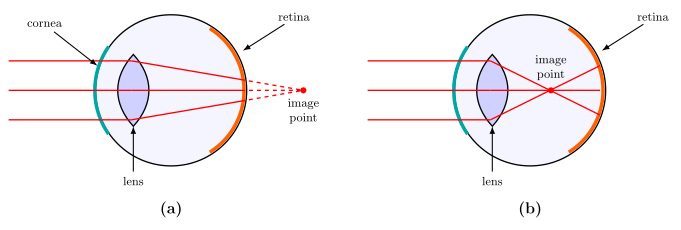
Q.From the above diagram (a),
(b) represents Refractive errors of the eye. Find
(a) and
(b) and suggest the Remedial measurement for
(a) and (b).
Puducherry TnboardTamil Nadu HSC First Year (DGE) Board 2020Subjective· 2mImportance★★★★★
61% · 34/56 Questions
You're viewing a preview — the full solution, concept, methods & PYQ mapping are locked.
Start your 14-day free trial to unlock the full solution →(a), where rays converge behind the retina, is Hypermetropia — corrected with a convex lens; (b), where rays converge in front of the retina, is Myopia — corrected with a concave lens.
The eye normally focuses light exactly on the retina to produce a sharp image. In refractive errors, the focal point falls either behind or in front of the retina:
- Diagram (a): the parallel light rays converge to a point BEHIND the retina. This is Hypermetropia (Hyperopia, far-sightedness) — it occurs because the eyeball is too short (front-to-back) or the lens's focusing power is too weak, so near objects cannot be brought into focus on the retina. Remedy: a CONVEX (converging) lens is used in spectacles, which adds extra converging power so the image is pulled forward onto the retina. …
Unlock everything free for 14 days
- Full step-by-step solutions
- Concept-first explanations
- Methods, shortcuts & mistakes
- PYQ mapping + timed mock tests
Full access for 14 days. No credit card required.