Physical Education · Ch 6 — Test and Measurement in Sports
Flamingo Balance Test
Flamingo Balance Test
Purpose
The Flamingo Balance Test checks the ability to balance on a single leg. This single-leg balance test assesses the strength of the leg, pelvic and trunk muscles, as well as static balance.
Infrastructure / Equipment Required
- A non-slippery, even surface.
- A stopwatch.
- The test can also be done while standing on a beam.
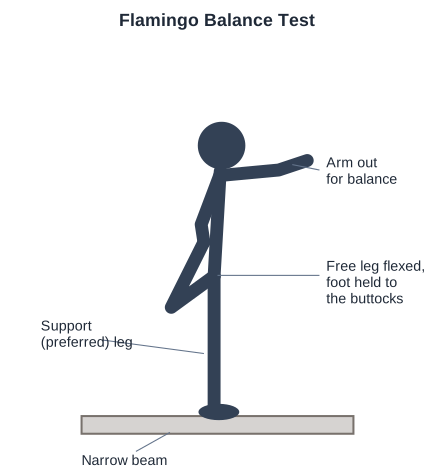
Drawn by us to help you understand the concept clearly, and verified to make sure it's accurate. For exams, practice from your textbook's own diagram.
Side view of the flamingo balance position: the subject balances on the preferred leg while standing on a narrow beam. The free leg is bent at the knee and its foot is held up behind, close to the buttocks, by the same-side …
Procedure
The subject stands on the beam and, if needed, steadies themselves at the start by holding the instructor's hand. Balancing on the preferred leg, the free leg is bent at the knee and the foot of that leg is held close to the buttocks. The watch is started the moment the instructor lets go. Each time the subject loses balance — by coming off the beam or letting go of the held foot — the stopwatch is paused, and timing resumes once balance is regained. The number of falls (losses of balance) in 60 seconds of balancing is counted. If there are more than 15 falls in the first 30 seconds, the test is stopped.
Scoring
The total number of falls, or losses of balance, in 60 seconds of balancing is recorded. If more than 15 falls occur in the first 30 seconds, the test is terminated.
Why It Matters (Physiological Rationale)
Standing on one leg challenges three systems at once: the vestibular (inner-ear) system that senses head position, the proprioceptive sense that tracks joint and muscle position without looking, and the strength of the ankle, knee, hip, pelvic and trunk muscles that make continuous small corrections to stay upright. Because the free leg is held bent behind the body, the subject cannot use it for a wide counterbalancing stance, so the test isolates static single-leg balance fairly strictly.
Benefits of Regular Testing
- Gives an early, simple indicator of a young child's postural control and core stability, both of which underpin almost every other motor skill.
- Because it is quick and needs no special equipment beyond a beam or even floor, it suits testing a whole class of young children in one session.
- Repeating the test across a school year can show whether balance is developing normally as a child grows.
Common Mistakes & Precautions
- Restarting the stopwatch incorrectly after a fall; it should be paused the instant balance is lost and resumed the instant the subject re-establishes the position, not reset to zero.
- Allowing the subject to use the non-preferred leg, or to hold the free foot too low (away from the buttocks), which changes the test's difficulty.
- Testing on a hard, slippery, or uneven floor without supervision close by; a cushioned mat or a spotter standing near the beam reduces injury risk from a fall. …