Question 117 of 148
Q.(a) A missile fired from ground level rises metres vertically upwards in seconds and . Find:
(i) the initial velocity of the missile
(ii) the time when the height of the missile is a maximum
(iii) the maximum height reached
(iv) the velocity with which the missile strikes the ground
OR
(b) Find the centre, foci and vertices of the hyperbola and draw the diagram.
Puducherry TnboardTamil Nadu HSC (DGE) Board 2019Subjective· 5mImportance★★★★★
79% · 117/148 Questions
You're viewing a preview — the full solution, concept, methods & PYQ mapping are locked.
Start your 14-day free trial to unlock the full solution →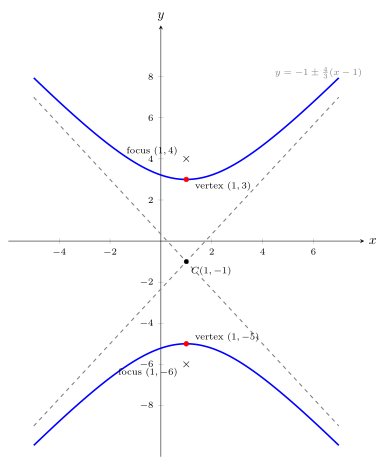
(a) differentiates the given height function to get velocity, then reads off the initial velocity, time/height of the peak, and the striking velocity; (b) completes the square twice to bring the given hyperbola to standard form and reads off its centre, foci and vertices.
(a) Missile kinematics,
- Velocity: .
- (i) Initial velocity: m/s.
- (ii) Time of maximum height: at the peak s (and confirms a maximum).
- (iii) Maximum height: m.
- (iv) Striking velocity: the missile returns to ground level () when or s (landing time). Then m/s, so it strikes the ground with speed m/s (directed downward).
(b) Hyperbola
- Group and complete the square: .
- .
- .
- Divide by : , i.e. — a hyperbola with vertical transverse axis.
- Standard form : centre , (), (), and .
- Vertices (): and . …
Unlock everything free for 14 days
- Full step-by-step solutions
- Concept-first explanations
- Methods, shortcuts & mistakes
- PYQ mapping + timed mock tests
Full access for 14 days. No credit card required.