Mathematics · Ch 2 — Complex Numbers
The nth Roots of Unity
The nth Roots of Unity
Definition. For a positive integer , the solutions of are the th roots of unity. In polar form, is written
Applying the root formula from §2.8.2 (with ), the th roots of unity are
Definition. A complex number is called an th root of unity if and only if . Denote (the value at ); then , so is itself an th root of unity, and (by the root formula) the full list of th roots of unity is exactly
These complex numbers are the points/vertices of a regular polygon of sides inscribed in the unit circle (since, as in §2.8.2, all th roots of unity have modulus and are equally spaced by ).
The th roots of unity form a geometric progression with common ratio .
- Sum: (since and , being ).
- Product:
Note — summary facts about the th roots of unity:
- All roots lie in Geometric Progression.
- The sum of the roots is always .
- The product of the roots is .
- All roots lie on a circle of radius centred at the origin, dividing it into equal parts and forming a regular -gon.
Cube roots of unity (). Solving by the same method: for , giving
with and (matching the general sum result at ) — the two identities used constantly to reduce any expression in (e.g. , and ).
Fourth roots of unity (). Similarly, solving gives . …
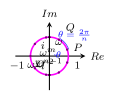
Drawn by us to help you understand the concept clearly, and verified to make sure it's accurate. For exams, practice from your textbook's own diagram.
What this figure shows. The n nth-roots of unity 1, omega, omega^2, ..., omega^(n-1) as equally spaced points (vertices of a regular polygon) on the unit circle, with adjacent roots P and Q …
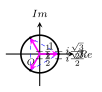
Drawn by us to help you understand the concept clearly, and verified to make sure it's accurate. For exams, practice from your textbook's own diagram.
What this figure shows. Cube roots of unity 1, -1/2+isqrt3/2 and -1/2-isqrt3/2 as vertices of an equilateral triangle inscribed in the un …

Drawn by us to help you understand the concept clearly, and verified to make sure it's accurate. For exams, practice from your textbook's own diagram.
What this figure shows. Fourth roots of unity 1, i, -1 and -i as vertices of a square inscribed in the unit ci …
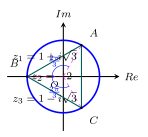
Drawn by us to help you understand the concept clearly, and verified to make sure it's accurate. For exams, practice from your textbook's own diagram.
What this figure shows. Equilateral triangle with vertices z1=1+isqrt3 (A), z2=-2 (B) and z3=1-isqrt3 (C) inscribed in the circle |z|=2, each pair of radii subtending 2pi/ …