Mathematics · Ch 8 — Differentials and Partial Derivatives
Function of Function Rule
Function of Function Rule
When the two variables of are themselves each functions of a single variable (with the same domain), the composite ultimately depends only on — so it should be treatable as an ordinary one-variable function, and its derivative should be computable. This is not a coincidence:
Theorem 8.2 (Function of Function Rule). Suppose has partial derivatives . If are both differentiable functions of a single variable , then is a differentiable function of , and
The tree diagram is the standard visual aid: branches down to and (labelled by and ), and each of branches further down to (labelled and ); multiplying along each full branch and summing over the branches reproduces (16) exactly.
Verifying the theorem directly. For with : substituting first gives , a function of alone, whose derivative (by direct differentiation, using ) works out to . Computing instead via (16): , , so
which simplifies to the same — confirming (16). Both routes always agree, so computing both is a genuine self-check; whichever route is algebraically shorter for a given problem is the one to use in practice.
Two-parameter version. Sometimes and both depend on two parameters , making ultimately a function of as well:
Theorem 8.3 (Chain Rule, two parameters). If has partial derivatives, and both have partial derivatives with respect to and , then
…
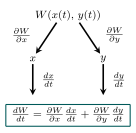
Drawn by us to help you understand the concept clearly, and verified to make sure it's accurate. For exams, practice from your textbook's own diagram.
What this figure shows. Fig 8.14 Tree diagram for the chain rule dW/dt when W=W(x,y) with x=x(t), y=y(t): W branches to x and y via the partial derivatives, then to t via …
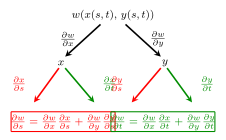
Drawn by us to help you understand the concept clearly, and verified to make sure it's accurate. For exams, practice from your textbook's own diagram.
What this figure shows. Fig 8.15 Tree diagram for the chain rule when w=w(x,y) with x=x(s,t), y=y(s,t): gives partial w / partial s and partial w / partial t as sums over t …