Question 108 of 127
Q.What are the important inferences from the average binding energy curve ?
Puducherry TnboardTamil Nadu HSC (DGE) Board 2020Subjective· 3mImportance★★★★★
85% · 108/127 Questions
You're viewing a preview — the full solution, concept, methods & PYQ mapping are locked.
Start your 14-day free trial to unlock the full solution →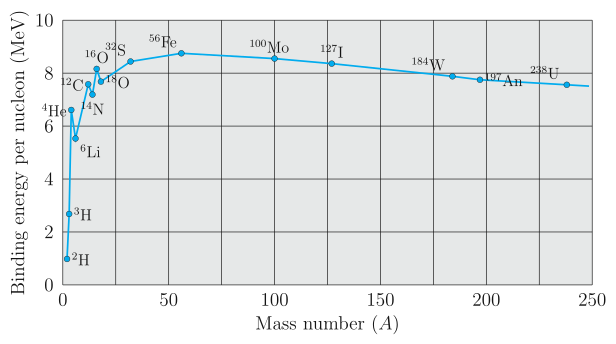
The average binding-energy-per-nucleon curve peaks around iron (), explaining why nuclear fusion of light elements and fission of heavy elements both release energy, and why medium-mass nuclei are the most stable.
- Sharp initial rise, then a broad, nearly flat maximum: for very light nuclei (), the binding energy per nucleon rises rapidly and irregularly with ; it then rises more gradually and reaches a broad maximum of about MeV/nucleon for nuclei with mass number roughly between and , peaking near (iron group).
- Gradual decrease for heavy nuclei: beyond about , decreases slowly, falling to about MeV/nucleon for the heaviest natural nuclei (like uranium) — this decrease is due to the increasing Coulomb repulsion among the growing number of protons, which is not compensated by the short-ranged attractive nuclear force.
- Nuclei of intermediate mass number are the most stable, since they have the highest binding energy per nucleon.
- Nearly constant plateau ⇒ saturation of nuclear force: the fact that is roughly constant over a wide range of shows that each nucleon interacts (via the strong nuclear force) with only a limited number of its immediate neighbours, not with every other nucleon in the nucleus — i.e. the nuclear force is short-ranged and saturates. …
Unlock everything free for 14 days
- Full step-by-step solutions
- Concept-first explanations
- Methods, shortcuts & mistakes
- PYQ mapping + timed mock tests
Full access for 14 days. No credit card required.