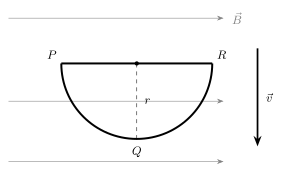
Q.A thin semi-circular conducting ring (PQR) of radius r is falling with its plane vertical in a horizontal magnetic field B, as shown in the figure. The potential difference developed across the ring when its speed is v, is (NEET 2014)
When a conductor moves through a magnetic field, the free charges inside it experience a magnetic force. This force pushes the charges along the conductor, setting up a potential difference across its ends — a motional emf. It is electromagnetic induction viewed from a moving conductor rather than from a changing field.
Origin: the Lorentz force
Consider a straight rod of length l moving with velocity v perpendicular to a uniform field B. Each free charge q feels a force
F=q(v×B)
of magnitude qvB directed along the rod. Charges pile up at the ends until the electric field they create balances the magnetic force. The resulting potential difference — the motional emf — is
ε=Bvl
Consistency with Faraday's law
Let the rod of length l slide along parallel conducting rails, sweeping out a distance x. The enclosed area is A=lx, so the flux is Φ=Blx. Then
ε=−dtdΦ=−Bldtdx=−Blv
The magnitude Bvl matches the Lorentz-force result, showing that the flux rule and the force picture agree.
Worked example
A rod of length 0.4m moves at 5m/s perpendicular to a field of 0.5T:
ε=Bvl=0.5×5×0.4=1V
If the circuit resistance is 2Ω, the induced current is I=ε/R=0.5A.
Force and energy
Once current I flows, the field exerts a retarding force F=BIl on the rod, opposing its motion (Lenz's law). To keep the rod moving at constant speed, an external agent must supply power
P=Fv=BIlv=εI
exactly equal to the electrical power dissipated in the circuit — energy is conserved.
Note
Motional emf arises only from the component of velocity perpendicular to B. Motion parallel to the field produces no emf.
Motional emf, derived from the Lorentz force on charges in a moving conductor, is a key numerical topic within the NCERT Class 12 Physics chapter on electromagnetic induction, tested in CBSE boards and JEE Main. Searches for "motional emf formula and derivation class 12 physics" will find this rod-on-rails explanation, consistent with Faraday's flux rule, matches the NCERT-prescribed derivation.
Why this formula?
Motional EMF: Why the Formula Holds
Let's build this from first principles — understanding the why before the formula.
The Core Idea
Motional EMF arises when a conductor moves through a magnetic field. The key insight: moving charges in a magnetic field experience a magnetic force, which acts like a battery pushing charges around the conductor.
Step 1: The Force on a Moving Charge
A charge q moving with velocity v in a magnetic field B feels the Lorentz magnetic force:
Fm=q(v×B)
This force is perpendicular to both velocity and magnetic field.
Step 2: What Happens Inside a Moving Conductor
Consider a straight metal rod of length L moving with constant velocity v perpendicular to a uniform magnetic field B (pointing into the page).
Free electrons in the rod are moving with the rod at velocity v.
Each electron experiences a magnetic force:
Fm=−e(v×B)
(negative sign because electron charge is −e)
This force pushes electrons along the rod — say, toward one end.
Step 3: Charge Separation Creates an Electric Field
As electrons accumulate at one end, that end becomes negatively charged, leaving the other end positively charged.
This charge separation creates an internal electric fieldE inside the rod, pointing from positive to negative end.
The electric field exerts an opposing force on the electrons:
Fe=−eE
Step 4: Equilibrium — The "Battery" is Formed
Charge keeps moving until the electric force balances the magnetic force:
Fe+Fm=0
−eE−e(v×B)=0
E=−(v×B)
Magnitude-wise (for perpendicular v and B):
E=vB
Step 5: From Electric Field to EMF
The motional EMFE is the work done per unit charge to move a test charge from one end to the other:
E=∫negativepositiveE⋅dl
For a uniform field along the rod of length L:
E=E⋅L=vBL
The Key Formula
Motional EMF for a straight conductor moving perpendicular to B:
E=BLv
Why This Makes Physical Sense
Quantity
Role
B
Stronger magnetic field → larger force on charges
L
Longer conductor → more charge separation possible
v
Faster motion → larger magnetic force → larger EMF
Alternative Derivation: Faraday's Law
The same result comes from Faraday's law of induction:
E=−dtdΦB
For a rod of length L moving with speed v through a field B, the area swept per second is Lv, so:
dtdΦB=B⋅dtdA=BLv
Thus:
E=BLv
Both approaches give the same answer — confirming consistency.
Important Exam Points
Direction: Use Fleming's right-hand rule (generator rule) to find polarity.
General formula (when v and B are not perpendicular):
E=BLvsinθ
where θ is the angle between v and B.
EMF is induced only while the conductor moves — stop the motion, stop the EMF.
Bottom line: Motional EMF is simply the magnetic force acting on moving charges inside a conductor, creating a charge separation that acts like a battery. The formula E=BLv is a direct consequence of balancing magnetic and electric forces.
Motional emf between two points of a moving conductor depends only on the straight-line (chord) distance PR = 2r between them, not the arc length, giving ε=B(2r)v=2Brv.
✓Final answer
(d) 2Brv and R is at higher potential
Step 1. For a conductor moving with velocity v in a field B, the motional emf between any two of its points depends only on the STRAIGHT-LINE distance between those points along the direction perpendicular to both v and B -- not on the actual (possibly curved) path length of the conductor between them.
Step 2. For the semicircular ring PQR of radius r, falling with speed v, the two ends P and R are separated by the straight-line (diameter) distance PR=2r, regardless of the semicircular arc's own length.
Step 3. The potential difference across the effective 'straight rod of length 2r' is therefore ε=B(2r)v=2Brv.
Step 4. The direction (which end is at higher potential) follows from the same v×B reasoning used for a straight rod, giving R at the higher potential for this geometry.
Step 5. Eliminating the others: (a) zero would be true only if there were no relative motion or no field component perpendicular to v; (b) and (c) both incorrectly involve πr (as if the arc LENGTH, not the chord, mattered).
✓Final answer
(d) 2Brv, with R at the higher potential -- because the effective emf depends on the straight-line distance 2r between P and R, not the semicircular arc length.
Recognise that motional emf between two points of any curved conductor depends only on the chord (straight-line) distance between them, then apply epsilon = B l v with l = 2r.
Using the arc length (pi*r) instead of the chord length (2r) as the effective 'l' in the motional emf formula.
Forgetting that only the component of velocity and field perpendicular to the conductor's effective length contributes to the emf.