Q.Two identical point charges of magnitude are fixed as shown in the figure below. A third charge is placed midway between the two charges, at the point P. Suppose this charge is displaced a small distance from the point P, in the directions indicated by the arrows , (along the line joining the two charges) and , (perpendicular to that line). In which direction(s) will be stable with respect to the displacement?
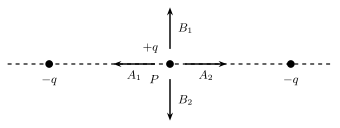
Step 1. At the midpoint P, the fields of the two equal charges cancel exactly, so sits in equilibrium there.
Step 2. Displace slightly along the line joining the two charges (directions , ). Moving toward one brings closer to that charge and farther from the other; since is attracted toward each , the nearer charge now pulls harder than before and the farther one pulls less, so the net force pulls back toward P. This is a restoring force, so the equilibrium is stable along , .
Step 3. Displace slightly perpendicular to the line (directions , ). By symmetry the two attractive forces from the charges now both acquire a component pushing further away from the line, since each pulls toward itself and the geometry tips both pulls in the same sideways sense away from P. This is a force that grows the displacement rather than opposing it, so the equilibrium is unstable along , .
Step 4. A configuration can be stable along one axis and unstable along the perpendicular axis simultaneously (a saddle point), which is exactly the case here.
(a) and
Unlock everything free for 14 days
- Full step-by-step solutions
- Concept-first explanations
- Methods, shortcuts & mistakes
- PYQ mapping + timed mock tests
Full access for 14 days. No credit card required.