Dielectric Insertion Capacitance – From Intuition to Precision
Imagine you have two metal plates facing each other, separated by air. You connect them to a battery. The plates get charged — one positive, one negative — and they store energy in the electric field between them. That's a capacitor.
Now, without disconnecting the battery, you slide a slab of some insulating material (like glass, plastic, or mica) between the plates. What happens? The battery pushes more charge onto the plates. The capacitor now stores more charge for the same voltage. Its capacitance has increased.
That increase — the extra capacitance contributed by the presence of the dielectric — is what we call dielectric insertion capacitance.
The word "insertion" here simply means "the capacitance that appears because you inserted a dielectric." It's not a separate device; it's the change in capacitance due to the material.
Why does the capacitance increase?
The key is polarisation. Inside a dielectric, molecules are like tiny electric dipoles — they have a positive end and a negative end. In an electric field, these dipoles rotate to align with the field. The positive ends point toward the negative plate, and the negative ends point toward the positive plate.
This alignment creates a layer of bound charge on the surfaces of the dielectric, right next to the plates. This bound charge partially cancels the electric field inside the dielectric. But here's the crucial point: if the capacitor is connected to a battery (constant voltage), the battery responds by pushing more free charge onto the plates to restore the original field. More charge for the same voltage means higher capacitance.
If the capacitor is disconnected from the battery (constant charge), the dielectric reduces the voltage across the plates. Same charge, lower voltage — again, higher capacitance.
A common mistake: thinking the dielectric "creates" extra charge out of nothing. It doesn't. The battery supplies the extra charge in the constant-voltage case. In the constant-charge case, the voltage drops — the capacitance formula C=Q/V still gives a larger C because V is smaller.
The precise statement
Let’s define:
- C0 = capacitance of the capacitor with vacuum (or air) between the plates.
- κ (or εr) = dielectric constant (relative permittivity) of the material. For vacuum, κ=1. For most solids, κ>1 (e.g., glass ~5–10, water ~80).
When you fill the entire space between the plates with a dielectric of constant κ, the new capacitance is:
C=κC0
The dielectric insertion capacitance is the additional capacitance contributed by the dielectric:
Cinsertion=C−C0=(κ−1)C0
Cinsertion=(κ−1)C0
This is the extra capacitance you get purely because you inserted the dielectric. If κ=1 (vacuum), Cinsertion=0 — no insertion effect.
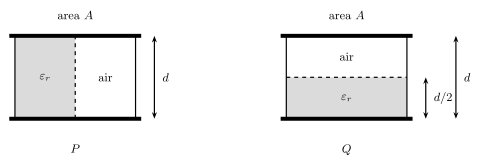
What if the dielectric only partially fills the gap?
In real problems, the slab might not fill the entire space. Then the capacitor behaves like two capacitors in series (or parallel, depending on geometry). The insertion capacitance is no longer a simple multiple — you have to compute the effective capacitance using the appropriate combination rules.
But the core idea remains: the dielectric increases capacitance because its polarisation reduces the net field (or, equivalently, allows more charge at the same voltage).
For a parallel-plate capacitor with plate area A, separation d, and a dielectric of thickness t inserted (leaving an air gap of d−t), the effective capacitance is:
C=d−t+κtε0A …