Q.A metal bar 70 cm long and 4.00 kg in mass supported on two knife-edges placed 10 cm from each end. A 6.00 kg load is suspended at 30 cm from one end. Find the reactions at the knife-edges. (Assume the bar to be of uniform cross section and homogeneous.)
You're viewing a preview — the full solution, concept, methods & PYQ mapping are locked.
Start your 14-day free trial to unlock the full solution →This problem involves a metal bar in static equilibrium, meaning the net force and net torque acting on it are both zero. By applying these two conditions, we can set up a system of equations to find the unknown reaction forces at the knife-edges. The reactions at the knife-edges are and .
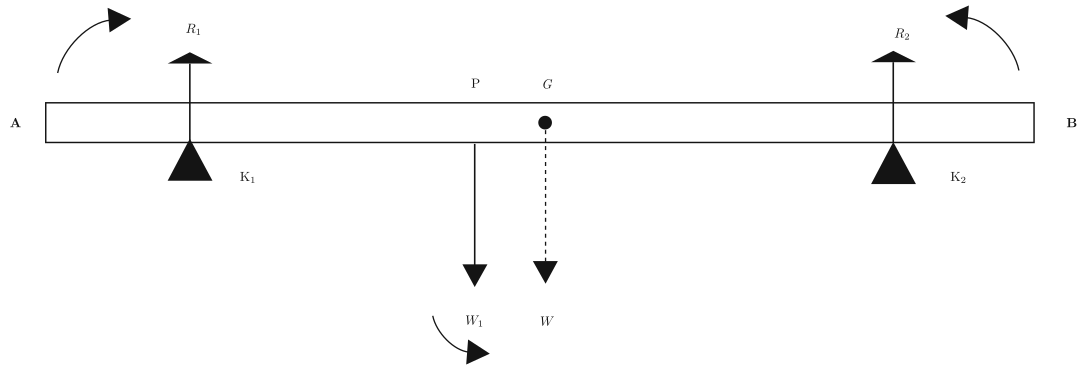
Figure 6.26 is a free-body diagram of a rigid rod in static equilibrium. The rod AB rests horizontally on two knife-edges, labelled K₁ and K₂. These supports are narrow, so they exert only vertical forces on the rod — there is no horizontal friction or binding. The upward reaction forces at K₁ and K₂ are labelled R₁ and R₂ respectively.
The rod’s own weight, W, acts vertically downward at its centre of gravity G. In addition, a load of weight W₁ is suspended from the rod at some point between the supports. The figure shows all these forces as arrows: R₁ and R₂ pointing up, W and W₁ pointing down. The distances between the points of application — from K₁ to G, from G to K₂, and from K₁ to the point where W₁ hangs — are marked along the rod.
The physical idea is that for a rigid body to be in complete equilibrium, two conditions must hold simultaneously. First, the net force on the body must be zero — the sum of all upward forces must equal the sum of all downward forces. Second, the net torque about any point must be zero — the clockwise and anticlockwise moments must balance. This figure is the textbook’s vehicle for teaching exactly that.
For a rigid body in static equilibrium:
The first condition ensures no translational acceleration; the second ensures no rotational acceleration.
From the figure, the force-balance equation is straightforward:
The torque-balance equation is written by choosing a convenient axis — usually one of the knife-edges, because the reaction at that point then produces zero torque about itself. If we take torques about K₁, the clockwise moments come from W and W₁ (each acting at their respective distances from K₁), and the anticlockwise moment comes from R₂ (acting at the full distance from K₁ to K₂). Setting the sum equal to zero gives:
where is the distance between K₁ and K₂, is the distance from K₁ to G, and is the distance from K₁ to the point where W₁ is suspended. A similar equation can be written about K₂.
Choosing the axis at a support eliminates one unknown reaction from the torque equation immediately. Solve for the other reaction from torque balance, then use the force-balance equation to find the remaining reaction.
The figure thus makes concrete the abstract idea that equilibrium is a double condition — forces and torques — and that the choice of axis for torque is arbitrary but strategically chosen to simplify algebra. The rod, the knife-edges, and the suspended load are not just a picture; they are a worked example of how to apply and to a real rigid body.
When an object is at rest and remains at rest, it is said to be in static equilibrium. For an object to be in static equilibrium, two fundamental conditions must be met:
- Translational Equilibrium: The net force acting on the object must be zero. This means the sum of all forces in any direction (e.g., vertical, horizontal) must be zero. If the net force were non-zero, the object would accelerate.
- Rotational Equilibrium: The net torque acting on the object about any point must be zero. Torque is the rotational equivalent of force; if the net torque were non-zero, the object would undergo angular acceleration (start rotating).
In this problem, the metal bar is supported and remains stationary, so we can apply these two conditions to find the unknown reaction forces.
Let's break down the solution step-by-step. We will use for the acceleration due to gravity.
-
Visualize and Draw a Free-Body Diagram (FBD)
First, it's essential to visualize the setup and draw a clear diagram showing all forces acting on the bar and their respective positions. Let's define the left end of the bar as the origin ().
- Bar length: .
- Bar mass: .
- Weight of the bar (): Since the bar is uniform and homogeneous, its center of mass is at its geometric center. . This force acts downwards at .
- Load mass: .
- Weight of the load (): . This force acts downwards at from one end (let's assume the left end).
- Knife-edges: They are placed 10 cm from each end.
- Knife-edge 1 (left): Position . It exerts an upward reaction force .
- Knife-edge 2 (right): Position . It exerts an upward reaction force .
Here's a summary of forces and their positions from the left end:
- (upwards) at
- (downwards) at
- (downwards) at
- (upwards) at
-
Apply the Condition for Translational Equilibrium
For the bar to be in vertical equilibrium, the sum of all upward forces must equal the sum of all downward forces.
Let's consider upward forces as positive and downward forces as negative.
This equation has two unknowns, $R_1$ and $R_2$, so we need another equation. …
Unlock everything free for 14 days
- Full step-by-step solutions
- Concept-first explanations
- Methods, shortcuts & mistakes
- PYQ mapping + timed mock tests
Full access for 14 days. No credit card required.