Q.Can a system be heated and its temperature remains constant?
🔒You're viewing a preview — the full solution, concept, methods & PYQ mapping are locked.
🔒 Start your 10-day free trial to unlock the full solution →Concept understanding — First Law of Thermodynamics
First Law of Thermodynamics
The Intuition: Energy is a Bank Account
Imagine you have a bank account. You can deposit money into it, withdraw money from it, or leave it untouched. The total amount of money in your account changes only when money goes in or comes out. You cannot create money from nothing, and money does not vanish into thin air.
Energy works exactly the same way. In any physical or chemical process, energy is never created and never destroyed. It only moves from one place to another, or changes from one form into another. This is the deepest idea behind the First Law.
Now, in thermodynamics, we focus on a specific "bank account": the internal energy of a system. Internal energy (U) is the total energy stored inside a substance — the kinetic energy of its molecules jiggling around, plus the potential energy stored in the bonds between them.
If you want to change how much energy is stored inside a system, you have exactly two ways to do it:
- Heat (Q) — energy that flows because of a temperature difference. Like putting a cold pan on a hot stove.
- Work (W) — energy transferred by a force moving something. Like pushing a piston to compress a gas.
That's it. No third option. Every change in internal energy comes from either heat or work.
The Precise Statement
ΔU=Q−W
Where:
- ΔU = change in internal energy of the system
- Q = heat added to the system (positive if heat flows in)
- W = work done by the system (positive if the system does work on surroundings)
This sign convention is the standard one used in Indian exams (JEE, NEET, etc.). Heat added to the system is positive. Work done by the system is positive.
Some textbooks use Q=ΔU+W or ΔU=Q+W with a different sign for work. Always check which convention your exam follows. The one above (ΔU=Q−W) is the most common in Indian syllabi.
What This Equation Really Says
Think of it as a balance sheet:
- If you add heat (Q>0), internal energy tends to increase.
- If the system does work (W>0), internal energy tends to decrease (because energy leaves the system to do the work).
- The net change is simply: what came in minus what went out.
If ΔU=0, the system has returned to its original internal energy — but that does not mean nothing happened. Heat could have come in, and exactly the same amount of energy could have left as work. The energy just passed through.
| Process | Q | W | ΔU |
|---------|-----|-----|------------|
| Gas expands, no heat exchange | 0 | + (does work) | Negative |
| Gas compressed, no heat exchange | 0 | – (work done on it) | Positive |
| Gas heated at constant volume | + | 0 | Positive |
| Gas cooled at constant volume | – | 0 | Negative |
A Concrete Example
Take a gas trapped in a cylinder with a movable piston. You place the cylinder on a hot plate.
- Heat Q=+100 J flows into the gas.
- The gas expands, pushing the piston upward, doing work W=+40 J on the surroundings.
What happens to the internal energy?
ΔU=100−40=+60 J …
Yes — this is possible when the heat supplied is used entirely to do work, not to raise the internal energy. The key idea is the First Law of Thermodynamics: ΔU=Q−W.
- For an isothermal process (constant temperature), the internal energy of an ideal gas depends only on temperature, so ΔU=0.
- From the First Law: 0=Q−W⟹Q=W. …
Yes — during an isothermal process, heat added to a system does work on the surroundings instead of raising the internal energy, so temperature stays constant. The First Law of Thermodynamics explains why.
The question touches a common confusion: we instinctively think "heat in = temperature up." But thermodynamics is more subtle. The First Law says:
ΔU=Q−W
where ΔU is the change in internal energy, Q is heat added to the system, and W is work done by the system. Temperature is directly linked to internal energy — for an ideal gas, U∝T. So if T is constant, ΔU=0, and the First Law becomes:
0=Q−W⇒Q=W
Every joule of heat added is exactly balanced by work done by the system. No energy is left over to raise the temperature.
-
The key condition: isothermal process.
"Isothermal" means constant temperature. For this to happen, the system must be in thermal contact with a large reservoir (like a water bath) that absorbs or supplies heat to keep T fixed. The process must also be slow enough that the system stays in equilibrium.
-
What happens to the heat?
When you add heat Q to an ideal gas in an isothermal expansion, the gas expands against an external pressure. That expansion does work W=∫PdV. Since ΔU=0, all the heat is converted into work. The gas does not get hotter — it just pushes the piston outward.
-
A concrete example: isothermal expansion of an ideal gas.
For n moles of an ideal gas at temperature T, the work done in a reversible isothermal expansion from volume Vi to Vf is:
W=nRTln(ViVf)
The heat absorbed is exactly the same:
Q=nRTln(ViVf)
Temperature T appears in the formula, but it does not change during the process.
A common mistake is to think "heat always raises temperature." That is false — heat can be entirely converted into work if the internal energy stays constant. The First Law is the boss: ΔU=Q−W, not ΔU=Q.
- What about real gases or phase changes? …
A sharper illustration than gas expansion: think of ice melting at 0∘C. Heat flows in continuously, yet the thermometer doesn't move until every crystal has melted, because the energy goes into breaking intermolecular bonds (latent heat) rather than speeding up molecular motion. This is the cleanest everyday proof that 'heat added' and 'temperature rises' are not the same statement — temperature tracks internal kinetic energy specifically, and Q=ΔU+W ( …
Showing the 12 most recent of 37 on this concept.
- JEE Main 2026Set 2026-04-08-s24 marksMCQQ.Initial pressure and volume of a monoatomic ideal gas are P and V. The change in internal energy of this gas in adiabatic expansion to volume V_final = 27 V is __________ J. (A) -2PV(3√3 - 1) (B) 4/3 PV (C) -4/3 PV (D) 3/4 PV
›Reveal solutionSolution
Use the adiabatic relation PVγ=const to find the final pressure, then apply ΔU=nCvΔT=23(PfVf−PV) for a monoatomic ideal gas.
- Monoatomic gas: γ=5/3, Cv=23R.
- Adiabatic process: PVγ=PfVfγ ⇒ Pf=P(27VV)5/3=P⋅27−5/3.
- 271/3=3⇒275/3=35=243, so Pf=243P.
- PfVf=243P×27V=24327PV=9PV. …
- JEE Main 2026Set 2026-01-24-s24 marksMCQQ.10 mole of an ideal gas is undergoing the process shown in the figure. The heat involved in the process from P1 to P2 is α Joule (P1 = 21.7 Pa and P2 = 30 Pa, Cv = 21 J/K.mol, R = 8.3 J/mol.K). The value of α is _____.
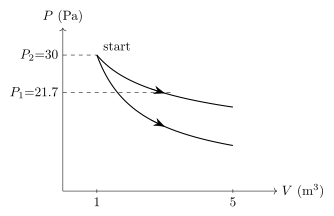 (A) 28
(B) 24
(C) 21
(D) 15
›Reveal solutionSolution
P-V diagram showing two processes from P1 to P2 A and B lie on the same vertical line of the P–V diagram (both at V=1m3), so the process is isochoric: no work is done, and all the heat goes into raising internal energy.
The figure's two curved lines (sweeping out to V=5m3) describe a larger cyclic process the gas undergoes elsewhere on the diagram, but the specific leg asked about — "from A to B" — is the short vertical segment at V=1m3 connecting P1=21.7Pa (point A) to P2=30Pa (point B). Recognising this constant-volume segment is the key step.
1. Work done.
Since volume is constant along A→B, W=∫PdV=0.
2. First law reduces to Q=ΔU.
Q=ΔU=nCvΔT.
3. Find ΔT from the ideal gas law at fixed V. …
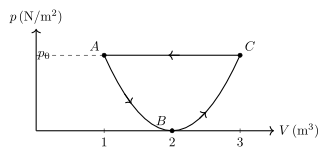
- JEE Main 2026Set 2026-01-28-s14 marksMCQQ.In the following p-V diagram the equation of state along the curved path is given by (V − 2)² = 4ap where a is a constant. The total work done in the closed path is ______.
 (A) 1/2a
(B) −1/3a
(C) +1/3a
(D) −1/a
›Reveal solutionSolution
The cycle runs A(1, 1/4a) → B(2, 0) → C(3, 1/4a) along the parabola, then straight back C → A at constant pressure. Net work = (area under the curve) − (area under the line) = −1/(3a); the loop is traced anticlockwise in the p–V plane, so the net work done BY the gas is negative.
p-V diagram showing a closed cycle A-B-C with a parabolic path NoteThe stored official key for this item is recorded as option (C), +1/(3a). Careful re-derivation below — cross-checked against an independently published worked solution for this exact JEE Main 2026, 28 January Shift 1 question — gives −1/(3a), which is option (B) in the list as given here, not (C). The magnitude, 1/(3a), is identical either way, so the derivation itself is not in doubt; only the sign (and hence which lettered option it lands on) differs from the stored key, most likely an option-lettering or transcription mismatch between this record and the original paper. The answer below is presented as the best-effort, independently cross-verified value.
- From (V−2)2=4ap, p=4a(V−2)2. Evaluate at the three marked points: at V=1, p=4a1; at V=2, p=0; at V=3, p=4a1. So A and C sit at the SAME pressure p0=1/(4a) — which is exactly why the return path C→A can be a horizontal (constant-pressure) segment.
- Work along the curve, A→B→C. Volume increases monotonically from 1 to 3 along this path (even though it dips through B), so the work is simply the definite integral of p(V):
Wcurve=∫134a(V−2)2dV
Substituting u=V−2 (limits −1 to 1):
Wcurve=4a1∫−11u2du=4a1[3u3]−11=4a1⋅32=6a1
- Work along the straight return, C→A. Pressure is constant at p0=1/(4a), and V goes from 3 down to 1, so ΔV=−2: …
- JEE Main 2026Set 2026-01-28-s24 marksQ.A thermodynamic system is taken through the cyclic process ABC as shown in the figure. The total work done by the system during the cycle ABC is ________ J.
›Reveal solutionSolution
The work done by the gas over one full cycle equals the area enclosed by the triangular loop on the P-V diagram, which works out to 300 J, with a clockwise traversal making it positive.
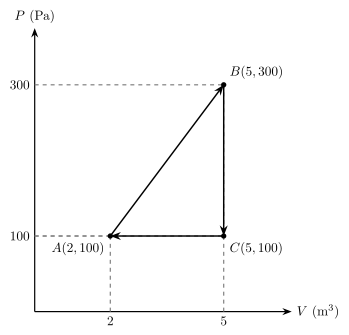
P-V diagram of the triangular cyclic process A(2 m3,100 Pa) to B(5 m3,300 Pa) to C(5 m3,100 Pa) back to A, showing the clockwise direction of traversal The three state points are A(2 m3,100 Pa), B(5 m3,300 Pa), and C(5 m3,100 Pa), connected A→B (diagonal), B→C (vertical, constant V=5 m3), and C→A (horizontal, constant P=100 Pa) to close the cycle.
Step 1 - Recognise the shape. Since A-C is horizontal and B-C is vertical, the triangle has its right angle at C.
Step 2 - Compute the base and height.
Base=VC−VA=5−2=3 m3Height=PB−PC=300−100=200 Pa
Step 3 - Area of the triangle (work done over one full cycle).
W=21×base×height=21×3×200=300 J …
- JEE Main 2025Set 2025-01-24-s14 marksMCQQ.An ideal gas goes from an initial state to final state. During the process, the pressure of gas increases linearly with temperature. A. The work done by gas during the process is zero. B. The heat added to gas is different from change in its internal energy. C. The volume of the gas is increased. D. The internal energy of the gas is increased. E. The process is isochoric (constant volume process) Choose the correct answer from the options given below: (A) A, C Only (B) A, D, E Only (C) E Only (D) A, B, C, D Only
›Reveal solutionSolution
P∝T together with PV=nRT forces V to be constant, making this an isochoric process; only A, D, E are true.
The key insight is to translate the stated condition 'pressure increases linearly with temperature' into what it implies about volume, using the ideal gas law, rather than assuming the process involves some independent volume change. A proportional (through-the-origin) P-T relationship is exactly the signature of a constant-volume process for an ideal gas.
- Ideal gas law: PV=nRT. If P=cT for some constant c, substitute: cTV=nRT⇒V=cnR, independent of T — so V is constant throughout the process.
- Since V is constant, the process is isochoric. Statement E is true.
- Since V doesn't change, work done by the gas W=∫PdV=0. Statement A is true; statement C (volume increases) is false.
- Temperature increases along the process (since P increases and P∝T), so internal energy U∝T also increases. Statement D is true. …
- JEE Main 2025Set 2025-01-24-s24 marksMCQQ.The magnitude of heat exchanged by a system for the given cyclic process ABCA (as shown in figure) is (in SI unit): (A) zero (B) 40π (C) 5π (D) 10π
›Reveal solutionSolution
For a complete cycle, Q=W= area enclosed by the path on the P–V diagram; here the path A→B→C→A is a semicircular arc (through the top point B) closed by a straight diameter back to A, so the enclosed area is half the ellipse's area.
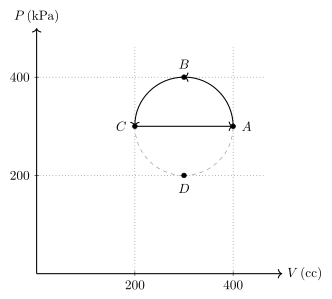
P-V diagram showing circular cyclic process A to B to C along the upper semicircle, returning directly from C to A along the horizontal diameter, with point D on the untravelled lower arc - The circle is centred at P=300 kPa, V=300 cc, with radius 100 kPa in pressure and 100 cc in volume (since it spans 200–400 on each axis). In SI units, with P and V on different numerical scales, the curve is really an ellipse with semi-axes a=1×10⁵ Pa (pressure) and b=1×10⁻⁴ m3 (volume).
- For a closed cyclic process, ΔU=0 over the full cycle, so the net heat exchanged equals the net work done, which equals the geometric area enclosed by the cycle's path on the P–V diagram. …
- JEE Main 2025Set 2025-01-29-s24 marksMCQQ.A poly-atomic molecule (CV = 3R, CP = 4R, where R is gas constant) goes from phase space point A (P_A = 10^5 Pa, V_A = 4×10^-6 m^3) to point B (P_B = 5×10^4 Pa, V_B = 6×10^-6 m^3) to point C (P_C = 10^4 Pa, V_C = 8×10^-6 m^3). A to B is an adiabatic path and B to C is an isothermal path. The net heat absorbed per unit mole by the system is : (A) 500R(ln 3 + ln 4) (B) 450R(ln 4 − ln 3) (C) 500R ln 2 (D) 400R ln 4
›Reveal solutionSolution
Only the isothermal leg (B→C, at 450 K) contributes heat — the adiabatic leg (A→B) by definition absorbs none.
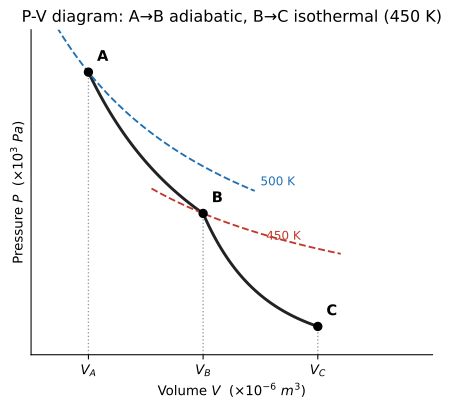
Pressure vs volume diagram showing points A, B, C with adiabatic path A to B and isothermal path B to C along the 450 K isotherm - A→B (adiabatic): by definition QAB=0. …
- JEE Main 2025Set 2025-04-02-s24 marksMCQQ.Identify the characteristics of an adiabatic process in a monoatomic gas. (A) Internal energy is constant. (B) Work done in the process is equal to the change in internal energy. (C) The product of temperature and volume is a constant. (D) The product of pressure and volume is a constant. (E) The work done to change the temperature from T1 to T2 is proportional to (T2 - T1). Choose the correct answer from the options given below : (A) (B), (D) only (B) (B), (E) only (C) (A), (C), (E) only (D) (A), (C), (D) only
›Reveal solutionSolution
Only statements (B) and (E) are correct — option (B).
Intuition: for an adiabatic process there is no heat exchange, so the first law collapses to a direct trade-off between work done and internal energy — everything else (constant U, constant PV, constant TV) belongs to other processes, not adiabatic ones.
- First law: ΔU=Q−W (W = work done by the gas). For adiabatic, Q=0, so ΔU=−W, i.e. W=−ΔU — the work done by the gas equals the decrease in internal energy (equivalently, work done on the gas equals the rise in internal energy). This confirms (B).
- (A) is false: internal energy changes (temperature changes) in an adiabatic process; only Q=0, not ΔU=0.
- (C) is false: the correct adiabatic relation is TVγ−1=const, not TV=const (that would require γ=2, which doesn't hold for a monatomic gas, γ=5/3). …
- JEE Main 2025Set 2025-04-03-s14 marksMCQQ.A piston of mass M is hung from a massless spring whose restoring force law goes as F = -kx^3, where k is the spring constant of appropriate dimension. The piston separates the vertical chamber into two parts, where the bottom part is filled with 'n' moles of an ideal gas. An external work is done on the gas isothermally (at a constant temperature T) with the help of a heating filament (with negligible volume) mounted in lower part of the chamber, so that the piston goes up from a height L0 to L1, the total energy delivered by the filament is:(Assume spring to be in its natural length before heating) (A) nRT ln(L1/L0) + Mg(L1-L0) + (3k/4)(L1^4 - L0^4) (B) nRT ln(L1/L0) + Mg(L1-L0) + (k/4)(L1^4 - L0^4) (C) nRT ln(L1^2/L0^2) + (Mg/2)(L1-L0) + (k/4)(L1^4 - L0^4) (D) 3nRT ln(L1/L0) + 2Mg(L1-L0) + (k/3)(L1^3 - L0^3)
›Reveal solutionSolution
Total heat supplied = isothermal gas work + gravitational PE gain + spring energy = nRT ln(L1/L0) + Mg(L1−L0) + (k/4)(L1⁴−L0⁴).
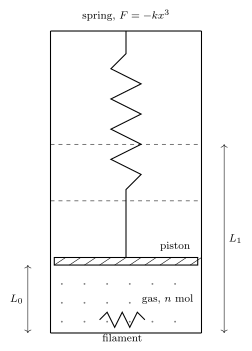
Vertical chamber with a piston hung from a spring (F = -kx^3) above, separating a lower gas-filled region heated by a filament; piston rises from height L0 to L1 - The gas is heated isothermally (constant T), so for an ideal gas ΔU_gas = 0. By energy conservation, all the heat Q supplied by the filament is converted into work done by the expanding gas as it pushes the piston up from L0 to L1.
- Isothermal work done by an ideal gas (volume ∝ length L, for constant cross-section): W_gas = nRT ln(V1/V0) = nRT ln(L1/L0).
- This work raises the piston (mass M) against gravity by height (L1−L0), storing gravitational PE: Mg(L1−L0). …
- JEE Main 2025Set 2025-04-07-s14 marksQ.An ideal gas has undergone through the cyclic process as shown in the figure. Work done by the gas in the entire cycle is ________ ×10⁻¹ J. (Take π = 3.14 )
›Reveal solutionSolution
Work done over a closed cycle equals the area enclosed by the P–V loop; for this circular loop that area is simply π times its two radii (100 kPa and 100 cm³), which converts to 31.4 J =314×10−1 J.
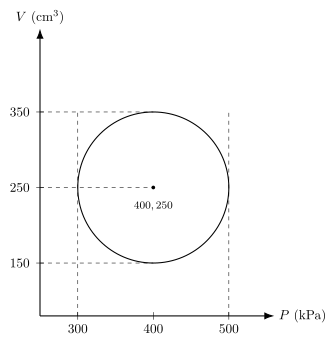
Circular P-V diagram cyclic process centered at 400 kPa, 250 cm cubed For any closed thermodynamic cycle, the net work done equals the geometric area enclosed by the curve on a P–V plot, regardless of which axis is drawn horizontally.
-
From the figure, the circle has a horizontal (pressure) extent of radius 100 kPa (center at 400 kPa, spanning 300 to 500 kPa) and a vertical (volume) extent of radius 100 cm3 (center at 250 cm³, spanning 150 to 350 cm³).
-
Area enclosed (a circle of these equal numerical radii): …
-
- JEE Main 2025Set 2025-01-23-s24 marksMCQQ.Using the given P − V diagram, the work done by an ideal gas along the path ABCD is : (A) 3P₀V₀ (B) −3P₀V₀ (C) −4P₀V₀ (D) 4P₀V₀
›Reveal solutionSolution
Summing PΔV over each leg of the open path A→B→C→D gives a net work of −3P0V0, matching the official answer.
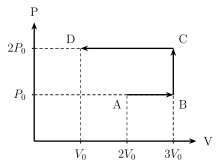
P-V diagram showing an open path A to B to C to D with corners at (2V0,P0), (3V0,P0), (3V0,2P0), (V0,2P0) On a P-V diagram, work done BY the gas along any leg is P×ΔV for that leg; isochoric legs (constant V) do zero work. This path goes right at the lower pressure P0 (small expansion) and then left at the higher pressure 2P0 over a much larger volume span, so the compression leg dominates and the net work done BY the gas is negative (net work is done ON the gas). …
- JEE Main 2024Set 2024-01-30-s14 marksMCQQ.Two thermodynamical processes are shown in the figure. The molar heat capacities for process A and B are CA and CB. The molar heat capacities at constant pressure and constant volume are represented by CP and CV, respectively. Choose the correct statement. [FIGURE] (A) CP>CB>CV (B) CA=0 and CB=∞ (C) CP>CV>CA=CB (D) CA>CP>CV
›Reveal solutionSolution
For a polytropic process PVn= const, the molar heat capacity is C=CV+1−nR; the slope on the logP–logV plot is −n. …
🎓Unlock everything free for 10 days
- ✓Full step-by-step solutions
- ✓Concept-first explanations
- ✓Methods, shortcuts & mistakes
- ✓PYQ mapping + timed mock tests
Full access for 10 days. No credit card required.