Business Studies · Ch 10 — Marketing
Consumer Products
Consumer Products
Consumer products are goods that are bought by the final user — you, your family, anyone — for personal or household use, not for resale or business operations. Soap, edible oil, toothpaste, textiles, fans, and eatables are all examples. The key idea is that the purchase is driven by personal needs and desires, not by commercial or industrial requirements.
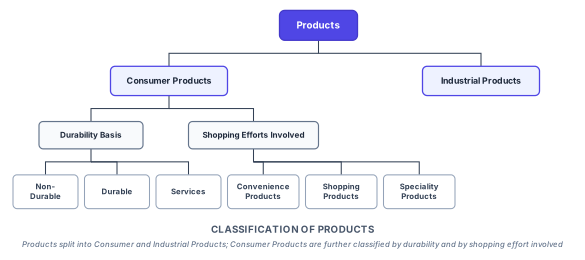
The textbook classifies consumer products into three categories based on the amount of shopping effort the buyer is willing to put in. This classification is important because it directly affects how each type of product is marketed, priced, and distributed.
1. Convenience Products
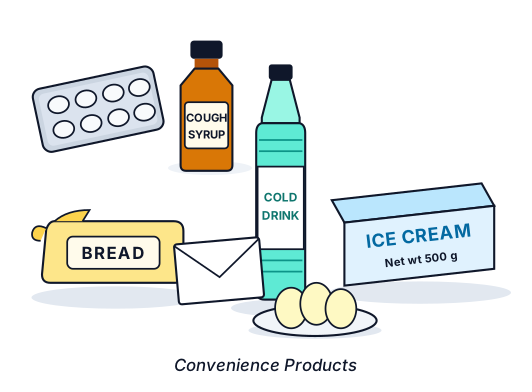
These are items that consumers buy frequently, immediately, and with the least possible time and effort. You don't think much before picking up a newspaper or a pack of ice cream — you just grab it. The unit value is low, and people usually buy them in small quantities.
Examples include cigarettes, ice creams, medicines, newspapers, stationery items, and toothpaste. Because the purchase is routine and low-risk, the buyer does not compare prices or features across multiple stores. The marketer's job is to make these products widely available — they need to be in every corner store, petrol pump, and supermarket.
2. Shopping Products
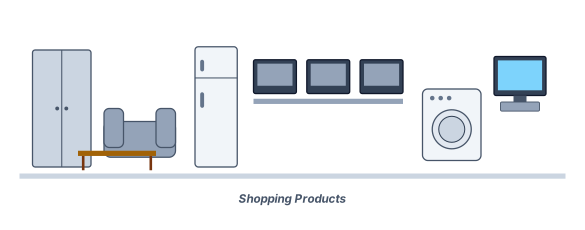
Here, the buyer is willing to invest considerable time and effort. Before making a final purchase, they visit several stores to compare quality, price, style, suitability, and other features. The decision is not impulsive; it is deliberate and comparative.
Examples are clothes, shoes, jewellery, furniture, radio, and television. Because the buyer is actively comparing, the marketer must focus on product differentiation, attractive displays, knowledgeable sales staff, and a strong brand image. Location and store ambience matter more here than for convenience goods.
3. Specialty Products
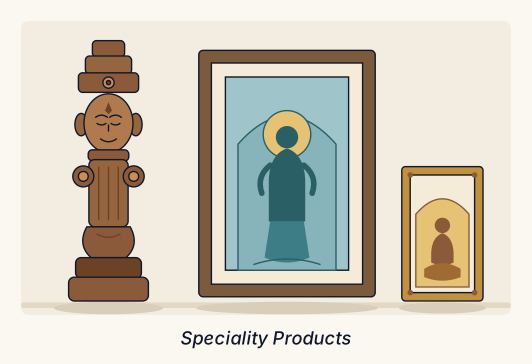
These are goods with unique features that create a very high level of brand loyalty. Buyers are not just willing — they are eager to make special efforts to purchase them. They will travel long distances, spend a lot of time, and pay a premium to get exactly what they want. …
Drawn by us to help you understand the concept clearly, and verified to make sure it's accurate. For exams, practice from your textbook's own diagram.
Our own simplified still-life rendering of the real page's grouping of everyday convenience goods: a blister pack of tablets, a bottle of cough syrup, a loaf of bread, a plain envelope, a cold-drink bottle, a box of ice cream, and eggs on a plate. …
Drawn by us to help you understand the concept clearly, and verified to make sure it's accurate. For exams, practice from your textbook's own diagram.
Our own simplified still-life rendering of the real page's grouping of durable household goods: a wardrobe, a sofa, a refrigerator, three televisions on a shelf, a washing machine, and a computer. …
Drawn by us to help you understand the concept clearly, and verified to make sure it's accurate. For exams, practice from your textbook's own diagram.
Our own simplified still-life rendering of the real page's grouping of collectible art: a carved sculpture and two framed paintings.
What it teaches: speciality products have unique features and a high level of brand loyalty -- buyers are willing to travel long distances and make spe …
What the Diagram Shows
Our own tree diagram lays out the textbook's two-way split of products. At the top, 'Products' branches into 'Consumer Products' and 'Industrial Products'. Consumer Products is then classified in two independent ways: by durability (Non-Durable, Durable, Services) and by the shopping effort a buyer puts in (Convenience, Shopping, Speciality Products).