Business Studies · Ch 10 — Marketing
Physical Distribution
Physical Distribution
Physical distribution is the fourth element of the marketing mix. Its job is to make goods and services available at the right place, at the right time, and to the right people — without any change in the product itself. Even after a product is manufactured, packaged, branded, priced, and promoted, none of that effort matters if the customer cannot actually buy it when and where they want.
Consider a simple example. A customer is convinced about a particular detergent bar. They go to a retail shop and ask for it. If the product is not on the shelf, the customer will likely pick an alternative brand that is available. That is a sure sale lost — not because of quality or price, but because the product was physically absent from the place the customer chose to buy. This is why physical distribution is a critical responsibility of the marketer.
Physical distribution is defined as the physical handling and movement of goods from the place of production to the place of distribution. It covers all activities required to physically move goods from manufacturers to customers. The major activities involved are transportation, warehousing, material handling, and inventory control. These form the core components of physical distribution.
Components of Physical Distribution
1. Order Processing
Order placement is the first step in any buyer-seller relationship. Products flow from manufacturers to customers through channel members, but orders flow in the reverse direction — from customers back to manufacturers. A good physical distribution system must ensure accurate and speedy processing of orders. If orders are processed slowly or incorrectly, goods reach customers late, or in the wrong quantity or specifications. The result is customer dissatisfaction, and the firm risks losing both business and goodwill.
2. Transportation
Transportation is the means of carrying goods and raw materials from the point of production to the point of sale. It is one of the major elements of physical distribution because, quite simply, unless goods are physically moved to where the customer is, the sale cannot be completed. Without transportation, the entire marketing effort stops at the factory gate.
3. Warehousing
Warehousing refers to the act of storing and assorting products in order to create time utility. The basic purpose is to arrange for the placement of goods and provide facilities to store them. The need for warehousing arises because there is often a gap between the time a product is produced and the time it is actually required for consumption.
The efficiency of a firm in serving its customers depends heavily on where its warehouses are located and where goods need to be delivered. A general rule: the larger the number of warehouses a firm has, the less time it takes to serve customers at different locations — but the cost of warehousing increases. Fewer warehouses mean lower cost but slower service. The firm must strike a balance between warehousing cost and the level of customer service.
Location decisions depend on the type of product:
- Products requiring long-term storage (e.g., agricultural products) — warehouses are located near production sites. This minimises transportation charges.
- Bulky or hard-to-ship products (e.g., machinery, automobiles) and perishable products (e.g., bakery items, meat, vegetables) — warehouses are kept at different locations near the market.
4. Inventory Control …
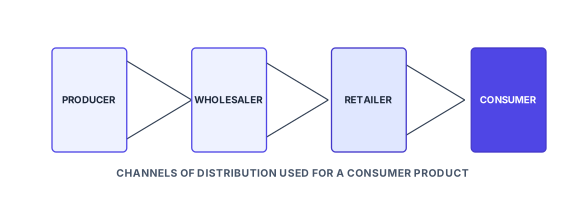
Drawn by us to help you understand the concept clearly, and verified to make sure it's accurate. For exams, practice from your textbook's own diagram.
Our own diagram of the typical channel a consumer product travels through: Producer to Wholesaler to Retailer to Consumer.
What it teaches: physical distribution isn't just about moving goods -- it's about making sure they flow through the right intermediaries so they reach the customer at the …
Nothing Beats Word of Mouth in India
Nothing sways an Indian buyer's choice more than a word of reassurance from the people he knows. Even for the purchases like cars, mobile phones and home loans, majority of the consumers in India rely on the references from their friends and relatives while making their decisions.
The story is different in developed economies. Take the case of automobiles. In markets like the US, Canada and Japan, more people are influenced by conventional advertising by automobile companies, in developing markets like India, Malaysia and Thailand it's the neighbour or the colleague who tips the scales one way or the other. "In case of luxury goods, the psyche of Indians has always been different. Buying a car is a family decision, so it is only natural that all the members of the family will talk to all the other users of a similar products, who they know", General Motors India director P Balendran said.
When the whole world is going crazy with Internet and mobile marketing, it is interesting that for Indians it's still conventional advertising and word of mouth campaigns that sways their choices. Unlike in the West, Indians come from a very closely-knit society where people get influenced by their peers, relatives and local celebrities. People are more than willing to accept a brand if it's endorsed by their favourite superstar or is recommended by their close associates. …