Chemistry · Ch 7 — Alcohols, Phenols and Ethers
Physical Properties
Physical Properties
Alcohols and phenols are both built from two parts joined together — a hydrocarbon portion (alkyl or aryl) and a hydroxyl group, . Because the physical behaviour of these compounds is governed almost entirely by the group, alcohols and phenols show closely related physical properties; the attached alkyl or aryl group only modifies these properties, it does not decide them.
Boiling Points: The Role of Hydrogen Bonding
Within a series of alcohols or phenols, boiling point rises steadily as the number of carbon atoms increases. A larger hydrocarbon skeleton has more surface area over which van der Waals (London dispersion) forces can act between neighbouring molecules, so more thermal energy is needed to separate them.
Branching works in the opposite direction. A branched-chain alcohol is more compact and closer to spherical than its straight-chain isomer, which reduces the surface area available for intermolecular contact. Weaker van der Waals attraction means a lower boiling point — the same relationship already familiar from the alkanes.
Superimposed on this size effect is a second, much stronger interaction unique to the group: intermolecular hydrogen bonding. The oxygen atom of one molecule's carries lone pairs that can accept a hydrogen bond from the of a neighbouring molecule, while its own hydrogen can simultaneously be donated to a third molecule. This lets alcohol and phenol molecules link up through a repeating pattern of
extending through the liquid, with phenol molecules associating with each other via their ring-bound groups in exactly the same way.
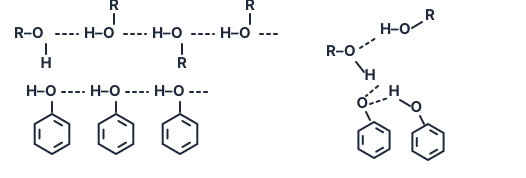
Drawn by us to help you understand the concept clearly, and verified to make sure it's accurate. For exams, practice from your textbook's own diagram.
Redrawn from the NCERT page with the structures, printed labels () and reagent placement exactly as the te …
Because forming this hydrogen-bonded network costs extra energy to break apart, alcohols and phenols boil at markedly higher temperatures than hydrocarbons, ethers, haloalkanes or haloarenes of comparable molecular mass — none of these other classes has an hydrogen available to donate, so none of them can build this kind of network.
The point is best seen by comparing three compounds of almost identical molecular mass: ethanol, methoxymethane (an ether isomeric in formula-weight terms), and propane. Propane has only weak van der Waals attractions and boils lowest. Methoxymethane is a polar molecule (a permanent dipole) but, having no bond, it cannot donate a hydrogen bond, so its boiling point is intermediate. Ethanol, which can both donate and accept hydrogen bonds through its , boils distinctly higher than both — even though all three molecules are close in mass.
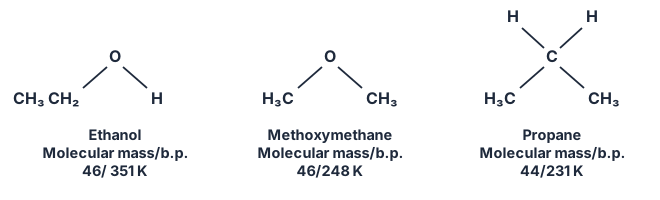
Drawn by us to help you understand the concept clearly, and verified to make sure it's accurate. For exams, practice from your textbook's own diagram.
Redrawn from the NCERT page with the structures, printed labels (CH3, CH2, O, H, Ethanol, Molecular mass/b.p., 46/ 351 K, H3C, Methoxymethane, 46/248 K) and reagent placement exac …
This gap between ethanol and propane is the clearest illustration that it is hydrogen bonding, not molecular mass, that dominates the boiling behaviour of alcohols.
Solubility in Water
The same hydrogen-bonding ability that raises boiling points also lets alcohols and phenols dissolve in water: the group of the solute can hydrogen-bond directly with surrounding water molecules, with the oxygen of the alcohol accepting a hydrogen bond from one water molecule while its own hydrogen is donated to another, so a single group can be hydrogen-bonded to several water molecules at once.
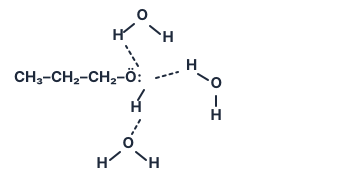
Drawn by us to help you understand the concept clearly, and verified to make sure it's accurate. For exams, practice from your textbook's own diagram.
Redrawn from the NCERT page with the structures, printed labels () and reagent placement exactly as the te …
This is why the lower members of the alcohol series — methanol, ethanol, and the propanols — are miscible with water in all proportions: the small hydrocarbon part barely interferes with the hydrogen-bonded network the group can form with water. …