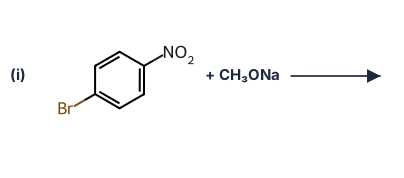
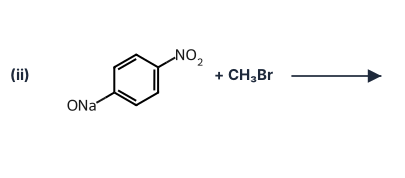
Q.Which of the following is an appropriate set of reactants for the preparation of 1-methoxy-4-nitrobenzene and why?
You're viewing a preview — the full solution, concept, methods & PYQ mapping are locked.
Start your 14-day free trial to unlock the full solution →The key idea is that Williamson ether synthesis works best when the nucleophile is the stronger one. Here, the phenoxide ion () is a much better nucleophile than methoxide () because the nitro group stabilises the negative charge on oxygen, making the phenoxide less basic but still a good nucleophile. The correct set is (ii).
To understand why, we need to revisit the Williamson ether synthesis — the most reliable method for making unsymmetrical ethers like 1-methoxy-4-nitrobenzene. The reaction is an displacement: an alkoxide (or phenoxide) ion attacks an alkyl halide. The trick is choosing which fragment becomes the nucleophile and which becomes the electrophile.
-
The target molecule: 1-methoxy-4-nitrobenzene is . It has an aryl group (the nitrobenzene ring) and a methyl group attached to oxygen. So we have two possible disconnections:
- Break the C–O bond to give an aryl halide + methoxide: (option i)
- Break the O–CH bond to give a phenoxide + methyl halide: (option ii)
-
The constraint: Aryl halides (like bromobenzene derivatives) do not undergo reactions. The carbon attached to bromine is -hybridised and the aromatic ring blocks backside attack. So option (i) is a non-starter — will not react with via to give the ether. Even if you tried harsh conditions, you’d get nucleophilic aromatic substitution (which requires a strong electron-withdrawing group ortho or para and often gives different products), but that’s not Williamson ether synthesis. …
Unlock everything free for 14 days
- Full step-by-step solutions
- Concept-first explanations
- Methods, shortcuts & mistakes
- PYQ mapping + timed mock tests
Full access for 14 days. No credit card required.