Q.Write Victor Meyer's test for Primary (1°) alcohol. OR Why boiling point of ethers are lower than alcohols?
🔒You're viewing a preview — the full solution, concept, methods & PYQ mapping are locked.
🔒 Start your 14-day free trial to unlock the full solution →Concept understanding — Boiling Point Trends
Boiling Point Trends (Organic Compounds)
A substance's boiling point is set by how much energy is needed to overcome the attractive forces HOLDING its molecules together in the liquid — the stronger those intermolecular forces, the higher the boiling point.
The Forces, Weakest to Strongest
- Van der Waals (London dispersion) forces — present in every molecule, and they grow stronger as the molecule gets bigger (more electrons, larger surface area of contact between neighbouring molecules) and more polarisable.
- Dipole–dipole forces — present in polar molecules, add an extra attraction on top of dispersion forces.
- Hydrogen bonding — present when H is bonded directly to N, O, or F; much stronger than ordinary dipole–dipole attraction, and it raises the boiling point sharply compared to a similarly-sized molecule without it.
Trend 1: Down a Series of Halogens (Same Alkyl Group)
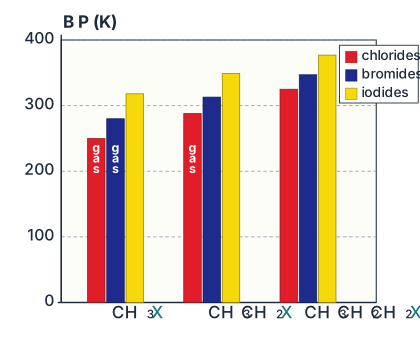
For a fixed R group, boiling point rises as the halogen gets heavier: R−I>R−Br>R−Cl>R−F. This looks surprising at first, since electronegativity (and so bond polarity/dipole moment) actually DECREASES down the group — but boiling point here is dominated by the growing size and polarisability of the halogen atom (stronger dispersion forces), which outweighs the shrinking dipole contribution.
The measured values for the methyl, ethyl and propyl halides show this rise clearly:
Trend 2: Chain Length and Branching
- Longer chains (more carbons) have more surface area for van der Waals contact between neighbouring molecules, so boiling point rises with chain length within a homologous series.
- Branching LOWERS boiling point compared to a straight-chain isomer of the same molecular formula — a more compact, spherical shape has less surface-to-surface contact with neighbouring molecules, weakening the dispersion forces. (E.g. neopentane boils well below n-pentane.)
Trend 3: Hydrogen Bonding Beats Molecular Mass …
Why this formula?
Boiling Point Trends: Why They Happen
Boiling point is the temperature at which a liquid's vapor pressure equals the external atmospheric pressure. To understand why boiling points follow certain trends, we must first understand what determines vapor pressure.
The Core Idea: Intermolecular Forces
A liquid boils when its molecules have enough kinetic energy to overcome the intermolecular forces (IMFs) holding them together in the liquid phase. Stronger IMFs → harder to escape → lower vapor pressure at a given temperature → higher boiling point.
There is no single "formula" for boiling point, but the relationship is captured by the Clausius–Clapeyron equation, which links vapor pressure (P) to temperature (T) and the enthalpy of vaporization (ΔHvap):
lnP=−RΔHvap⋅T1+C
Where:
- P = vapor pressure
- ΔHvap = enthalpy of vaporization (energy needed to vaporize 1 mole)
- R = gas constant
- T = absolute temperature (Kelvin)
- C = constant (depends on substance)
Why this formula makes sense
- ΔHvap is large when IMFs are strong — more energy is needed to separate molecules.
- At boiling point, P=Patm (usually 1 atm). So a substance with larger ΔHvap needs a higher T to reach that pressure.
Thus, boiling point ∝ strength of intermolecular forces.
The Four Key Trends (with Reasoning)
1. Trend across a period (e.g., Period 2: CH₄ → NH₃ → H₂O → HF)
| Molecule | IMFs present | Boiling point (°C) |
|---|---|---|
| CH₄ | London dispersion only | -161 |
| NH₃ | Dispersion + H-bonding | -33 |
| H₂O | Dispersion + H-bonding (2 per molecule) | 100 |
| HF | Dispersion + H-bonding | 19 |
Why?
- CH₄ is nonpolar — only weak London dispersion forces.
- NH₃, H₂O, HF have hydrogen bonding (strongest IMF).
- H₂O forms two H-bonds per molecule (donor + acceptor), while NH₃ forms one and HF forms one — hence H₂O has the highest boiling point.
Key insight: Hydrogen bonding dominates over molecular mass in small molecules.
2. Trend down a group (e.g., Halogens: F₂ → Cl₂ → Br₂ → I₂)
| Molecule | Molar mass (g/mol) | Boiling point (°C) |
|---|---|---|
| F₂ | 38 | -188 |
| Cl₂ | 71 | -34 |
| Br₂ | 160 | 59 |
| I₂ | 254 | 184 |
Why?
- All are nonpolar — only London dispersion forces.
- Dispersion force strength increases with number of electrons (larger molar mass → more polarizable electron cloud → stronger temporary dipoles).
- So boiling point increases down the group.
Key insight: For nonpolar molecules, molar mass (electron count) is the primary factor.
3. Branching in alkanes (e.g., C₅H₁₂ isomers)
| Isomer | Boiling point (°C) |
|---|---|
| n-pentane (straight chain) | 36 |
| 2-methylbutane (branched) | 28 |
| 2,2-dimethylpropane (highly branched) | 10 |
Why?
- All have same molecular formula — same molar mass. …
Victor Meyer's test distinguishes the classes of alcohol by converting each to a nitroalkane and then treating it with nitrous acid, which gives a different colour for each class. A primary alcohol yields a nitrolic acid that turns red in potassium hydroxide. …
Victor Meyer's test distinguishes 1°, 2°, 3° alcohols by the colour given after converting them to nitroalkanes and treating with nitrous acid; a primary alcohol gives a red colour.
Victor Meyer's test proceeds in three steps:
Step 1: The alcohol is converted to the corresponding alkyl iodide by treatment with red phosphorus and iodine.
R-OH+HIred PR-I+H2O
Step 2: The alkyl iodide is treated with silver nitrite (AgNO2), converting it to the corresponding nitroalkane.
R-I+AgNO2→R-NO2+AgI
Step 3: The nitroalkane is treated with nitrous acid (HNO2, generated from NaNO2+HCl), followed by a few drops of KOH.
For a PRIMARY alcohol, the resulting primary nitroalkane reacts with HNO2 to form a nitrolic acid, which dissolves in KOH to give a RED (blood-red) solution. …
Showing the 12 most recent of 24 on this concept.
- CBSE 2026Set 56/2/11 markMCQQ.Identify the correct increasing order of boiling points of the given compounds : (A) Propan-1-ol < butan-1-ol < butan-2-ol < pentan-1-ol (B) Pentan-1-ol < butan-1-ol < butan-2-ol < Propan-1-ol (C) Propan-1-ol < butan-2-ol < butan-1-ol < pentan-1-ol (D) Butan-1-ol < Butan-2-ol < Propan-1-ol < Pentan-1-ol
›Reveal solutionSolution
Boiling points of alcohols depend on chain length (more carbons → higher bp) and branching (more branching → lower bp). The correct order is Propan-1‑ol < butan‑2‑ol < butan‑1‑ol < pentan‑1‑ol, which matches option (C).
Why boiling points of alcohols behave this way
Alcohols boil at much higher temperatures than hydrocarbons of similar mass because of hydrogen bonding between the –OH groups. Two factors control the boiling point within a family of alcohols:
-
Chain length – A longer carbon chain means more surface area for van der Waals forces. These weak attractions add up, so a larger molecule needs more energy (higher temperature) to escape into the vapour phase. For straight‑chain alcohols, boiling point rises steadily as the number of carbons increases.
-
Branching – When the –OH group is attached to a secondary or tertiary carbon (as in butan‑2‑ol), the molecule becomes more compact. A compact shape reduces the surface area available for van der Waals interactions, so the boiling point drops compared to its straight‑chain isomer. The hydrogen‑bonding ability is roughly the same for all isomers (one –OH per molecule), so the difference comes from the weaker London forces in the branched form.
Watch outA common mistake is to think that branching increases boiling point because the molecule looks “more crowded”. In reality, branching decreases the surface area and therefore weakens the intermolecular forces. Always compare chain length first, then branching.
Step‑by‑step reasoning
-
Identify the compounds and their carbon counts
- Propan‑1‑ol: 3 carbons, straight chain.
- Butan‑1‑ol: 4 carbons, straight chain.
- Butan‑2‑ol: 4 carbons, branched (the –OH is on carbon 2).
- Pentan‑1‑ol: 5 carbons, straight chain.
-
Order by chain length
Longer chain → higher boiling point. So the 5‑carbon alcohol (pentan‑1‑ol) should have the highest bp, and the 3‑carbon alcohol (propan‑1‑ol) the lowest. The two 4‑carbon alcohols will sit in between.
-
Compare the two C₄ isomers …
-
- CBSE 2026Set ANNUAL1 markMCQQ.Assertion (A): Boiling point of alkanes decreases with increase in molecular mass. Reason (R): Intermolecular Vander Waals forces increase with increase in molecular size or surface area of the molecules.(a) Both Assertion (A) and Reason (R) are true and Reason (R) is the correct explanation of Assertion (A).(b) Both Assertion (A) and Reason (R) are true, but Reason (R) is not the correct explanation of Assertion (A).(c) Assertion (A) is true, but Reason (R) is false.(d) Assertion (A) is false, but Reason (R) is true.
›Reveal solutionSolution
The Assertion has the trend backwards — alkane boiling points INCREASE with molecular mass — while the Reason correctly describes why (stronger van der Waals forces with larger surface area).
Assertion: 'Boiling point of alkanes decreases with increase in molecular mass' — this is false. In reality, as molecular mass (chain length) increases, boiling point increases (e.g. methane −162°C → butane −0.5°C → octane 126°C).
…
- CBSE 2025Set X11 markMCQQ.Two compounds 'A' and 'B' were being tested for their boiling points. It was observed that 'A' started boiling after 'B', when both were subjected to same conditions. If the compound 'B' is acetone, which of the following can be compound 'A'?(a) Propanal(b) Propan-1-ol(c) Methoxyethane(d) n-Butane
›Reveal solutionSolution
"A boils after B" → A has the higher boiling point; among the options only propan-1-ol (H-bonding) boils higher than acetone, so A = propan-1-ol.
B is acetone (propanone), b.p. ≈56∘C. "A started boiling after B" means A needs a higher temperature, i.e. A has a higher boiling point than acetone. Comparing approximate boiling points of the options (all C3/C4 molecules of similar mass):
Compound Approx. b.p. Reason (a) Propanal ≈49∘C dipole–dipole only (b) Propan-1-ol ≈97∘C strong intermolecular H-bonding - CBSE 2025Set X11 markMCQQ.Select the correct order of melting points of isomeric dichlorobenzenes.(a) o-dichlorobenzene > m-dichlorobenzene > p-dichlorobenzene(b) p-dichlorobenzene > m-dichlorobenzene > o-dichlorobenzene(c) p-dichlorobenzene > o-dichlorobenzene > m-dichlorobenzene(d) m-dichlorobenzene > o-dichlorobenzene > p-dichlorobenzene
›Reveal solutionSolution
Melting point depends on how well molecules pack in the crystal; the symmetrical para isomer packs best (highest m.p.), giving the order para > ortho > meta.
For isomeric dichlorobenzenes, melting point is governed mainly by crystal packing / molecular symmetry rather than by intermolecular force magnitude:
- p-dichlorobenzene is the most symmetrical, so it packs most efficiently into the crystal lattice and has the highest melting point (≈53∘C).
- o-dichlorobenzene (≈−17∘C) packs better than the meta isomer. …
- CBSE 2025Set X11 markMCQQ.Sufficient amount of 2-methylpropan-2-ol heated with 20% phosphoric acid at 358 K gives main product 'X' with the elimination of water and tert-butyl alcohol undergoes dehydration when it is passed over heated copper at 573 K gives 'Y' Pick the correct statement regarding X and Y.(a) The boiling points of 'X' and 'Y' are equal(b) The boiling point of 'X' is greater than the boiling point of 'Y'(c) The boiling point of 'X' is lesser than the boiling point of 'Y'(d) At room temperature both 'X' and 'Y' exists as a solids
›Reveal solutionSolution
Acid dehydration and passing over hot copper both convert 2-methylpropan-2-ol to the same alkene (2-methylpropene), so X = Y and their boiling points are equal — option (a).
2-Methylpropan-2-ol is a tertiary alcohol (tert-butyl alcohol), (CH3)3C–OH.
- With 20% phosphoric acid at 358 K it undergoes acid-catalysed dehydration (elimination of water) to give the alkene: (CH3)3C–OH→(CH3)2C=CH2+H2O, so X = 2-methylpropene (isobutylene). …
- CBSE 2025Set D1 markMCQQ.At room temperature, formaldehyde is(a) gas(b) liquid(c) solid(d) none of these
›Reveal solutionSolution
Formaldehyde, the first member of the aldehyde series, is a gas at ordinary temperature (b.p. about −19 °C).
Formaldehyde (methanal, HCHO) is the lowest aldehyde. It has a very low boiling point (about −19 °C), so at room temperature it exists as a colourless, pungent-smelling gas. Its 40% aqueous solution is calle …
- CBSE 2025Set ANNUAL1 markQ.Fill in the blank: The boiling point of methanol is ________ K.
›Reveal solutionSolution
Methanol (CH3OH), the smallest alcohol, boils at about 338 K (64.7 degrees C) at atmospheric pressure.
Methanol's boiling point of ~338 K is relatively low among common alcohols because of its small molecular size (weaker van der Waals/London forces), even though, like other alcohols, it is capable of intermolecu …
- CBSE 2025Set ANNUAL1 markMCQQ.Which of the following compounds has highest melting point?(a) 1,2-dichlorobenzene (ortho-dichlorobenzene, structure drawn)(b) 1,3-dichlorobenzene (meta-dichlorobenzene, structure drawn)(c) 1,4-dichlorobenzene (para-dichlorobenzene, structure drawn)(d) All have same melting point.
›Reveal solutionSolution
Melting point depends on how efficiently molecules pack into a crystal lattice, not just molecular weight — the highly symmetric para isomer packs far better than the less symmetric ortho and meta isomers, giving it a much higher melting point.
All three dichlorobenzenes have the same molecular formula and molecular weight, so their melting-point difference comes purely from crystal packing efficiency. p-Dichlorobenzene is linear and symmetric, so molecules stack very closely and regularly in the solid lattice, maximising van der Waals contact — this raises its melting point sharply (~53°C). The or …
- CBSE 2025Set ANNUAL1 markQ.Arrange the following compounds in increasing order of their boiling points: CH3CHO, CH3CH2OH, CH3OCH3, CH3CH2CH3
›Reveal solutionSolution
Boiling point here tracks the strength of intermolecular forces: propane (only weak van der Waals forces) boils lowest, dimethyl ether (weak dipole-dipole, no H-bonding) next, acetaldehyde (stronger dipole-dipole from the polar C=O) next, and ethanol (hydrogen-bonded) boils highest.
All four compounds have comparable molar mass (propane 44, dimethyl ether 46, acetaldehyde 44, ethanol 46 g mol−1), so the boiling-point order is decided almost entirely by the type of intermolecular attraction available, not by size:
- CH3CH2CH3 (propane): a non-polar hydrocarbon; molecules are held together only by weak instantaneous dipole–induced dipole (London/van der Waals) forces. Lowest boiling point (real value ≈ −42 °C).
- CH3OCH3 (dimethyl ether): the C–O–C linkage gives the molecule a small permanent dipole, so molecules attract each other by dipole–dipole forces, stronger than propane's dispersion forces alone but the ether oxygen has no O–H bond, so no hydrogen bonding is possible. Boils higher than propane (real value ≈ −24 °C). …
- CBSE 2025Set ANNUAL1 markMCQQ.The correct order of boiling points of alcohols having the same number of Carbon atoms is ...................... .(a) 2° > 1° > 3°(b) 1° > 2° > 3°(c) 3° > 1° > 2°(d) 3° > 2° > 1°
›Reveal solutionSolution
Among isomeric alcohols, boiling point falls as branching increases, because branching reduces the effective surface area available for intermolecular hydrogen bonding and van der Waals interactions.
All isomeric alcohols with the same molecular formula can hydrogen-bond through their –OH group, but a straight-chain (primary) alcohol packs more efficiently and has a larger surface area for van der Waals contact between molecules than a branched (te …
- CBSE 2025Set ANNUAL1 markMCQQ.Which of the following has the highest melting point?(a) o-xylene(b) m-xylene(c) p-xylene(d) Toluene
›Reveal solutionSolution
p-Xylene has the highest melting point because its high molecular symmetry allows the most efficient crystal packing.
Among the three xylene isomers (o-, m-, p-) and toluene, melting point depends heavily on how symmetrically the molecules can pack into a solid lattice (not just on molecular weight or boiling point). p-Xylene, with its methyl groups symmetrically placed at opposite (1,4) positions on the ring, packs most efficiently into a crystal lattice, giving it a distinct …
- CBSE 2024Set ANNUAL1 markQ.Why has propanol higher boiling point than propane?
›Reveal solutionSolution
Boiling point depends on the strength of intermolecular forces that must be overcome; propanol's -OH group enables hydrogen bonding between molecules, a much stronger force than the weak van der Waals (London dispersion) forces that are all propane has.
Propane (CH3-CH2-CH3) is a non-polar hydrocarbon with no functional group capable of hydrogen bonding. Its molecules are held together only by weak van der Waals (induced-dipole) forces, so relatively little energy is needed to separate them - it boils at a very low temperature (-42 degree C) and is a gas at room temperature.
…
🎓Unlock everything free for 14 days
- ✓Full step-by-step solutions
- ✓Concept-first explanations
- ✓Methods, shortcuts & mistakes
- ✓PYQ mapping + timed mock tests
Full access for 14 days. No credit card required.