Chemistry · Ch 8 — Aldehydes, Ketones and Carboxylic Acids
Nomenclature
Nomenclature
Aldehydes and ketones are the simplest and most important carbonyl compounds, and each one can be named in two ways: an older common name and a systematic IUPAC name.
(a) Common names
Aldehydes. The common name of most aldehydes is built from the common name of the corresponding carboxylic acid, by dropping the acid's -ic ending and adding aldehyde in its place. Along with borrowing the acid's name, the common name also inherits the acid's Latin or Greek root (the original natural source of the acid or aldehyde) — which is why, for instance, the aldehyde derived from formic acid is formaldehyde, and the one derived from acetic acid is acetaldehyde ().
Substituent positions in a common name are not given numbers — they are given Greek letters: starting right next to the carbonyl carbon. The -carbon is the one directly bonded to the carbon, the -carbon is the next one along the chain, and so on. For example, a bromine on the third carbon of a four-carbon aldehyde chain is described as the -substituent, giving the name -bromobutyraldehyde.
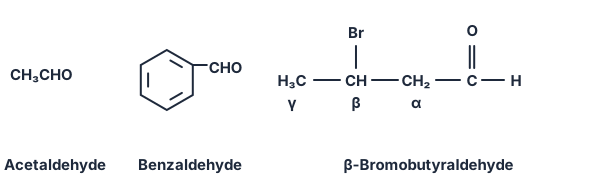
Drawn by us to help you understand the concept clearly, and verified to make sure it's accurate. For exams, practice from your textbook's own diagram.
Redrawn from the NCERT page with the structures, printed labels (CHO) and reagent placement exactly as the textbook prints them. Every element of this display was checked against the printed page during the sweep's blind-judge verification pass, so what …
Ketones. The common name of a ketone is built by naming the two alkyl or aryl groups attached to the carbonyl carbon (in alphabetical order), followed by the word ketone. Substituent positions are again marked with Greek letters, but here there are two chains radiating from the carbonyl carbon, so the labelling starts as on the two carbons flanking the carbonyl, then , and so on outward.
Some ketones simply carry a historical common name instead — the simplest ketone, dimethyl ketone, is universally called acetone. Ketones in which one group is an aryl group and the carbonyl is attached directly to a benzene ring are commonly named by prefixing the name of the acyl group to the word -phenone: an acetyl group on a phenone gives acetophenone, a propionyl group gives propiophenone, and a benzoyl group (a second phenyl ring) gives benzophenone.
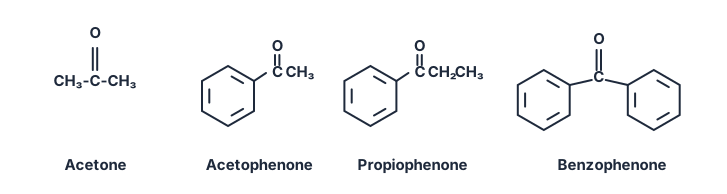
Drawn by us to help you understand the concept clearly, and verified to make sure it's accurate. For exams, practice from your textbook's own diagram.
Redrawn from the NCERT page with the structures, printed labels (C, CH3, CH2, O) and reagent placement exactly as the textbook prints them. Every element of this display was checked against the printed page during the sweep's blind-judge verification pass, so wha …
(b) IUPAC names
The IUPAC name of an open-chain aliphatic aldehyde or ketone is derived from the name of the corresponding alkane of the same carbon count, by replacing the alkane's final -e with:
- for an aldehyde, or
- for a ketone.
Numbering the chain. For an aldehyde, the longest carbon chain is numbered starting from the carbonyl carbon itself — the carbon is always C-1. For a ketone, numbering instead begins from whichever end of the chain is nearer to the carbonyl group, so the carbonyl carbon receives the lowest possible locant. In both cases, substituents are cited as prefixes in alphabetical order, each with a numeral marking its position on the chain.
The same lowest-locant rule extends to cyclic ketones: the carbonyl carbon of the ring is always numbered C-1.
Aldehydes on a ring. When the group is attached to (rather than part of) a ring, the suffix -carbaldehyde is added after the full name of the cycloalkane, and the ring numbering starts from the ring carbon that carries the aldehyde group. The simplest aromatic aldehyde — a group directly on benzene — is systematically benzenecarbaldehyde, though IUPAC also accepts its familiar common name, benzaldehyde. Every other aromatic aldehyde is then named as a substituted benzaldehyde, with the ring position of each substituent numbered relative to the carbon bearing the group.
Multiple carbonyl groups. When a molecule carries more than one aldehyde group and the usual suffix cannot treat every group identically, the -carbaldehyde suffix is used instead, attached to the name of the parent chain — for example, a three-carbon chain bearing a group on every carbon is named propane-1,2,3-tricarbaldehyde rather than being forced into the pattern. …
| Structure | Common name | IUPAC name |
|---|---|---|
| Aldehydes | ||
| Formaldehyde | Methanal | |
| Acetaldehyde | Ethanal | |
| Isobutyraldehyde | 2-Methylpropanal | |
| (1,3-; the book draws the ring — see the illustration card) | γ-Methylcyclohexanecarbaldehyde | 3-Methylcyclohexanecarbaldehyde |
| α-Methoxypropionaldehyde | 2-Methoxypropanal | |
| Valeraldehyde | Pentanal | |
| Acrolein | Prop-2-enal | |
| (o-; drawn in the book) | Phthaldehyde | Benzene-1,2-dicarbaldehyde |
| m- (drawn in the book) | m-Bromobenzaldehyde | 3-Bromobenzenecarbaldehyde or 3-Bromobenzaldehyde |
| Ketones | ||
| Methyl n-propyl ketone | Pentan-2-one | |
| Diisopropyl ketone | 2,4-Dimethylpentan-3-one |
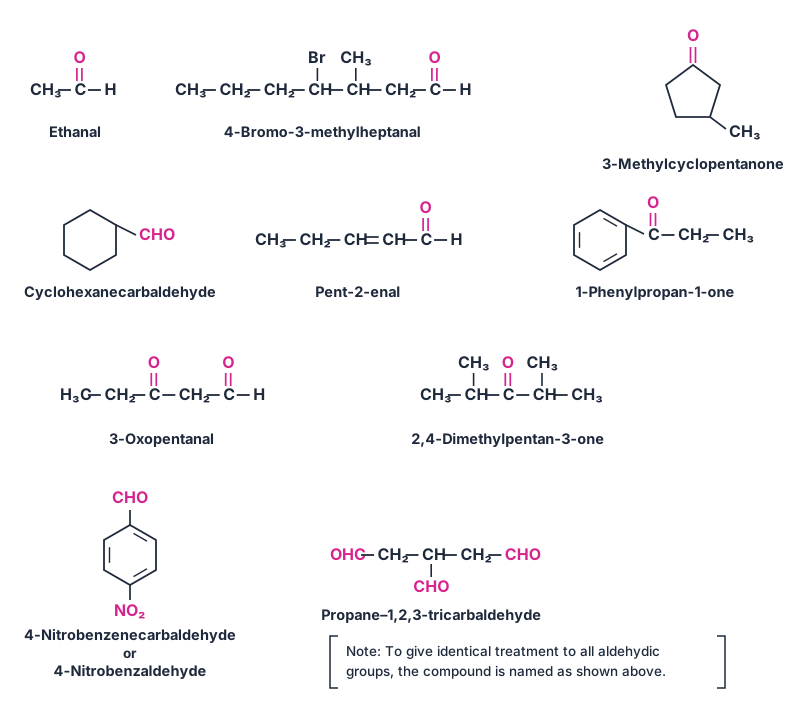
Drawn by us to help you understand the concept clearly, and verified to make sure it's accurate. For exams, practice from your textbook's own diagram.
Redrawn from the NCERT page with the structures, printed labels (CH3, C, H, CH2, CH, CHO, H3C, NO2, OHC) and reagent placement exactly as the textbook prints them. Every element of this display was checked against the printed page during the sweep's blind-judge verification pass, so …
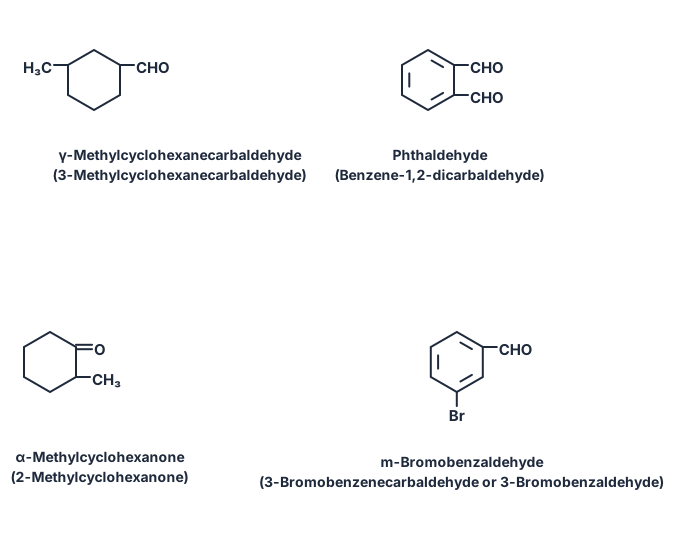
Drawn by us to help you understand the concept clearly, and verified to make sure it's accurate. For exams, practice from your textbook's own diagram.
Redrawn from the NCERT page with the structures, printed labels (H3C, CHO, Br, O, CH3) and reagent placement exactly as the textbook prints them. Every element of this display was checked against the printed page during the sweep's blind-judge verification pass, so wh …