Q.Would you expect benzaldehyde to be more reactive or less reactive in nucleophilic addition reactions than propanal? Explain your answer.
Benzaldehyde is less reactive than propanal toward nucleophilic addition because the carbonyl carbon in benzaldehyde is less electrophilic — the phenyl ring stabilises the carbonyl group through resonance, reducing its partial positive charge, while propanal has no such stabilisation.
Why resonance matters here
Nucleophilic addition reactions depend on how strongly the carbonyl carbon attracts a nucleophile. That attraction comes from the partial positive charge () on the carbon. Anything that reduces this makes the carbon less electrophilic — and therefore less reactive.
In benzaldehyde, the carbonyl group is directly attached to a benzene ring. That ring can delocalise the electrons of the C=O bond through resonance. This is the key effect.
Propanal has an alkyl group (ethyl) attached to the carbonyl. Alkyl groups are electron-donating by hyperconjugation and induction, but they cannot participate in resonance with the C=O bond. So the carbonyl carbon in propanal retains a stronger charge.
Step-by-step reasoning
-
Draw the resonance structures of benzaldehyde.
The lone pair on the carbonyl oxygen can be pushed into the C=O bond, and that electron density can be further delocalised into the benzene ring. This gives a resonance structure where the carbonyl carbon gains electron density (it becomes a single bond to oxygen, and the ring carries a positive charge elsewhere).
The net effect: the carbonyl carbon in benzaldehyde has less partial positive charge than in a simple aldehyde.
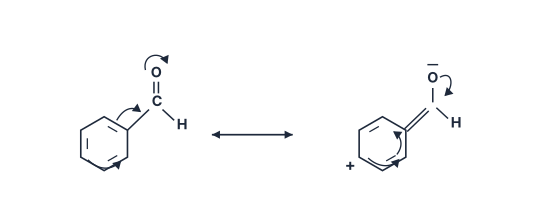
Resonance structures of benzaldehyde: the ring's pi electrons delocalise toward the carbonyl group, giving a charge-separated structure with O-minus and a positive ring, which reduces the carbonyl carbon's electrophilicity -
Compare with propanal.
Propanal () has no such resonance delocalisation. The ethyl group donates electrons weakly through induction, but this is much smaller than the resonance effect in benzaldehyde. The carbonyl carbon in propanal remains significantly .
-
Relate charge to reactivity.
A nucleophile attacks the electrophilic carbonyl carbon. The more positive this carbon is, the faster the attack. Since benzaldehyde’s carbonyl carbon is less positive, it is less reactive toward nucleophilic addition.
-
Consider steric hindrance (a minor factor).
The phenyl ring is bulkier than an ethyl group, but steric hindrance is not the dominant reason here — the electronic effect is far more important.
A common mistake is to think that the benzene ring “withdraws” electrons by induction (it does, weakly), and therefore benzaldehyde should be more reactive. But the resonance donation from the ring into the carbonyl dominates, making the carbon less electrophilic. Induction is secondary here.
You can remember this as: resonance stabilises the reactant (the carbonyl group) in benzaldehyde, so it is less eager to react. Propanal has no such stabilisation, so it reacts more readily.
Final answer
Benzaldehyde is less reactive than propanal in nucleophilic addition reactions because resonance delocalisation from the phenyl ring reduces the electrophilicity of the carbonyl carbon.
Unlock everything free for 14 days
- Full step-by-step solutions
- Concept-first explanations
- Methods, shortcuts & mistakes
- PYQ mapping + timed mock tests
Full access for 14 days. No credit card required.