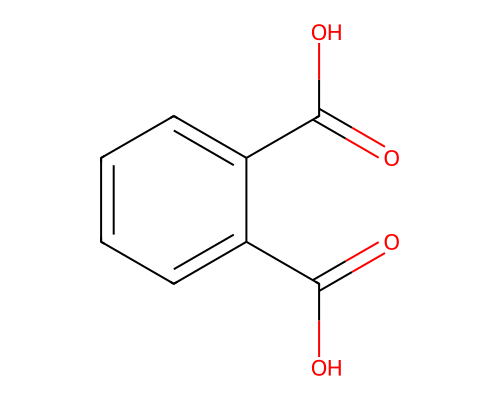
Q.An organic compound with the molecular formula forms 2,4-DNP derivative, reduces Tollens' reagent and undergoes Cannizzaro reaction. On vigorous oxidation, it gives 1,2-benzenedicarboxylic acid. Identify the compound.
You're viewing a preview — the full solution, concept, methods & PYQ mapping are locked.
Start your 14-day free trial to unlock the full solution →The compound is an aldehyde (reduces Tollens') with no -hydrogen (undergoes Cannizzaro), and its oxidation yields phthalic acid — so it must be 2-ethylbenzaldehyde, with the aldehyde and ethyl group ortho to each other.
The problem gives you four clues about a compound . Let’s unpack each one and see how they fit together.
Why the Cannizzaro reaction is the key
The Cannizzaro reaction is a disproportionation of an aldehyde that has no -hydrogen atoms — that is, no hydrogen on the carbon next to the group. In strong base, one molecule gets oxidised to a carboxylic acid and another gets reduced to an alcohol. So if your compound undergoes Cannizzaro, it must be an aldehyde with the group attached either to an aromatic ring or to a tertiary carbon (like ). That immediately narrows the field.
Now let’s walk through the clues step by step.
-
Forms a 2,4-DNP derivative
This tells you the compound has a carbonyl group () — either an aldehyde or a ketone. 2,4-dinitrophenylhydrazine reacts with any carbonyl to give an orange/red precipitate.
-
Reduces Tollens’ reagent
Tollens’ reagent () is reduced only by aldehydes (and some -hydroxy ketones, but that’s rare). Ketones do not react. So the compound is an aldehyde.
-
Undergoes Cannizzaro reaction
As we said, this means the aldehyde has no -hydrogen. For an aromatic aldehyde, that’s automatic — the -carbon is part of the benzene ring. So the compound is an aromatic aldehyde.
-
On vigorous oxidation, gives 1,2-benzenedicarboxylic acid
That’s phthalic acid — a benzene ring with two carboxylic acid groups in the ortho positions. Vigorous oxidation (like hot or ) will oxidise any alkyl side chain on a benzene ring to , and it will also oxidise to . So the original compound must have had two substituents on the benzene ring that could be oxidised to groups, and they must be ortho to each other.
One of those substituents is the aldehyde group (). The other must be a carbon chain that, after oxidation, becomes the second . Since the molecular formula is , and we already have (benzene ring) + (1 carbon), that accounts for . The remaining must be the other side chain — an ethyl group ().
So the compound is an ethylbenzaldehyde with the two groups ortho to each other. …
Unlock everything free for 14 days
- Full step-by-step solutions
- Concept-first explanations
- Methods, shortcuts & mistakes
- PYQ mapping + timed mock tests
Full access for 14 days. No credit card required.