Skip to content

Chemistry · Ch 8 — Aldehydes, Ketones and Carboxylic Acids

Reactions Involving Cleavage of C–OH Bond

8.9.2

Reactions Involving Cleavage of C–OH Bond

In these reactions the entire −OH-OH of the carboxyl group is replaced by another group while the carbonyl carbon is retained — this is exactly analogous to reactions at the C−OHC-OH bond of an alcohol.

1. Formation of Anhydride

Heating a carboxylic acid with a mineral acid such as concentrated H2SO4H_2SO_4, or with phosphorus pentoxide (P2O5P_2O_5), brings about loss of a water molecule between two acid molecules, giving the corresponding acid anhydride:
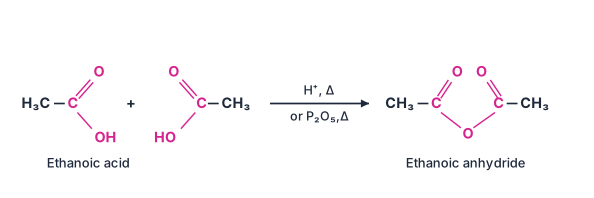
Formation of ethanoic anhydride from two molecules of ethanoic acid drawn with explicit C=O and C-OH bonds (the second acid molecule printed mirrored, HO on the left), over an arrow carrying 'H⁺, Δ' above and 'or P₂O₅,Δ' below, giving the anhydride drawn with two C=O groups bridged by O — as printed on NCERT p251; the printed 'Ethanoic acid' label sits centred under the reactant pair and is attached here to the first panel (disclosed).

Drawn by us to help you understand the concept clearly, and verified to make sure it's accurate. For exams, practice from your textbook's own diagram.

Redrawn from the NCERT page with the structures, printed labels (H₃C—C, O, OH, HO, C—CH₃, CH₃, C – CH₃) and reagent placement exactly as the textbook prints them. Every element of this display was checked against the printed page during the sweep's blind-judge verification pass, so …

(Ethanoic acid + Ethanoic acid →\rightarrow Ethanoic anhydride)

2. Esterification

Carboxylic acids react with alcohols (or phenols) in the presence of a mineral-acid catalyst — concentrated H2SO4H_2SO_4 or dry HClHCl gas — to form esters. The reaction is reversible:

RCOOH+R′OH  ⇌H+  RCOOR′+H2ORCOOH + R'OH \;\underset{}{\overset{H^+}{\rightleftharpoons}}\; RCOOR' + H_2O

Mechanism of esterification (Fischer esterification)

Esterification is a nucleophilic acyl substitution and proceeds as follows:
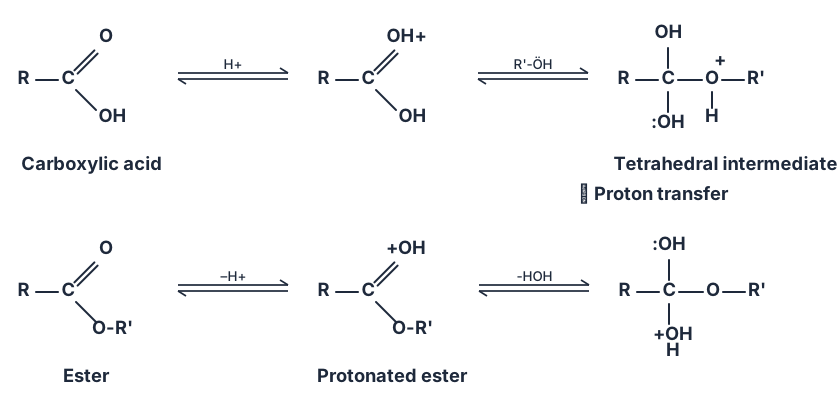
The boxed NCERT p252 esterification mechanism drawn structure-by-structure: carboxylic acid protonated at the carbonyl oxygen by H⁺, nucleophilic attack of R'-OH giving the tetrahedral intermediate, proton transfer converting -OH to the -⁺OH₂ leaving group, loss of water (-HOH) to the protonated ester, and final deprotonation (-H⁺) to the ester. Disclosed departures from the print: the curved electron-pushing arrows and lone-pair dots are omitted; the printed bottom row runs right-to-left and is linearised left-to-right here; the vertical 'Proton transfer' double arrow is rendered as a text row; equilibrium half-arrows render as plain arrows.

Drawn by us to help you understand the concept clearly, and verified to make sure it's accurate. For exams, practice from your textbook's own diagram.

Redrawn from the NCERT page with the structures, printed labels (R, C, O, OH, OH+, :OH, R', H, +, O-R') and reagent placement exactly as the textbook prints them. Every element of this display was checked against the printed page during the sweep's blind-judge verification pass, so …

  1. Protonation of the carbonyl oxygen of the carboxylic acid by H+H^+ activates the carbonyl carbon towards nucleophilic attack.
  2. Nucleophilic addition of the alcohol. The oxygen of R′OHR'OH attacks the activated (electrophilic) carbonyl carbon, generating a tetrahedral intermediate that carries both the original −OH-OH and the new −O+HR′-\overset{+}{O}HR' (protonated alkoxy) group.
  3. Proton transfer within the tetrahedral intermediate moves the positive charge from the newly added oxygen onto the original hydroxyl oxygen, converting that −OH-OH into a much better leaving group, −O+H2-\overset{+}{O}H_2.
  4. Loss of water. The protonated −O+H2-\overset{+}{O}H_2 leaves as a neutral water molecule, giving the protonated ester.
  5. Deprotonation. The protonated ester loses a proton to regenerate the acid catalyst and give the neutral ester.

Every step up to and including loss of water is reversible, which is why esterification itself is an equilibrium reaction (driven towards the ester by using excess alcohol or by removing water as it forms).

3. Reactions with PCl₅, PCl₃ and SOCl₂

The hydroxyl group of a carboxylic acid, like that of an alcohol, is readily replaced by chlorine on treatment with phosphorus pentachloride, phosphorus trichloride, or thionyl chloride, giving the acid chloride:

RCOOH+PCl5⟶RCOCl+POCl3+HClRCOOH + PCl_5 \longrightarrow RCOCl + POCl_3 + HCl

3RCOOH+PCl3⟶3RCOCl+H3PO33RCOOH + PCl_3 \longrightarrow 3RCOCl + H_3PO_3

RCOOH+SOCl2⟶RCOCl+SO2+HClRCOOH + SOCl_2 \longrightarrow RCOCl + SO_2 + HCl

Tip

Thionyl chloride (SOCl2SOCl_2) is the preferred reagent because its two other products, SO2SO_2 and HClHCl, are both gases that escape the reaction mixture — this makes purification of the acid chloride much easier than with PCl5PCl_5 or PCl3PCl_3, which leave a phosphorus-containing by-product behind.

4. Reaction with Ammonia

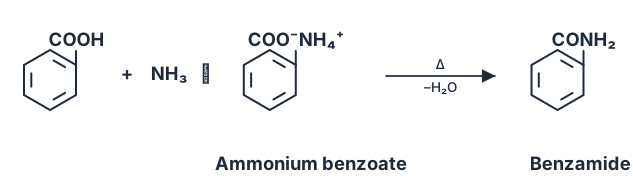
Carboxylic acids react with ammonia to first give an ammonium salt; further heating of this salt at high temperature drives off water and gives an amide:

CH3COOH+NH3  ⇌  CH3COO−NH4+Ammonium acetate  →−H2OΔ  CH3CONH2AcetamideCH_3COOH + NH_3 \;\rightleftharpoons\; \underset{\text{Ammonium acetate}}{CH_3COO^-NH_4^+} \;\xrightarrow[-H_2O]{\Delta}\; \underset{\text{Acetamide}}{CH_3CONH_2} …

Reaction of benzoic acid with ammonia drawn with Kekulé benzene rings as on NCERT p252: benzoic acid + NH₃ in equilibrium with ammonium benzoate (printed 'COONH₄' carrying − over the second O and + over N, rendered inline as COO⁻NH₄⁺, disclosed), then Δ over the arrow and –H₂O below giving benzamide.

Drawn by us to help you understand the concept clearly, and verified to make sure it's accurate. For exams, practice from your textbook's own diagram.

Redrawn from the NCERT page with the structures, printed labels (COOH, COO⁻NH₄⁺, CONH₂) and reagent placement exactly as the textbook prints them. Every element of this display was checked against the printed page during the sweep's blind-judge verification pass, so wh …
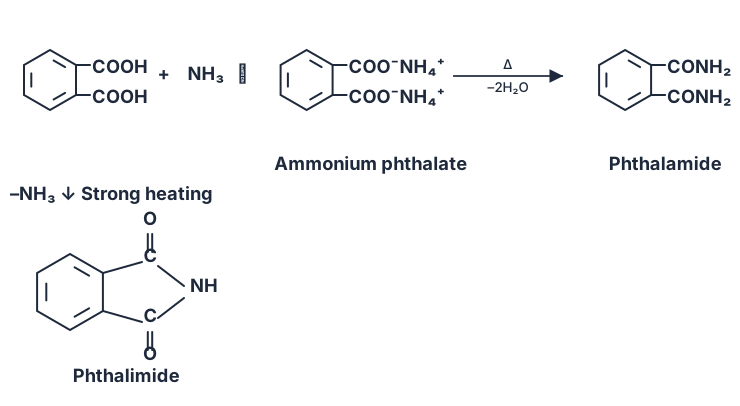
The NCERT p253 phthalic-acid-to-phthalimide scheme drawn with Kekulé rings: the unlabelled ortho-dicarboxylic acid + NH₃ in equilibrium with ammonium phthalate (both COO⁻NH₄⁺ groups; printed charges − over O and + over N, rendered inline, disclosed), Δ/–2H₂O to phthalamide (two CONH₂), then the printed vertical arrow flanked by '–NH₃' and 'Strong heating' (linearised as a text row, disclosed) closing the five-membered imide ring of phthalimide, drawn with both carbonyl C=O groups bridged by NH.

Drawn by us to help you understand the concept clearly, and verified to make sure it's accurate. For exams, practice from your textbook's own diagram.

Redrawn from the NCERT page with the structures, printed labels (COOH, COO⁻NH₄⁺, CONH₂) and reagent placement exactly as the textbook prints them. Every element of this display was checked against the printed page during the sweep's blind-judge verification pass, so wh …