Chemistry · Ch 9 — Amines
Method of Preparation of Diazonium Salts
Method of Preparation of Diazonium Salts
The Diazonium Ion and Its Salts
Diazonium salts have the general formula , where R is an aryl group and may be , , , , etc. The group is called the diazonium group. The salts are named by adding the suffix diazonium to the name of the parent hydrocarbon, followed by the name of the anion — so is benzenediazonium chloride and is benzenediazonium hydrogensulphate.
Primary aliphatic amines form highly unstable alkyldiazonium salts, while primary aromatic amines form arenediazonium salts that are stable for a short time in solution at low temperature (273–278 K). The stability of the arenediazonium ion is explained on the basis of resonance:
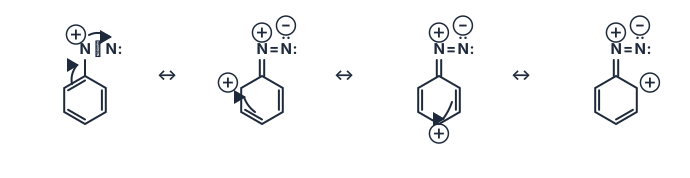
Drawn by us to help you understand the concept clearly, and verified to make sure it's accurate. For exams, practice from your textbook's own diagram.
Redrawn from the NCERT page with the structures, printed labels (··) and reagent placement exactly as the textbook prints them. Every element of this display was checked against the printed page during the sweep's blind-judge verification pass, so what …
Diazotisation Defined
Converting a primary aromatic amine into its diazonium salt is called diazotisation. Aniline is the standard example: treated with sodium nitrite and dilute hydrochloric acid in an ice bath (273–278 K), it is converted to benzenediazonium chloride.
Two moles of HCl are required overall — one combines with sodium nitrite to liberate nitrous acid, and the other supplies the chloride counter-ion that ends up in the diazonium salt.
Nitrous Acid Is Generated In Situ
Nitrous acid () is too unstable to be stored or added as a separate reagent. Instead, it is generated as needed, directly inside the reaction flask, from sodium nitrite and hydrochloric acid:
This freshly formed nitrous acid is the species that actually attacks the amine nitrogen, so the two reagents — aniline and sodium nitrite — are typically mixed with hydrochloric acid together, with the sodium nitrite added gradually to the cold amine hydrochloride solution.
An Outline of the Mechanism
Diazotisation proceeds through electrophilic attack on the amine nitrogen by a nitrosating species derived from nitrous acid:
- Generation of the electrophile. In the acidic medium, nitrous acid is protonated and loses water to give the nitrosonium ion (or, when two molecules of nitrous acid combine, its equivalent, dinitrogen trioxide):
- Attack on the amine. The lone pair on the aniline nitrogen attacks this electrophilic nitrosonium ion, and loss of a proton gives an N-nitrosamine:
- Tautomerisation. The N-nitrosamine tautomerises (a proton shifts from nitrogen to oxygen) into the diazohydroxide form:
- Loss of water. Protonation of the hydroxyl oxygen followed by loss of water gives the resonance-stabilised arenediazonium ion:
This last cation, paired with the chloride ion present in solution, is benzenediazonium chloride.