Chemistry · Ch 9 — Amines
Physical Properties
Physical Properties
Physical state and odour
The lightest aliphatic amines occur as gases and carry a characteristic fishy, ammonia-like smell. As the carbon skeleton grows, primary amines bearing three or more carbon atoms turn into liquids, and the still bulkier members of the family exist as solids. Aniline and the other arylamines are colourless when freshly prepared, but on standing they pick up a tinge of colour — a slow change brought on by oxidation in air rather than by any change in the compound's basic structure.
Solubility behaviour
Lower aliphatic amines dissolve readily in water. The reason is the same kind of intermolecular attraction alcohols show: the N–H bond of the amine can hydrogen-bond to water molecules. As the alkyl portion of the amine gets larger, this hydrocarbon (hydrophobic) part starts to dominate the molecule's character, and water-solubility falls off correspondingly — amines with long chains are practically insoluble in water.
A useful way to compare amines with alcohols is to look at the electronegativity of the atom carrying the lone pair and the N–H/O–H bond: nitrogen is rated at about and oxygen at about . Because oxygen pulls electron density more strongly, the O–H bond in an alcohol is more polarised than the N–H bond in an amine of comparable size, so alcohols engage in stronger hydrogen bonding — both with water and with themselves — than amines do. This is also why alcohols are consistently more water-soluble than an amine of similar molar mass.
Besides water, amines dissolve well in common organic solvents such as alcohol, ether and benzene.
Boiling points and intermolecular hydrogen bonding
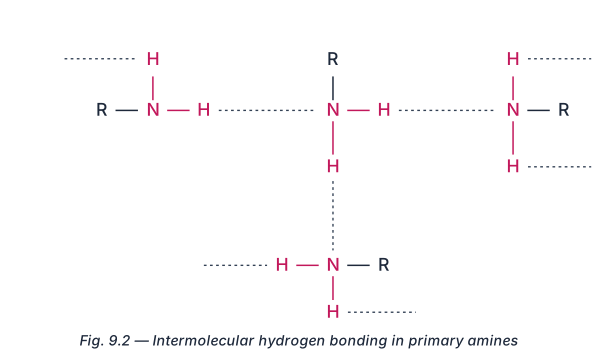
Primary and secondary amines can associate with one another through hydrogen bonds, since each has at least one N–H bond available: the nitrogen of one molecule, carrying a lone pair, bonds to a hydrogen on the nitrogen of a neighbouring molecule. A primary amine, , offers two such N–H hydrogens per molecule, so it can build a more extensive hydrogen-bonded network than a secondary amine, , which has only one. A tertiary amine, , has no hydrogen left on nitrogen at all, so its molecules cannot hydrogen-bond to each other.
Drawn by us to help you understand the concept clearly, and verified to make sure it's accurate. For exams, practice from your textbook's own diagram.
What the Figure Shows
The figure depicts a cluster of three or more primary amine molecules (general structure ). Each molecule is drawn with its nitrogen atom bonded to two hydrogen atoms and one alkyl group (). The key visual feature is a network of dotted lines connecting the molecules. These dotted lines represent hydrogen bonds (). Specifically, the lone pair of electrons on the nitrogen atom of one molecule accepts a hydrogen bond from an hydrogen of a neighbouring molecule. Simultaneously, the hydrogens of that same molecule donate hydrogen bonds to the lone pairs of further neighbours, creating an extended, chain-like network.
The Physical Idea It Teaches
The figure illustrates why primary amines have higher boiling points than alkanes of comparable molar mass. The hydrogen bonds () are intermolecular forces that require extra energy (heat) to break when the liquid boils. Because nitrogen is less electronegative than oxygen, these bonds are weaker than the hydrogen bonds in alcohols. This explains the trend in boiling points from Table 9.2: for similar molar masses, alcohols boil highest, amines next, and alkanes lowest.
Key Formula(s) Developed with This Figure
The figure directly supports the comparison of boiling points in Table 9.2. The relevant relationship is that boiling point () depends on the strength of intermolecular forces. For a series of compounds with similar molar mass ():
- Alkanes (no hydrogen bonding): lowest .
- Amines (weaker hydrogen bonding): intermediate .
- Alcohols (stronger hydrogen bonding): highest . …
This directly sets the boiling-point order among isomeric amines of the same molecular formula:
The more extensively a set of molecules can hydrogen-bond, the more energy is needed to separate them, and so the higher the boiling point.
The network of N–H···N hydrogen bonds that links primary-amine molecules together in the liquid state is pictured in Fig. 9.2 — each molecule reaches out through both of its N–H hydrogens to neighbouring nitrogen atoms, building up a chain of associated molecules. …
| Sl. No. | Compound | Molar mass | b.p./K |
|---|---|---|---|
| 1. | n- | 73 | 350.8 |
| 2. | 73 | 329.3 | |
| 3. | 73 | 310.5 |