Q.Explain sex determination in humans with a line diagram. [2+1=3]
You're viewing a preview — the full solution, concept, methods & PYQ mapping are locked.
Start your 14-day free trial to unlock the full solution →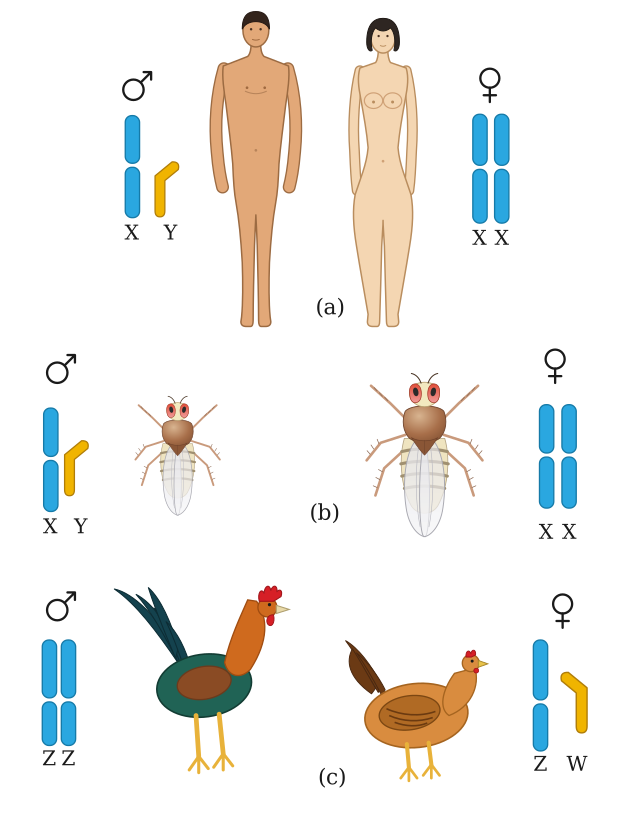
Human sex is determined by the sex chromosomes contributed by the father: an X-bearing sperm fertilizing the egg gives a girl (XX), while a Y-bearing sperm gives a boy (XY); each outcome has equal probability.
In humans, sex determination follows the XY type. Out of the 23 pairs of chromosomes, 22 pairs (autosomes) are the same in males and females, but the 23rd pair (sex chromosomes) differs: females have two X chromosomes (XX), while males have one X and one Y chromosome (XY).
- The mother produces eggs that all carry a single type of sex chromosome, X - so females are called the homogametic sex.
- The father produces two types of sperm in equal numbers, half carrying X and half carrying Y - so males are called the heterogametic sex.
At fertilization, each egg (always carrying X) can be fertilized by either an X-bearing sperm or a Y-bearing sperm, each with 50% probability:
- Egg (X) + Sperm (X) -> Zygote (XX) -> develops into a female
- Egg (X) + Sperm (Y) -> Zygote (XY) -> develops into a male
Line diagram (textual representation):
            Mother (XX)                 Father (XY)
                 |                            |
        Eggs: all carry X          Sperm: half X, half Y
                 \                          /      \
                  \                        /        \ …
Unlock everything free for 14 days
- Full step-by-step solutions
- Concept-first explanations
- Methods, shortcuts & mistakes
- PYQ mapping + timed mock tests
Full access for 14 days. No credit card required.