Q.Draw circuit diagram of a Wheatstone bridge and obtain the balance condition for the galvanometer to give zero or null deflection using Kirchhoff's Rule. [1+2=3] OR What do you understand by internal resistance of cell? Two cells of e.m.f. epsilon1 and epsilon2 whose internal resistance are r1 and r2 respectively, are connected in series. Determine the total e.m.f. and total internal resistance of the combination. Draw necessary diagram. [1+2=3]
You're viewing a preview — the full solution, concept, methods & PYQ mapping are locked.
Start your 14-day free trial to unlock the full solution →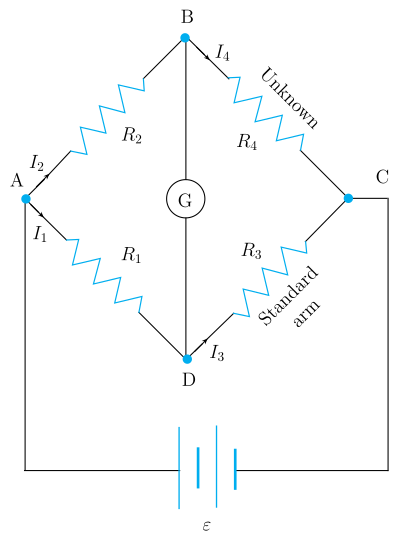
A Wheatstone bridge is a four-arm resistor network used to precisely measure an unknown resistance; at balance, the ratio of the resistances in one pair of arms equals the ratio in the other pair.
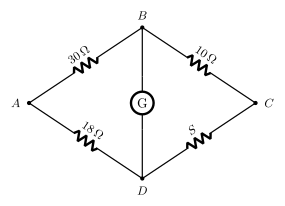
Circuit (described): Four resistances (arm A-B), (arm B-C), (arm A-D), and (arm D-C) form a quadrilateral (diamond) ABCD. A battery (with a key) is connected across the diagonal A-C, and a galvanometer is connected across the other diagonal B-D.
Deriving the balance condition using Kirchhoff's rules:
At balance, the galvanometer shows zero deflection, so the current through it . Since , the same current flows through both (A to B) and then (B to C) in series (no current diverts into the galvanometer branch at B); similarly the same current flows through (A to D) and then (D to C).
Since regardless of the galvanometer's own resistance, there is no potential drop across B-D, so .
Applying Kirchhoff's voltage law (loop rule) along A-B and A-D:
…
Unlock everything free for 14 days
- Full step-by-step solutions
- Concept-first explanations
- Methods, shortcuts & mistakes
- PYQ mapping + timed mock tests
Full access for 14 days. No credit card required.