Question of 50
Q.What do you understand by nuclear force? Draw the graph of binding energy per nucleon as a function of mass numbers and explain.
Rajasthan RbseRajasthan Board Senior Secondary Examination 2025Subjective· 2mImportance★★★★★
0% · 0/50 Questions
You're viewing a preview — the full solution, concept, methods & PYQ mapping are locked.
Start your 14-day free trial to unlock the full solution →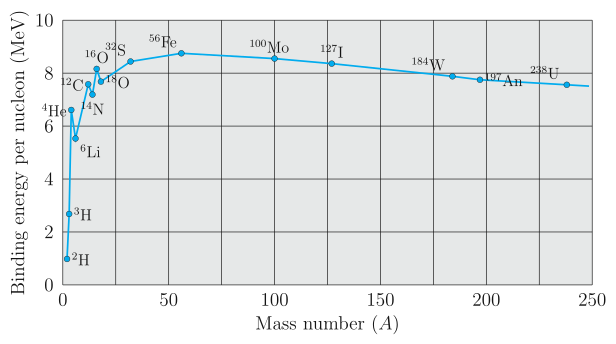
The nuclear force is the strong, short-range glue holding protons and neutrons together against electrostatic repulsion; how tightly bound a nucleus is (per nucleon) rises then falls with mass number, and this single curve explains both fission and fusion.
Nuclear force: The nuclear (strong) force is the force that binds protons and neutrons together inside a nucleus. Its key properties:
- It is the strongest of the fundamental forces at nuclear distances (far exceeding the electrostatic repulsion between protons).
- It is short-range, acting only over distances of about 1-2 fm (femtometres) — negligible beyond nucleus-sized separations, unlike gravity or the Coulomb force.
- It is charge-independent — it acts equally between p-p, n-n, and p-n pairs.
- It is attractive over most of its range but becomes strongly repulsive at very short distances (preventing nuclear collapse), and saturates (a nucleon interacts only with its nearest neighbours, not all others).
Binding energy per nucleon vs mass number graph: (described, since it cannot be drawn here)
- Plot (MeV per nucleon) on the vertical axis against mass number on the horizontal axis.
- The curve rises sharply for very light nuclei (small ), reaching a broad maximum of about 8.7-8.8 MeV/nucleon around (iron) — the most tightly bound nuclei. …
Unlock everything free for 14 days
- Full step-by-step solutions
- Concept-first explanations
- Methods, shortcuts & mistakes
- PYQ mapping + timed mock tests
Full access for 14 days. No credit card required.