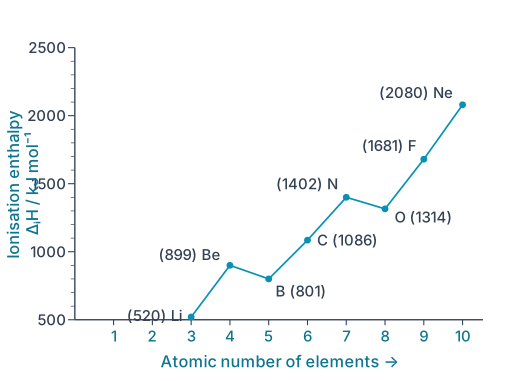
Q.Explain the deviation in ionisation enthalpy of some elements from the general trend by using Fig. 3.2.
You're viewing a preview — the full solution, concept, methods & PYQ mapping are locked.
Start your 14-day free trial to unlock the full solution →The two dips in first ionisation enthalpy — B below Be and O below N — arise because removing an electron from a fully filled or half-filled subshell costs extra energy, whereas removing one from a doubly occupied orbital (where electron‑electron repulsion is high) is easier.
The general trend across a period is clear: as you move from left to right, nuclear charge increases and atomic radius shrinks, so the outermost electron feels a stronger pull and becomes harder to remove. That is why ionisation enthalpy usually rises. But the trend is not perfectly smooth — two sharp drops stand out. Understanding why requires looking not just at the number of electrons, but at their arrangement in orbitals.
1. The electronic configurations of Be and B
Beryllium (atomic number 4) has the configuration . Its two valence electrons are paired in the 2s orbital. Boron (atomic number 5) is — the fifth electron goes into a 2p orbital, which is higher in energy than the 2s.
When you ionise Be, you must remove an electron from the filled subshell. That electron is relatively stable because it is in a spherical s‑orbital that penetrates close to the nucleus, and because the subshell is full — there is no extra destabilisation from electron‑electron repulsion within the subshell (the two s‑electrons are paired, but the repulsion is not as severe as in a more crowded orbital).
For B, you remove the single 2p electron. That electron is in a higher‑energy orbital (2p is about 4–5 eV above 2s), and it is alone in its orbital — but more importantly, it is shielded from the nucleus by the two 2s electrons. The effective nuclear charge felt by that 2p electron is lower than the effective charge felt by a 2s electron in Be.
A common mistake is to think that because B has a higher nuclear charge (+5 vs +4), its ionisation enthalpy must be higher. But the electron being removed is not the same type — B’s 2p electron is both higher in energy and better shielded than Be’s 2s electron. The drop is real and large (899 → 801 kcal mol⁻¹).
Result: The 2p electron in B is easier to remove than a 2s electron in Be, so the ionisation enthalpy falls.
2. The electronic configurations of N and O
Nitrogen (atomic number 7) has the configuration . According to Hund’s rule, the three 2p electrons occupy three different p‑orbitals — one electron in each of , , — all with parallel spins. This is a half‑filled subshell, which is exceptionally stable. The symmetry and exchange energy (Hund’s rule stabilisation) make it harder to remove an electron from this arrangement. …
Unlock everything free for 14 days
- Full step-by-step solutions
- Concept-first explanations
- Methods, shortcuts & mistakes
- PYQ mapping + timed mock tests
Full access for 14 days. No credit card required.