Physics · Ch 10 — Wave Optics
Refraction of a Plane Wave
Refraction of a Plane Wave
Refraction of a Plane Wave Using Huygens Principle
Huygens principle states that every point on a wavefront acts as a source of secondary spherical wavelets. The new wavefront is the envelope of these wavelets. This principle is used here to derive the laws of refraction.
Step 1: Setting Up the Geometry
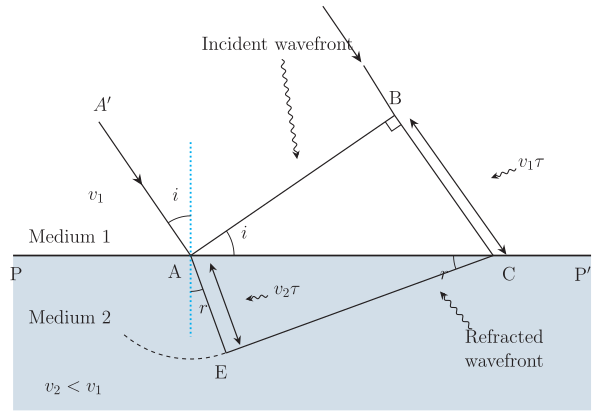
- Consider a plane wavefront AB incident on the interface PP' separating medium 1 (speed ) and medium 2 (speed ).
- The wavefront travels in the direction A'A, making an angle of incidence with the normal.
- Let be the time taken for the wavefront to travel from B to C. In this time, the distance covered in medium 1 is:
Step 2: Constructing the Refracted Wavefront
- From point A (on the interface), draw a sphere of radius in medium 2. This sphere represents the secondary wavelet from A after time .
- From point C (on the interface), draw a tangent plane to this sphere. The point of tangency is E.
- The line CE is the refracted wavefront. The distance AE is:
Step 3: Deriving Snell's Law
- In triangle ABC (in medium 1), the angle at A is . Using the right triangle:
- In triangle AEC (in medium 2), the angle at A is (angle of refraction). Using the right triangle:
- Dividing the two equations gives:
This is the law of refraction in terms of wave speeds.
Step 4: Physical Interpretation
- If (ray bends toward the normal), then , so . This means the speed of light is less in the denser medium.
- This prediction of wave theory is opposite to the corpuscular model and was confirmed by experiments.
Step 5: Introducing Refractive Indices
- The refractive index of a medium is defined as:
where is the speed of light in vacuum.
- Substituting into the ratio:
- Therefore, the law becomes Snell's law:
Step 6: Wavelength and Frequency
- Let and be the wavelengths in medium 1 and medium 2 respectively. …
Drawn by us to help you understand the concept clearly, and verified to make sure it's accurate. For exams, practice from your NCERT textbook's own diagram.
The figure shows a plane wavefront approaching a slanted interface from medium 1 (above, with wave speed ) toward medium 2 (below, with wave speed ). The interface is drawn as a straight line, and a normal (dashed line) is drawn perpendicular to it at point . The incident wavefront makes an angle with the interface — this is the angle of incidence.
- Point is the last point of the incident wavefront to touch the interface, reaching point after time .
- During this same time , a secondary wavelet (Huygens wavelet) spreads from point into medium 2 with speed , forming a sphere of radius .
- The refracted wavefront is the common tangent drawn from to that sphere. It makes an angle with the interface — the angle of refraction.
Two right triangles are highlighted:
- : right-angled at , with and as the hypotenuse.
- : right-angled at , with and as the common hypotenuse.
Because (medium 2 is denser), the refracted wavefront is bent toward the normal, so .
Key formulas derived from this figure
From :
From :
Dividing these gives the refraction law:
…