Q.(a) Explain VSEPR theory. Applying this theory to predict the shapes of IF7 and SF6.
a) CH3Br + KOH →
b) CH3-O-CH3 + HI →
You're viewing a preview — the full solution, concept, methods & PYQ mapping are locked.
Start your 14-day free trial to unlock the full solution →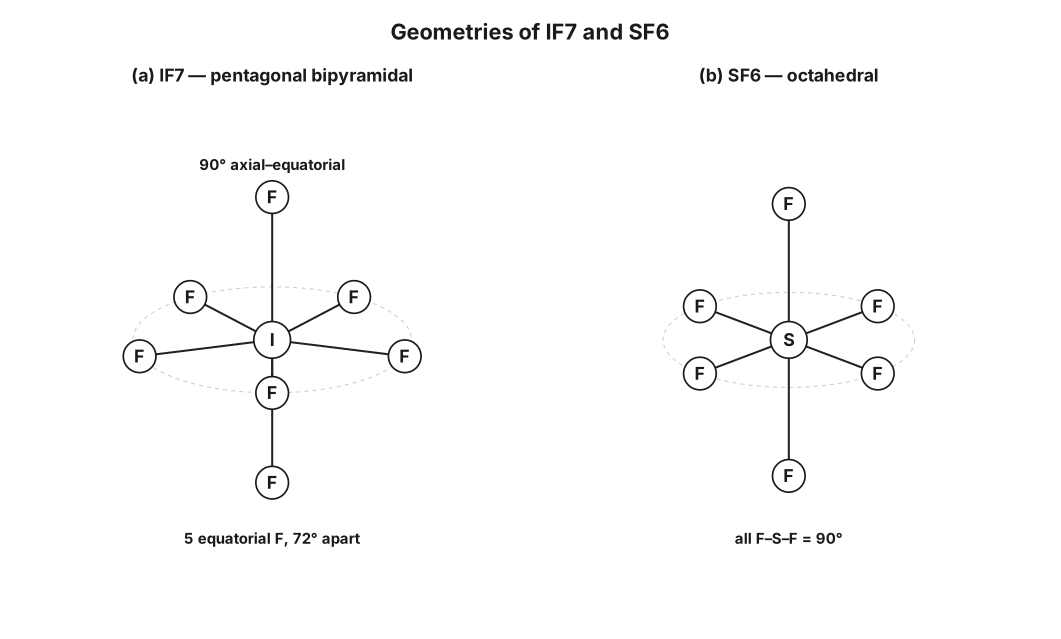
This is a 5-mark either/or question; both alternatives are answered below.
(a) VSEPR predicts IF7 is pentagonal bipyramidal (sp3d3) and SF6 is octahedral (sp3d2); (b) the two reactions give CH3OH and CH3I/CH3OH, and the three structures are acetaldehyde, 3-ethyl-2-methyl-1-pentene and 3-chlorobutan-1-ol.
PART (a) — VSEPR theory and shapes of IF7 and SF6:
VSEPR (Valence Shell Electron Pair Repulsion) theory states that the electron pairs (bonding and lone pairs) in the valence shell of the central atom repel one another and arrange themselves in space so as to be as far apart as possible, minimising repulsion; this arrangement decides the molecular shape. The order of repulsion strength is: lone pair-lone pair > lone pair-bond pair > bond pair-bond pair. Lone pairs therefore distort ideal bond angles.
- IF7: iodine is the central atom bonded to 7 fluorine atoms, with 7 bond pairs and no lone pairs. Seven electron domains give sp3d3 hybridisation and a pentagonal bipyramidal shape (five F in a pentagon in the equatorial plane, two F axial).
- SF6: sulphur is bonded to 6 fluorine atoms, with 6 bond pairs and no lone pairs. Six electron domains give sp3d2 hybridisation and a regular octahedral shape (all F-S-F angles 90°).
PART (b)(i) — Completing the reactions:
- CH3Br + KOH(aq) → CH3OH + KBr (nucleophilic substitution: OH- replaces Br- to give methanol). …
Unlock everything free for 14 days
- Full step-by-step solutions
- Concept-first explanations
- Methods, shortcuts & mistakes
- PYQ mapping + timed mock tests
Full access for 14 days. No credit card required.