Q.Write the marked parts in the given diagram.
You're viewing a preview — the full solution, concept, methods & PYQ mapping are locked.
Start your 14-day free trial to unlock the full solution →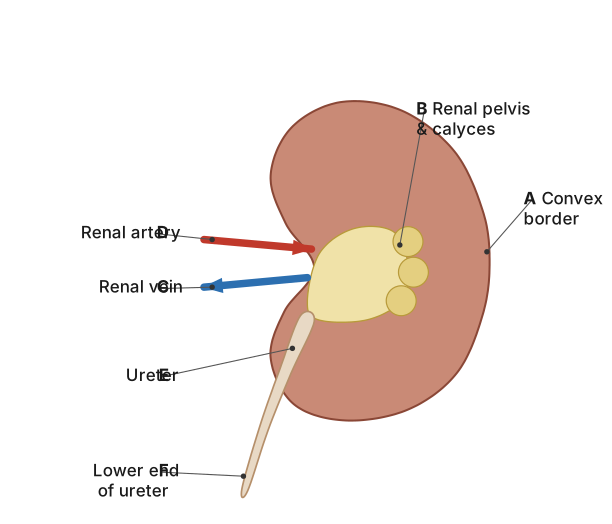
This is the standard external view of a bean-shaped kidney at its hilum, labelling the outer border, the renal pelvis, the renal vessels entering/leaving, and the ureter.
A kidney is bean-shaped, with a convex outer (lateral) border and a concave inner (medial) border. On the concave side there is a deep notch called the hilum (hilus), through which the renal artery enters the kidney, the renal vein and ureter leave it, and nerves and lymphatics also pass. Working through the description of the diagram's leader lines, from the topmost line to the lowest: the topmost line points to the outer, curved margin of the kidney's outline, which is simply its convex outer border (A). The next line points to an arrow drawn pointing INTO the hilum notch — this represents a vessel entering the kidney, which is the renal artery, carrying blood into the kidney to be filtered (D). Just below it, a line points to an arrow drawn pointing OUT of the same notch — this represents a vessel/duct leaving the kidney, which is the renal vein, carrying filtered blood away from the kidney (C). The next line points to the solid inner body of the kidney, drawn with several small rounded/triangular projections — this inner region, with its branching cup-like projections, represents the renal pelvis together with its calyces, the funnel-shaped cavity inside the kidney that collects urine from the renal papillae before it passes onward (B). The next line points to a narrow tube emergin …
Unlock everything free for 14 days
- Full step-by-step solutions
- Concept-first explanations
- Methods, shortcuts & mistakes
- PYQ mapping + timed mock tests
Full access for 14 days. No credit card required.