Informatics Practices · Ch 5 — Internet and Web
Gateway
Gateway
What a Gateway Is and Why It Matters
A gateway is exactly what its name suggests — a “gate” between an organisation’s internal network and the outside world of the Internet. Think of it as the single, controlled entry and exit point for all data traffic. Every piece of data that enters or leaves the network must first pass through the gateway. This makes the gateway a critical device for both connectivity and security.
How a Gateway Works
The gateway does more than just let data in and out. It also handles routing. When a device (a node) on one network wants to talk to a device on a completely different network — say, a computer in your office trying to reach a server in another country — it sends the data packet to the gateway. The gateway then examines the destination and forwards the packet along the best possible route.
To do this job well, the gateway maintains two kinds of information:
- Internal connection paths — the routes within its own host network.
- Identified paths of other remote networks — routes it has learned about to reach networks elsewhere.
Where You Find a Gateway in Everyday Life
For simple home Internet connections, the gateway is usually your Internet Service Provider (ISP). The ISP acts as the gate that gives your home network access to the entire Internet. In a more technical sense, a router is commonly configured to work as a gateway device in computer networks.
Implementation and Integration
A gateway is not limited to a single form. It can be implemented as:
- Software — a program running on a general-purpose computer.
- Hardware — a dedicated physical device.
- A combination of both — the most common approach in practice.
This flexibility exists because a network gateway is placed at the edge of a network — the boundary between the internal network and the outside. At that edge, security is a major concern, so a firewall is usually integrated with the gateway. The two often work together as a single unit.
Key Points to Remember
- A gateway serves as both the entry and exit point of a network. …
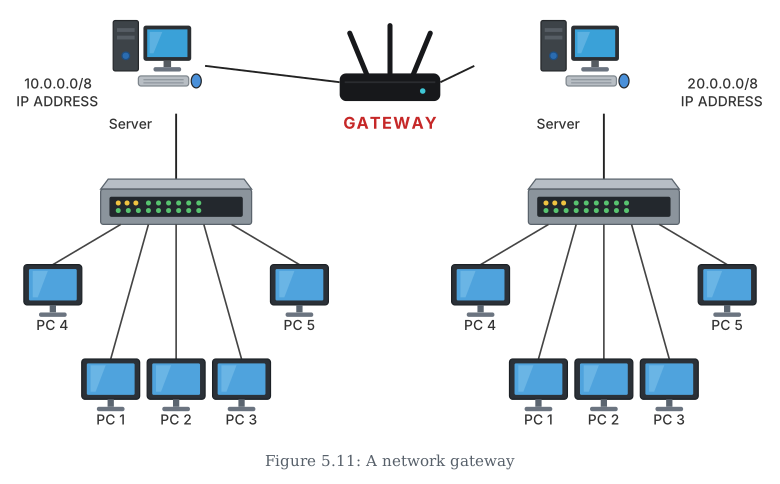
Drawn by us to help you understand the concept clearly, and verified to make sure it's accurate. For exams, practice from your textbook's own diagram.
The figure shows a gateway acting as the single point of connection between two separate networks. On the left side of the diagram is one network, labelled with the IP block 10.0.0.0/8. Inside this network are several PCs (labelled PC 1, PC 2, PC 3, PC 4, PC 5) and a single Server. On the right side is a second, independent network, labelled with the IP block 20.0.0.0/8. This network also contains its own set of PCs (again labelled PC 1 through PC 5) and a Server.
Between these two networks, in the centre of the schematic, is a box labelled GATEWAY. All the PCs and servers on the left network connect to this central gateway, and all the PCs and servers on the right network also connect to it. The key relationship shown is that no direct connection exists between the two networks — every piece of data that travels from a device on the left network to a device on the right network must first go to the gateway, which then forwards it to the destination. The same is true for data moving in the opposite direction.
The gateway is the only path between the two networks. A device on the 10.0.0.0/8 network cannot reach a device on the 20.0.0.0/8 network without passing through the gateway. …