Informatics Practices · Ch 5 — Internet and Web
Modem
Modem
A modem — short for MOdulator-DEModulator — is the device that makes it possible for computers to send and receive data over telephone lines or other analog transmission media.
Computers work with digital data: a stream of 0s and 1s. But the telephone network, and many other long-distance communication channels, carry analog signals — continuous waves that vary in frequency and amplitude. A modem bridges this gap. At the sender's end, the modem acts as a modulator: it converts the computer's digital bits into an analog signal that can travel over the medium (such as a telephone line or free space). At the receiver's end, a second modem acts as a demodulator: it converts the incoming analog signal back into digital bits that the destination computer can understand.
A modem is therefore required at both the source node and the destination node. Without a modem at each end, the conversion cannot happen in both directions, and the communication fails.
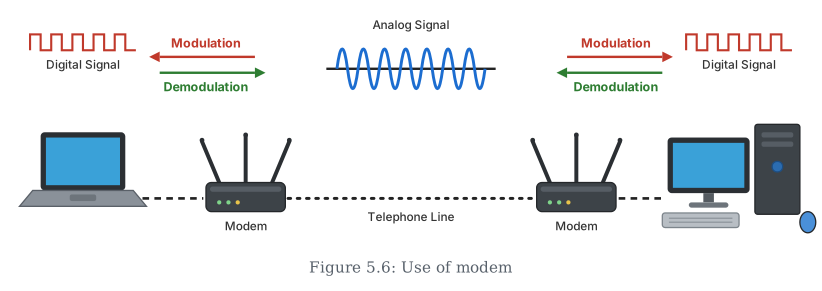
The textbook illustrates this with Figure 5.6, which shows a simple two-way path: a digital signal enters the first modem, is modulated into an analog signal that travels over a telephone line, and is then demodulated back into a digital signal by the second modem. The arrows in the figure are labelled "Modulation" (digital to analog) and "Demodulation" (analog to digital). …
Drawn by us to help you understand the concept clearly, and verified to make sure it's accurate. For exams, practice from your textbook's own diagram.
Figure 5.6 is a simple two‑node schematic that shows exactly one thing: how a pair of modems lets two computers communicate over a telephone line. The diagram is laid out horizontally, with a sending computer on the left, a receiving computer on the right, and a telephone line running between them.
At the left end, the sending computer is labelled Digital Signal — a stream of 0s and 1s. This signal enters the first modem, which is clearly marked Modem and also carries the label Modulation. Inside that modem, the digital bits are converted into an analog waveform (the modulation step). The analog signal then travels across the Telephone Line (drawn as a single line connecting the two modems) to the second modem on the right.
At the right end, the second modem is also labelled Modem, but here the label reads Demodulation. This modem takes the incoming analog signal and converts it back into digital bits (the demodulation step). The resulting digital signal then leaves the modem and enters the receiving computer, which is again labelled Digital Signal.
The figure uses arrows to show the direction of data flow: from left to right, from the sending computer through the first modem, across the telephone line, through the second modem, and into the receiving computer. The two key processes — Modulation and Demodulation — are placed directly on the respective modems, making it clear that each modem performs only one half of the conversion at its end. …