Q.The ratio of close packed atoms to tetrahedral hole in cubic packing is
Concept understanding — Close Packing — hcp, ccp and Voids
Building close-packed layers in the ABAB... pattern (Section 6.6.2, each sphere touching 6 neighbours) and stacking a third layer over them in two different ways gives the two most efficient 3D packings possible:
- aba stacking -> hexagonal close-packed (hcp): the third layer sits directly over the first.
- abc stacking -> cubic close-packed (ccp): the third layer is offset from BOTH earlier layers (built on the fcc unit cell).
Both reach coordination number 12 (6 in-layer + 3 above + 3 below) and a packing efficiency of ~74% -- the highest of any arrangement in this unit (derived from the fcc relation 4r = root-2*a, giving r = (root-2/4)a).
Voids. Stacking two close-packed layers creates two kinds of gap: a tetrahedral void (4 touching spheres, 3 from the lower layer + 1 from the upper, centres forming a tetrahedron) and an octahedral void (6 touching spheres, 3+3, centres forming an octahedron). If n is the number of close-packed spheres, the number of octahedral voids = n and the number of tetrahedral voids = 2n -- so the ratio of close-packed atoms to tetrahedral holes is always 1:2. This directly gives the formula of a compound where a second atom occupies some fraction of the voids of a ccp/fcc lattice of a first atom (e.g. atom M in ccp with atom N filling 1/3 of the tetrahedral voids: M:N = 4 : (1/3 x 8) = 4 : 8/3 = 3:2, formula M3N2).
n close-packed atoms generate 2n tetrahedral voids, so the ratio is 1:2.
(b) 1:2
Step 1. In a close-packed structure of n spheres, the number of octahedral voids generated equals n.
Step 2. The number of tetrahedral voids generated equals 2n -- twice the number of close-packed atoms.
Step 3. So the ratio of close-packed atoms (n) to tetrahedral holes (2n) is n:2n=1:2.
(b) 1:2
Recall the standard void-counting rule: octahedral voids = n, tetrahedral voids = 2n, for n close-packed spheres.
- Confusing this with the octahedral-void ratio (which is 1:1, not 1:2) -- the question specifically asks about tetrahedral holes.
- CBSE 2024Set ANNUAL1 markQ.Draw a neat labeled diagram of tetrahedral void.
›Reveal solutionSolution
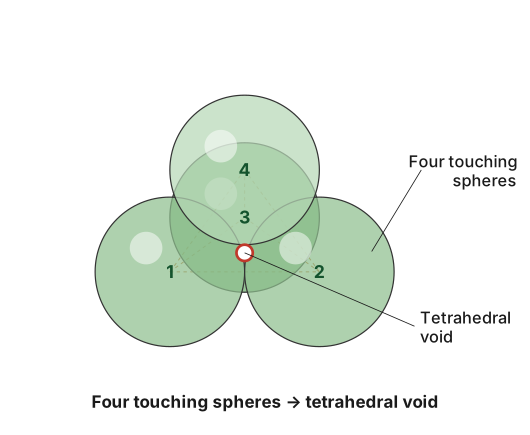
Figure — Neat labelled diagram of a TETRAHEDRAL VOID in a crystal lattice. Three mutually touching equal sphe A tetrahedral void is the empty space enclosed by 4 spheres whose centres form a tetrahedron.
In a close-packed structure, when a second layer of spheres is placed over the triangular hollows of the first layer, each sphere of the second layer sits directly above the depression left by 3 touching spheres of the first layer. This arrangement of 4 spheres — 3 in one layer forming a triangular base, plus 1 sitting in the hollow above them — encloses a small void at the centre. Because the line joining the centres of these 4 spheres traces out a regular tetrahedron (with the void at its centroid), this empty space is called a tetrahedral void.
Diagram description (labelled): draw 3 spheres of equal size touching each other, arranged in a triangle, representing one layer; draw a 4th identical sphere resting in the depression at the centre of the triangle, directly above (or below) the first three. Label the small enclosed gap at the centre, where the 4 spheres nearly meet, as the "tetrahedral void"; an arrow/label pointing from the centre of the triangle of contact points to this gap makes the labelling clear. Each sphere in a close-packed lattice generates 2 tetrahedral voids per sphere.
✓Final answerThe tetrahedral void is the small enclosed space formed when a 4th sphere rests in the triangular hollow of 3 touching spheres, with all 4 sphere-centres forming a tetrahedron around the void.
- CBSE 2023Set ANNUAL1 markMCQQ.The number of octahedral voids in the unit cell of ccp lattice is:(a) 2(b) 3(c) 4(d) 6
›Reveal solutionSolution
A ccp (cubic close-packed / face-centred cubic) unit cell has 4 octahedral voids, the same as its atom count.
In a ccp/fcc unit cell:
- Atoms per unit cell = 8 corner atoms x 1/8 + 6 face-centre atoms x 1/2 = 1 + 3 = 4.
- Octahedral void positions: 1 at the body centre (fully inside, counts as 1) + 12 edge-centre voids x 1/4 share = 3.
- Total octahedral voids = 1 + 3 = 4.
This illustrates the general rule: in any close-packed (ccp or hcp) structure, the number of octahedral voids equals the number of atoms (close-packed spheres) in the unit cell, while the number of tetrahedral voids is twice that.
✓Final answer(c) 4 octahedral voids per unit cell of ccp lattice.
- CBSE 2021Set TERM11 markMCQQ.If N is the number of closed packed sphere, then total number of tetrahedral voids generated is :(a) N(b) N/2(c) 2N(d) None of these
›Reveal solutionSolution
In a close-packed arrangement of N spheres, there are N octahedral voids and 2N tetrahedral voids.
In any close-packed structure (hcp or ccp/fcc) built from N spheres, each sphere contributes to voids in a fixed ratio: the number of octahedral voids = N and the number of tetrahedral voids = 2N (there are two tetrahedral voids for every sphere in the packing, located above and below each sphere along the body diagonal positions).
✓Final answerNumber of tetrahedral voids =2N (option c).
- CBSE 2020Set ANNUAL1 markQ.Atoms of element B (as anions) make CCP and those of element A (as cations) occupy all the octahedral voids. Predict the formula of the compound.
›Reveal solutionSolution
With B forming a ccp lattice and A filling every octahedral void (equal in number to the close-packed atoms), the ratio A:B is 1:1.
In a cubic close-packed (ccp) arrangement, the number of octahedral voids equals the number of atoms forming the close-packed lattice. If B forms the ccp lattice, ZB=4 per unit cell, and the number of octahedral voids is also 4. Since A occupies all the octahedral voids, ZA=4 too.
Ratio A:B=4:4=1:1, giving formula AB.
✓Final answerAB.
🎓Unlock everything free for 14 days
- ✓Full step-by-step solutions
- ✓Concept-first explanations
- ✓Methods, shortcuts & mistakes
- ✓PYQ mapping + timed mock tests
Full access for 14 days. No credit card required.