Q.Distinguish tetrahedral and octahedral voids.
You're viewing a preview — the full solution, concept, methods & PYQ mapping are locked.
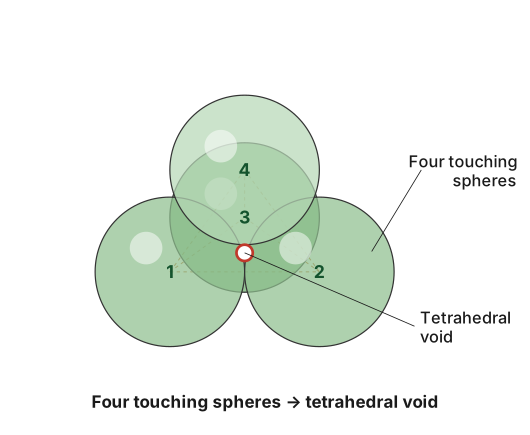
Start your 14-day free trial to unlock the full solution →Step 1. A tetrahedral void forms wherever a sphere of the upper layer sits directly above a void of the lower layer: it is bounded by 4 touching spheres in total (3 from the lower layer, 1 from the upper layer), and joining the centres of these 4 spheres traces out a tetrahedron.
Step 2. An octahedral void forms at the OTHER kind of gap in the lower layer, one that is only partially covered by the upper layer: it is bounded by 6 touching spheres in total (3 from the lower layer, 3 from the upper layer), and joining the centres of these 6 spheres traces out an octahedron.
Step 3. Because it is surrounded by more spheres, the octahedral void is geometrically larger than the tetrahedral void -- which is exactly why a bigger cation (higher radius ratio) tends to occupy an octahedral void, while a smaller cation occupies a tetrahedral void (Section 6.6.6, radius ratio rule). …
Unlock everything free for 14 days
- Full step-by-step solutions
- Concept-first explanations
- Methods, shortcuts & mistakes
- PYQ mapping + timed mock tests
Full access for 14 days. No credit card required.