Mathematics · Ch 6 — Applications of Vector Algebra
Intercept Form of the Equation of a Plane
6.8.3
Intercept Form of the Equation of a Plane
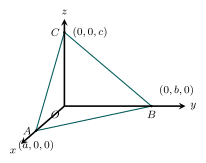
Suppose the plane meets the coordinate axes at with intercepts . Since lies on the plane, , i.e. ; similarly and . Substituting into gives , i.e. . Dividing throughout by gives the intercept form:
the equation of the plane cutting intercepts on the -axes respectively.
Theorem 6.16. Every first-degree equation in represents a plane. Proof. Rewrite it as , i.e. — the standard vector-form equation of a plane, with as its normal. …
Figure 6.26Fig. 6.26 — Intercept form of a plane meeting the axes at $A(a,0,0)$, $B(0,b,0)$ and $C(0,0,c)$
Drawn by us to help you understand the concept clearly, and verified to make sure it's accurate. For exams, practice from your textbook's own diagram.
What this figure shows. Fig. 6.26 — Intercept form of a plane meeting the axes at , and $C(0,0 …