Q.Explain dielectrics in detail and how an electric field is induced inside a dielectric.
You're viewing a preview — the full solution, concept, methods & PYQ mapping are locked.
Start your 14-day free trial to unlock the full solution →Step 1. What a dielectric is. A dielectric has no free charges; every electron remains bound within its own atom or molecule (examples: glass, mica, ebonite).
Step 2. Non-polar molecules. In molecules whose positive and negative charge centres normally coincide, an applied field displaces the two centres apart by a tiny distance, inducing a small dipole moment aligned with the field.
Step 3. Polar molecules. In molecules that already possess a permanent dipole moment (e.g. water) but are normally randomly oriented by thermal motion, the applied field exerts a torque () that partially aligns them, giving a net polarisation.
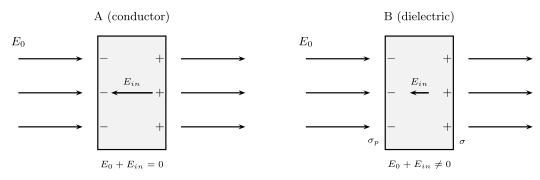
Step 4. Induced internal field. The resulting polarised material -- filled with a huge number of roughly aligned dipoles -- produces its own internal field that points opposite to the applied external field , since the aligned dipoles' own field opposes the field that caused the alignment. …
Unlock everything free for 14 days
- Full step-by-step solutions
- Concept-first explanations
- Methods, shortcuts & mistakes
- PYQ mapping + timed mock tests
Full access for 14 days. No credit card required.