Q.Describe the internal structure of a dicot root.
You're viewing a preview — the full solution, concept, methods & PYQ mapping are locked.
Start your 14-day free trial to unlock the full solution →A dicot root T.S. shows epiblema, cortex, endodermis with Casparian strips, pericycle, and 2-4 radial, exarch xylem strands alternating with phloem around a small pith - the radial, exarch, limited bundles being characteristic.
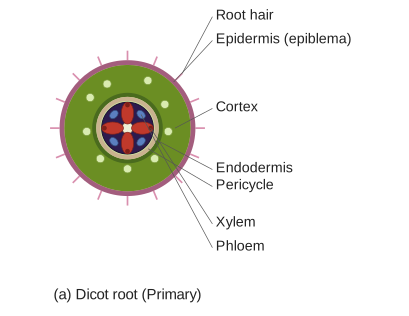
Internal structure (T.S.) of a dicot root - from the periphery to the centre:
- Epiblema (epidermis / piliferous layer):
-
The outermost single layer of cells; it has NO cuticle and NO stomata.
-
Some of its cells extend outward as unicellular ROOT HAIRS, which absorb water and minerals from the soil.
- Cortex:
-
A broad zone of several layers of thin-walled parenchyma with large intercellular spaces.
-
It stores food and helps in the conduction of absorbed water towards the inner tissues. (No chlorophyll is present.)
- Endodermis:
-
The innermost, single layer of the cortex, made of barrel-shaped cells fitted closely without spaces.
-
Their radial and inner tangential walls have band-like thickenings of suberin called CASPARIAN STRIPS, which regulate the flow of water into the vascular tissue. Thin-walled passage cells lie opposite the xylem strands.
- Pericycle:
-
A single layer (sometimes more) of thin-walled parenchyma just inside the endodermis.
-
It gives rise to LATERAL (secondary) roots and, later, takes part in secondary growth (formation of part of the cambium).
- Vascular tissue (stele):
- Xylem and phloem occur as separate strands arranged in a RADIAL manner (they lie on different radii, alternating with each other) - NOT in the same bundle.
- The number of xylem strands is limited: usually 2 (diarch), 3 (triarch) or 4 (tetrarch) in dicot roots.
- Xylem is EXARCH (protoxylem lies towards the periphery and metaxylem towards the centre). …
Unlock everything free for 14 days
- Full step-by-step solutions
- Concept-first explanations
- Methods, shortcuts & mistakes
- PYQ mapping + timed mock tests
Full access for 14 days. No credit card required.