Question of 38
Q.Explain the structure of dicot root with diagram. State two functions of stomata. OR Explain the anatomy of monocot stem with diagram. State the function of endodermis.
Haryana BsehBoard of School Education Haryana (Senior Secondary Part-I / Class 11) 2026Subjective· 4mImportance★★★★★
0% · 0/38 Questions
You're viewing a preview — the full solution, concept, methods & PYQ mapping are locked.
Start your 14-day free trial to unlock the full solution →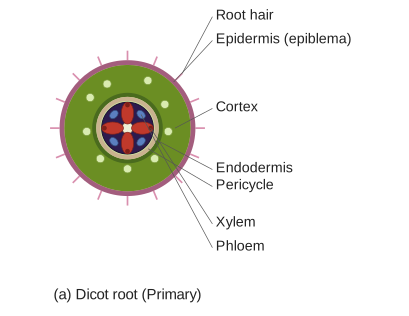
A dicot root's transverse section is organised in concentric layers from a protective outer epiblema down to a central radial arrangement of xylem and phloem with few xylem arches — a structure well suited to anchorage, absorption, and eventual secondary thickening.
Structure of a dicot root (as would be labelled on a diagram), outside to inside:
- Epiblema — outermost single-celled layer, without a cuticle or stomata, bearing unicellular root hairs for absorption.
- Cortex — several layers of thin-walled, loosely arranged parenchyma cells (with intercellular spaces) for storage and radial movement of water.
- Endodermis — the innermost, single-layered ring of the cortex; its cells bear characteristic Casparian strips (waxy suberin bands) on their radial and transverse walls, forcing water to pass through the cell membrane (not between cells) to enter the vascular tissue — a key checkpoint for selective mineral uptake.
- Pericycle — a layer just inside the endodermis, from which lateral roots originate and which also contributes to secondary growth (vascular cambium formation).
- Vascular bundles (stele) — arranged radially, with xylem and phloem on alternating radii, not fused into one bundle as in stems; xylem is exarch (protoxylem points outward, toward the periphery; metaxylem is central); the number of xylem arches is few — described as diarch to hexarch (2 to 6) in dicots.
- Pith — usually small or absent, since the centre is largely occupied by xylem.
- Later, a cambium forms between the xylem and phloem (from pericycle and conjunctive tissue), enabling secondary growth — thickening of the root, a feature unique to dicots among the two root types.
Two functions of stomata:
- Gas exchange — stomata allow CO₂ to diffuse into the leaf for photosynthesis and O₂ (a photosynthetic byproduct) to diffuse out, and also allow O₂ in / CO₂ out during respiration. …
Unlock everything free for 14 days
- Full step-by-step solutions
- Concept-first explanations
- Methods, shortcuts & mistakes
- PYQ mapping + timed mock tests
Full access for 14 days. No credit card required.