Question of 38
Q.Describe the internal structure of a dicot root.
Telangana TsbieTelangana Board of Intermediate Education (Intermediate 1st Year) 2026Subjective· 8mImportance★★★★★
0% · 0/38 Questions
You're viewing a preview — the full solution, concept, methods & PYQ mapping are locked.
Start your 14-day free trial to unlock the full solution →A dicot root (T.S.) shows epiblema (with root hairs), cortex, endodermis with Casparian strips, pericycle, radial and exarch vascular bundles (2-6 xylem strands, diarch to hexarch), conjunctive tissue, and little or no pith.
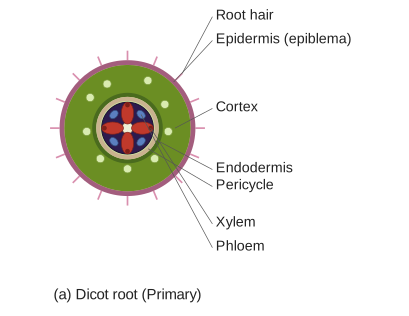
Internal structure of a dicot root (transverse section):
From the periphery towards the centre, the following tissues are seen:
1. Epiblema (Piliferous layer / Rhizodermis):
- The outermost single layer of cells. It has no cuticle and no stomata, but many cells extend outwards as unicellular root hairs for absorption of water and minerals.
2. Cortex:
- A broad zone of several layers of thin-walled parenchyma cells with prominent intercellular spaces. It stores food and helps in the conduction of absorbed water towards the inner tissues.
3. Endodermis:
- The innermost layer of the cortex, made of a single row of barrel-shaped cells fitted without intercellular spaces. Their radial and inner tangential walls bear band-like thickenings of suberin called Casparian strips, which regulate the flow of water into the vascular tissue. Some thin-walled passage cells (opposite the xylem) allow water to pass.
4. Pericycle:
- A layer (one or few cells thick) of parenchyma just inside the endodermis. It gives rise to lateral (branch) roots and takes part in secondary growth (formation of cambium and cork cambium).
5. Vascular tissue (stele):
- The vascular bundles are radial - the xylem and phloem lie on separate radii, alternating with each other.
- The xylem is exarch (protoxylem towards the periphery, metaxylem towards the centre).
- The number of xylem strands is limited (2 to 6): diarch (2), triarch (3), tetrarch (4)... up to hexarch - a characteristic feature distinguishing dicot roots (dicot roots are diarch to hexarch, i.e. oligarch) from monocot roots (polyarch). …
Unlock everything free for 14 days
- Full step-by-step solutions
- Concept-first explanations
- Methods, shortcuts & mistakes
- PYQ mapping + timed mock tests
Full access for 14 days. No credit card required.