Mathematics · Ch 4 — Straight Lines
Intercept - Form
Intercept - Form
The Intercept Form of a Line
When a line crosses the coordinate axes, the points where it meets the x-axis and y-axis are especially easy to work with. Suppose a line cuts the x-axis at a distance from the origin, and the y-axis at a distance from the origin. These distances are called the x-intercept and y-intercept, respectively.
Intercepts are signed lengths. If the line meets the x-axis to the left of the origin, is negative. If it meets the y-axis below the origin, is negative. The intercept form works for all real values of and , except or (the line would then pass through the origin, and the form breaks down).
Since the line meets the x-axis at and the y-axis at , we have two known points. The two-point form of a line gives us a direct way to write its equation.
Deriving the Intercept Form
Let the line pass through and . Using the two-point form:
Simplify the right-hand side:
Cross-multiply:
Expand:
Bring all terms to one side:
Now divide both sides by (provided and ):
This is the intercept form of the equation of a line. The numbers and are the x-intercept and y-intercept, respectively.
The intercept form is a special case of the general linear equation . If you multiply through by , you get , which is in general form with , , and .
Worked Example
Example 8: Find the equation of the line which makes intercepts and on the x- and y-axes respectively.
Solution: Here and . Substitute directly into the intercept form:
Multiply through by the common denominator 6 to clear fractions:
Or, rearranged:
This is the required equation.
When an intercept is negative, the corresponding term in the intercept form becomes negative. For instance, is the same as . Always keep the sign with the intercept value.
Key Points to Remember
- The intercept form is valid only when both and are non-zero. If either intercept is zero, the line passes through the origin, and you must use another form (like slope-intercept or two-point).
- The intercepts are the actual coordinates where the line meets the axes: and . …
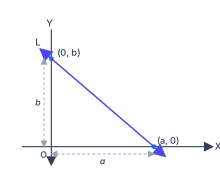
Drawn by us to help you understand the concept clearly, and verified to make sure it's accurate. For exams, practice from your textbook's own diagram.
Figure 9.13 is a simple coordinate-plane sketch that shows a straight line crossing both axes. The line is drawn with double arrows at its ends to indicate it extends infinitely in both directions. It meets the x-axis at the point and the y-axis at the point . Two dashed segments are marked along the axes: one from the origin to along the x-axis, labelled with length ; another from the origin to along the y-axis, labelled with length . These are the intercepts — the distances (with sign) at which the line cuts the axes.
The physical idea is simple: if you know where a line hits the two axes, you can write its equation directly, without needing the slope. The intercepts and completely determine the line, provided neither is zero. The figure makes this geometric fact visual — the line is pinned down by its two axis-crossing points.
The textbook uses the two-point form of a line to derive the equation. Since the line passes through and , the slope is . Using point-slope form with :
Multiplying out: . Rearranging gives .
This is the intercept form of the equation of a line. Here is the x-intercept (the x-coordinate where the line meets the x-axis) and is the y-intercept (the y-coordinate where the line meets the y-axis). Both and can be positive, negative, or zero — but if either is zero, the line passes through the origin and the intercept form fails (the corresponding term becomes undefined). In that case you use a different form. …