Mathematics · Ch 4 — Straight Lines
Point-slope Form
Point-slope Form
The Point-Slope Form: Building the Equation from a Point and a Slope
We now move from the slope-intercept form, which requires the y-intercept, to a more general method. Suppose you know a line's slope and any one point that lies on it — not necessarily where it crosses the y-axis. Can you still write its equation? Yes, and the result is the point-slope form.
Consider a non-vertical line with slope . Let be a fixed point on . Now take any other point on the same line. Because both points lie on , the slope calculated between them must equal .
Recall the slope formula: for two points and , slope . Applying this to and :
This is true for every point on (except itself, where the denominator would be zero). Multiply both sides by to clear the denominator:
This single equation is the point-slope form of the line. It is satisfied by the coordinates of every point on , and by no other point in the plane. The fixed point and the slope completely determine the line.
Point-Slope Form
where is the slope and is a known point on the line.
This form fails for vertical lines. A vertical line has an undefined slope ( is not a real number), so the equation cannot be written. Vertical lines are handled separately with the equation .
Worked Example: Applying the Point-Slope Form
Example 5 (from the textbook): Find the equation of the line through with slope .
Solution.
Here the given point is and the slope is . Substitute directly into the point-slope formula:
…
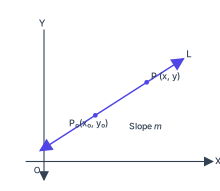
Drawn by us to help you understand the concept clearly, and verified to make sure it's accurate. For exams, practice from your textbook's own diagram.
The figure shows a single straight line drawn in the first quadrant of the -plane. The line rises as it moves from left to right — it has a positive slope . Two points are marked on this line. The first is a fixed point labelled . The second is an arbitrary point labelled , which can slide anywhere along the line. A small label beneath the line reads "Slope ".
The axes are the standard -axis (horizontal) and -axis (vertical). No grid lines, curves, or other panels appear. The entire teaching point of the diagram is to show that any point on the line, together with the fixed point , gives the same slope when you compute rise over run.
The physical idea is simple: a non-vertical line has a constant slope. If you know one point on the line and the slope, you can locate every other point on that line. The figure makes this concrete by showing two points and the horizontal and vertical distances between them.
From the fixed point to the arbitrary point , the vertical change (rise) is and the horizontal change (run) is . Since the slope is the same everywhere on the line, we have:
Multiplying both sides by gives the point-slope form of the equation of a line:
Here:
- is the slope of the line,
- are the coordinates of the fixed point ,
- are the coordinates of any point on the line.
This single equation is satisfied by every point on the line and by no point off the line. That is what makes it the equation of the line. …