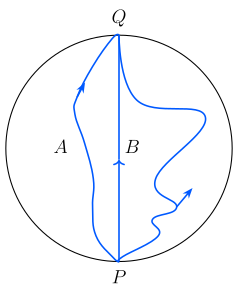
Q.Three girls skating on a circular ice ground of radius 200m start from a point P on the edge of the ground and reach a point Q that is diametrically opposite to P, each following a different path across the ground. The first girl follows a curved path that bulges out to the left, the second girl travels along the straight diameter directly from P to Q, and the third girl follows a wavy (zig-zag) path that bulges out to the right, as shown below.
Figure 3.19
What is the magnitude of the displacement vector for each girl? For which girl is this magnitude equal to the actual length of the path she skated?
Displacement Magnitude — The Straight-Line Shortcut
Imagine you walk 3 steps east, then 4 steps north. You end up at a spot that's not 7 steps away from where you started — it's only 5 steps away, diagonally. That 5 steps is your displacement magnitude.
Here's the core idea: displacement magnitude is the straight-line distance between where you began and where you ended. It doesn't care about the twists and turns of your actual path. It's the "as the crow flies" distance.
The Precise Definition
Displacement is a vector — it has both a direction and a magnitude. The magnitude of displacement (often written as ∣s∣ or simply s) is the length of that vector. Mathematically, if your initial position is (x1,y1) and your final position is (x2,y2), then:
∣s∣=(x2−x1)2+(y2−y1)2
This is just the distance formula from coordinate geometry. For the 3-step east, 4-step north example:
∣s∣=32+42=9+16=25=5 units
Watch out
Never confuse displacement magnitude with total distance travelled. In the example above, the total distance walked was 3+4=7 units, but the displacement magnitude was only 5 units. They are equal only when you move in a perfectly straight line without changing direction.
Why This Matters in Physics
In kinematics problems, displacement magnitude tells you the net effect of motion. When a car drives around a circular track and returns to the starting point, its displacement magnitude is zero — even though it travelled hundreds of metres. The car ended up exactly where it began.
For motion along a straight line (say, the x-axis), the displacement magnitude simplifies to:
∣s∣=∣x2−x1∣
That's just the absolute difference between final and initial positions. No square roots needed.
A Quick Check
If a particle moves from x=2 m to x=−3 m, what's the displacement magnitude? …
The displacement is the straight P-to-Q line, which equals the diameter 2R=400m for all three girls. It equals the path length only for the girl who skates along the straight diameter.
Displacement depends only on the endpoints. Since P and Q are diametrically opposite, ∣displacement∣=2R=2×200=400m for every girl. Path length equals this only when the route is a straight line — the middle girl on the diame …
All three girls start at P and finish at the diametrically opposite point Q, so each has the same displacement — a straight P-to-Q line whose magnitude equals the diameter, 2×200=400m. Only the girl who skates along the straight diameter has a path length equal to this displacement.
Concept
The displacement is the straight-line vector from the initial position to the final position; its magnitude depends only on the endpoints, not on the route taken. The path length depends on the actual route travelled and is always greater than or equal to the displacement magnitude.
Given
Radius of the ground R=200m.
P and Q are diametrically opposite, so the segment PQ is a diameter.
Displacement magnitude
Because all three girls begin at P and end at Q,
∣displacement∣=PQ=2R=2×200=400m
for each of them, regardless of the curved route followed.
Concept: Coordinates Plus the Shortest-Path Theorem
Method: Place P,Q on Coordinates, Compute Displacement by the Distance Formula, Then Invoke the Shortest-Path Theorem for the Path-Length Comparison
Rather than reasoning purely verbally ("displacement only depends on endpoints"), this method sets up explicit coordinates for P and Q, computes the displacement vector's magnitude directly by the distance formula, and then settles the path-length question by citing the general mathematical theorem that a straight line is the unique shortest curve joining two points.
Step 1 -- Place the circle on coordinates
Let the centre of the circular ground be the origin, with radius R=200m. Since P and Q are diametrically opposite, place them at the two ends of a diameter along the x-axis:
P=(−200,0),Q=(200,0)
Step 2 -- Displacement vector, by the distance formula
The displacement for any of the three girls is the same vector PQ, since all three start at P and end at Q -- regardless of the route taken between:
PQ=Q−P=(200−(−200),0−0)=(400,0)
∣PQ∣=4002+02=400m
Step 3 -- Invoke the shortest-path theorem for the path-length question
A standard theorem of Euclidean geometry states: among all curves connecting two given points, the straight-line segment joining them is the unique curve of minimum length; every other curve connecting the same two points is strictly longer.
Applying this directly:
The middle girl's path is the straight segment PQ itself, so her path length equals exactly ∣PQ∣=400m -- matching the displacement magnitude exactly. …
Same / Similar Concept — real previous-year questions on the same or a closely similar concept, not this exact question.
TG EAPCET 2025Set eng-2025-05-02-AN1 markMCQ
Q.Two bodies are projected from the same point with the same initial velocity 'u' making angles 'θ' and (90∘−θ) with the horizontal in opposite directions. The horizontal distance between their positions when the bodies are at their maximum heights is
(A) 2gu2(sin2θ−cos2θ)
(B) 2gu2sin2θ
(C) gu2
(D) gu2sin2(90∘−θ)
›Reveal solutionSolution
The key idea is that at maximum height, each projectile has zero vertical velocity and has covered half its horizontal range; the horizontal separation between them is simply the sum of their individual half‑ranges, which simplifies to 2gu2sin2θ.
Concept & Intuition
When two projectiles are launched from the same point with the same speed but at complementary angles (θ and 90∘−θ), their trajectories are symmetric. At the instant each reaches its maximum height, the vertical velocity is zero, and the horizontal velocity remains constant (ucosθ for the first, usinθ for the second). The horizontal distance each has traveled from the launch point at that moment is exactly half its total range. The total separation between them is the sum of these two half‑ranges, because they are thrown in opposite directions.
Time to reach maximum height
For a projectile launched at angle θ with speed u, the vertical component is usinθ. At the top, vy=0, so
0=usinθ−gt⇒t=gusinθ.
Horizontal distance covered in that time
Horizontal velocity is constant: ucosθ. So the horizontal distance from the launch point at maximum height is
x1=(ucosθ)⋅gusinθ=gu2sinθcosθ.
For the second projectile (angle 90∘−θ)
Its horizontal velocity is ucos(90∘−θ)=usinθ, and its time to maximum height is
t′=gusin(90∘−θ)=gucosθ.
Hence its horizontal distance from the launch point at maximum height is
x2=(usinθ)⋅gucosθ=gu2sinθcosθ.
Separation when both are at their maximum heights
Since they are thrown in opposite directions, the total horizontal distance between them is
x1+x2=gu2sinθcosθ+gu2sinθcosθ=g2u2sinθcosθ.
Using the identity 2sinθcosθ=sin2θ, we get
Separation=gu2sin2θ.
Watch out
A common mistake is to think the separation is the difference of the half‑ranges, but because the projectiles go in opposite directions, the distances add. …
Q.The maximum range of a projectile is 80 m. If the projectile is projected with the same speed at an angle of 12π with the horizontal, then the range of the projectile is
(A) 40 m
(B) 80 m
(C) 20 m
(D) 60 m
›Reveal solutionSolution
The maximum range occurs at 45° and gives us the launch speed; projecting at 15° yields half that maximum range because sin(30°)=21.
The range of a projectile depends on both the launch speed and the angle. Maximum range is achieved at 45° (or 4π radians), and knowing this maximum lets us work backward to find the launch speed. Once we have the speed, we can calculate the range at any other angle.
The range formula is
R=gu2sin(2θ)
where u is the launch speed, θ is the angle of projection, and g is acceleration due to gravity.
At maximum range, θ=4π, so sin(2θ)=sin(2π)=1. This gives
Rmax=gu2=80 m
This tells us that gu2=80 m, which is the key quantity we need.
Now we find the range when the projectile is launched at θ=12π (which is 15°):
Calculate the angle term: We need sin(2θ) where θ=12π.
Q.Two particles execute simple harmonic motion (SHM) along close parallel lines. SHM of the both the particles have same frequency and same amplitude. When they pass each other moving in opposite direction each time, their displacement is half their amplitude. Then their phase difference is
(A) 0
(B) 2π/3
(C) π/3
(D) π/2
›Reveal solutionSolution
When two particles in SHM with the same amplitude and frequency pass each other at half their amplitude while moving in opposite directions, their phase difference is 2π/3.
The motion of a particle executing Simple Harmonic Motion (SHM) can be described by its displacement from the equilibrium position as a function of time. The key to solving this problem lies in correctly interpreting the conditions given for the displacement and velocity of the two particles at the moment they pass each other.
Concept and Intuition
A particle undergoing SHM has a displacement x(t) given by:
x(t)=Asin(ωt+ϕ)
where A is the amplitude, ω is the angular frequency, t is time, and ϕ is the initial phase constant. The term (ωt+ϕ) is the instantaneous phase of the particle.
The velocity v(t) of the particle is the time derivative of its displacement:
v(t)=dtdx=Aωcos(ωt+ϕ)
The problem states that both particles have the same frequency (ω) and same amplitude (A). Let their initial phase constants be ϕ1 and ϕ2. We are looking for the phase difference, which is ∣ϕ1−ϕ2∣.
When the particles "pass each other," it means their displacements are equal at that instant. The condition "moving in opposite direction" means their velocities must have opposite signs at that same instant. The specific displacement is given as "half their amplitude," meaning x=A/2.
We will set up the equations for displacement and velocity for both particles, apply these conditions, and then solve for the phase difference.
Step-by-Step Derivation
Set up the equations for displacement and velocity:
Let the displacement equations for the two particles be:
x1(t)=Asin(ωt+ϕ1)
x2(t)=Asin(ωt+ϕ2)
Their corresponding velocity equations are:
v1(t)=Aωcos(ωt+ϕ1)
v2(t)=Aωcos(ωt+ϕ2)
We are interested in the phase difference, $\Delta\phi = |\phi_1 - \phi_2|$.
2. Apply the displacement condition:
At the moment they pass each other, their displacements are equal and half their amplitude. Let this time be t0.
x1(t0)=x2(t0)=2A
Substituting this into the displacement equations:
Asin(ωt0+ϕ1)=2A⟹sin(ωt0+ϕ1)=21
Asin(ωt0+ϕ2)=2A⟹sin(ωt0+ϕ2)=21
Let $\theta_1 = \omega t_0 + \phi_1$ and $\theta_2 = \omega t_0 + \phi_2$. Then we have:
sin(θ1)=21andsin(θ2)=21
This means that $\theta_1$ and $\theta_2$ can be $\pi/6$ (first quadrant) or $5\pi/6$ (second quadrant), or angles coterminal with these.
3. Apply the velocity condition:
At the same instant t0, the particles are moving in opposite directions. This means their velocities have opposite signs:
v1(t0)=−v2(t0)
Substituting the velocity equations:
Aωcos(ωt0+ϕ1)=−Aωcos(ωt0+ϕ2)
Dividing by $A\omega$ (since $A \neq 0, \omega \neq 0$):
cos(θ1)=−cos(θ2)
Combine conditions to find the phase difference:
We have two conditions for θ1 and θ2:
sin(θ1)=21 and sin(θ2)=21
cos(θ1)=−cos(θ2)
From condition (i), θ1 and θ2 must be angles whose sine is 1/2. These are typically π/6 or 5π/6 (within the range [0,2π)).
Let's consider the possible values for θ1:
Case 1: If θ1=π/6
Then cos(θ1)=cos(π/6)=23.
From condition (ii), cos(θ2)=−cos(θ1)=−23. …