Q.A cyclist starts from the centre O of a circular park of radius 1 km. She first rides straight out along a radius to the edge P of the park (with O at the centre and the radius OP pointing horizontally to the right). She then rides a quarter of the way around the circumference from P to a point Q on the edge, where Q is positioned so that the radius OQ is perpendicular to OP (i.e. Q lies directly above O). Finally she returns straight from Q back to the centre O along the radius QO, as shown below.
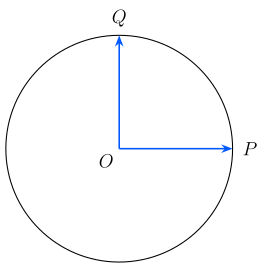
🔒You're viewing a preview — the full solution, concept, methods & PYQ mapping are locked.
🔒 Start your 14-day free trial to unlock the full solution →Concept understanding — Average Speed vs Velocity
Average Speed vs Velocity: The Intuition First
Imagine you're walking home from school. You take a shortcut through a park, then stop to buy a snack, then realise you forgot something and run back a bit, then finally walk home. By the time you reach your front door, you've walked a total of 2 km — but your house is only 500 metres from school in a straight line.
That difference — between the total ground you covered and how far you actually ended up from where you started — is the entire point of speed vs velocity.
The Precise Definitions
Average speed is a measure of how fast something is moving overall. It cares only about the total distance travelled, not the direction.
Average speed=Total time takenTotal distance travelled
Average velocity is a measure of how fast and in what direction something is moving overall. It cares about the net displacement — the straight-line distance from start to finish, with a direction.
Average velocity=Total time takenDisplacement
Displacement is the straight-line distance from the starting point to the ending point, with a direction. Distance is the total length of the actual path travelled, with no direction.
The Key Difference in One Sentence
Speed is a scalar (just a number, like 5 km/h). Velocity is a vector (a number and a direction, like 5 km/h north).
That one word — direction — changes everything.
A Concrete Example
You walk 3 km east, then 4 km north. The whole trip takes 1 hour.
- Total distance travelled = 3 + 4 = 7 km
- Displacement = straight line from start to finish = 32+42=5 km, northeast
Now compute:
Average speed=1 h7 km=7 km/h
Average velocity=1 h5 km, northeast=5 km/h, northeast
A common mistake: students think average velocity is just "speed with direction". It's not. It's displacement divided by time, not distance divided by time. If you walk in a circle and return to your starting point, your displacement is zero — so your average velocity is zero, even though your average speed is positive.
When Are They Equal?
Only when the motion is in a straight line without changing direction. If you walk 2 km east in a straight line, then distance = displacement, so average speed = magnitude of average velocity.
But the moment you turn, or stop, or go backwards — they diverge.
Why This Matters for Exams
In Indian board exams (CBSE, ICSE, state boards), you will be asked to:
- Distinguish between speed and velocity (scalar vs vector)
- Calculate average speed and average velocity from given data …
The cyclist ends where she started (at O), so the net displacement and the average velocity are both zero. The average speed is the total distance (2+2π≈3.57 km) divided by 10 min, about 21.4 km/h. …
The cyclist begins and finishes at the centre O, so her net displacement is zero and therefore her average velocity is also zero. Her average speed, however, is not zero: it is the total distance travelled (2+2π≈3.57 km) divided by the 10 min trip time, giving about 21.4 km/h.
Concept
Displacement is the straight-line vector from the starting point to the finishing point. Average velocity =timedisplacement (a vector), while average speed =timetotal path length (a scalar). When start and end coincide, displacement is zero even though the distance travelled is not.
The three legs of the trip
- OP (radius, out to the edge) =R=1 km.
- Arc PQ (a quarter of the circumference) =41(2πR)=41(2π×1)=2π km≈1.571 km.
- QO (radius, back to the centre) =R=1 km.
(a) Net displacement
The cyclist starts at O and returns to O, so the initial and final positions are the same:
net displacement=0.
(b) Average velocity
vˉ=timenet displacement=10 min0=0.
(c) Average speed …
Concept: Displacement Is Defined by Endpoints Alone — Skip the Vector Sum Entirely
Method: Position-Vector Definition First (No Leg-by-Leg Vector Addition), Arc Length via s=rθ
Both existing solutions implicitly treat the trip as three legs and could in principle add them as vectors to find displacement. This method skips that step altogether: displacement is defined as rfinal−rinitial, so the moment we notice the cyclist's final position coincides with her initial position, the vector sum is already known to be zero — no need to ever write down the individual leg vectors for OP, arc PQ, or QO. For the speed half of the question, this method also uses the general arc-length formula s=rθ (radian measure) rather than "a quarter of the circumference," which generalizes immediately to any fraction of a circle without re-deriving a new fraction each time.
Step 1 — Displacement, straight from the definition
By definition, for any journey, however winding:
d=rfinal−rinitial
The cyclist's journey is O→P→Q→O — she starts at O and the last leg explicitly returns her to O. So rfinal=rinitial=rO, and:
d=rO−rO=0
This holds regardless of the shape of the middle leg (arc PQ) or how far out the radius R is — any closed trip has zero displacement, by the definition alone.
Step 2 — Average velocity follows immediately
vavg=td=10 min0=0
Step 3 — Average speed needs the actual path length, via s=rθ
Unlike displacement, speed genuinely depends on the shape walked, so here the individual legs must be added — but as scalar lengths, not vectors.
- OP=R=1 km (radius).
- Arc PQ: the radius sweeps through θ=90∘=2π rad (from OP to OQ, a right angle since OQ⊥OP). Using s=rθ directly in radians:
sPQ=Rθ=(1 km)(2π)=2π km≈1.571 km
- QO=R=1 km.
Total path length: …
- TG EAPCET 2025Set ap-2025-04-29-FN1 markMCQQ.A motor cyclist is travelling towards north with a uniform speed of 10ms−1 and a train is travelling towards north-west with a uniform speed of 102ms−1. The direction of motion of the motor cyclist as observed by a passenger in the train is (A) East (B) West (C) North (D) South
›Reveal solutionSolution
The key is to find the relative velocity of the motorcyclist with respect to the train. The motorcyclist appears to move East relative to the passenger in the train.
The problem is about relative motion in two dimensions. When you are inside a moving train and look at a motorcyclist outside, what you see is not the motorcyclist’s actual velocity, but the velocity of the motorcyclist relative to you — that is, the vector difference between the motorcyclist’s velocity and the train’s velocity.
The motorcyclist goes north at 10 m/s. The train goes north-west at 102 m/s. North-west means exactly halfway between north and west — a direction that makes a 45∘ angle with both north and west. So the train’s velocity has equal components northward and westward.
We want the direction of the motorcyclist as seen from the train. That is the direction of the relative velocity vector vMT=vM−vT.
-
Set up coordinates. Let north be the +y direction and east be the +x direction. Then:
- Motorcyclist’s velocity: vM=10 j^ m/s.
- Train’s velocity: north-west means 45∘ west of north. So its components are:
- Northward: 102cos45∘=102×21=10 m/s.
- Westward: 102sin45∘=10 m/s.
- Since west is the negative x-direction, vT=−10 i^+10 j^ m/s.
-
Find the relative velocity. The velocity of the motorcyclist as seen by the passenger in the train is:
vMT=vM−vT=(10 j^)−(−10 i^+10 j^)=10 i^ m/s.
That is, vMT=10 m/s due east. …
-
- TG EAPCET 2022Set eng-2022-07-20-FN1 markMCQQ.Two towns X and Y are connected by a regular bus service. A bus leaves in either direction at every t=T minutes. A man moving with some speed in the direction X to Y finds that a bus goes past him every t=t1 minutes in the direction of his motion, and every t=t2 minutes in the opposite direction. Then T is given by (A) t1+t22t1t2 (B) t1+t2(t1−t2)t1 (C) ∣t1−t2∣2t2(t1+t2) (D) ∣t1−t2∣t1t2
›Reveal solutionSolution
This problem uses the concept of relative velocity to relate the observed time intervals between buses to the actual bus departure interval. By setting up equations for buses moving in the same and opposite directions relative to the man, we find that the actual time interval T is t1+t22t1t2.
The core idea here is relative motion. When an observer is moving, the rate at which they encounter objects that are also moving changes. This is because the relative speed between the observer and the objects determines how quickly the distance between them closes or opens.
Imagine a series of buses, equally spaced, moving along a road. If you stand still, you see a bus every T minutes. This means the distance between any two consecutive buses is vbT, where vb is the speed of the bus. Now, if you start moving, this observed time interval will change.
- If you move in the same direction as the buses, and slower than them, the buses will still overtake you, but they will appear to pass less frequently than if you were standing still. This is because the relative speed between you and the bus is reduced.
- If you move in the opposite direction to the buses, they will appear to pass more frequently. This is because the relative speed between you and the bus is increased.
We will use this principle to set up two equations based on the man's observations, and then solve for T.
-
Define variables and the constant spacing:
Let vb be the speed of a bus and vm be the speed of the man.
Buses leave every T minutes. This means that at any given instant, the distance between two consecutive buses moving in the same direction is constant. Let's call this distance L.
In time T, a bus travels a distance vbT. So, the distance between two consecutive buses is L=vbT. This distance L is the key to relating the observed time intervals to the actual time interval T.
-
Consider buses moving in the same direction as the man (X to Y):
The man is moving from X to Y. Buses also leave from X to Y.
The man observes a bus passing him every t1 minutes. For a bus to "go past him in the direction of his motion", the bus must be moving faster than the man. So, vb>vm.
The relative speed of a bus with respect to the man is vrel,1=vb−vm.
In the time t1, the man observes one bus pass, and then the next bus (which was L distance behind the first one) also passes him. This means that in time t1, the relative distance covered by the bus with respect to the man is L.
Therefore, we can write:
L=vrel,1×t1
Substituting L=vbT and vrel,1=vb−vm:
vbT=(vb−vm)t1(Equation 1)
- Consider buses moving in the opposite direction to the man (Y to X): The man is moving from X to Y. Buses also leave from Y to X, meaning they are moving opposite to the man's direction. The man observes a bus passing him every t2 minutes. …
- TG EAPCET 2022Set ap-2022-07-31-AN1 markMCQQ.The relation between the displacement and time of an object is given as x=t2+7. The displacement happens under the action of a force in x- direction. The mass of the object is 2 kg. The displacement of object when the velocity is 2 m/s and work done by the force during initial 10 s are (A) 7 m and 428 J (B) 8 m and 428 J (C) 7 m and 400 J (D) 8 m and 400 J
›Reveal solutionSolution
The velocity v=2t tells us when v=2 m/s, t=1 s, giving displacement x=8 m. The work–energy theorem applied over 10 s yields work done W=400 J.
The displacement–time relation x=t2+7 encodes all the kinematics. Velocity comes from differentiating once, acceleration from differentiating twice. Once we have acceleration, Newton's second law gives the force, and the work–energy theorem connects force and displacement to the work done. The key is to extract each piece systematically.
Finding displacement when velocity is 2 m/s
- Differentiate to find velocity.
v=dtdx=dtd(t2+7)=2t
- Solve for the time when v=2 m/s.
2t=2⟹t=1 s
- Substitute t=1 s into the displacement equation.
x=(1)2+7=8 m
Finding work done during the first 10 s
The cleanest route is the work–energy theorem: work done equals the change in kinetic energy.
-
Find the velocity at t=0 s and t=10 s.
At t=0: v0=2(0)=0 m/s
At t=10: v10=2(10)=20 m/s
-
Compute the change in kinetic energy.
ΔKE=21mv102−21mv02=21(2)(20)2−0=400 J …
- TG EAPCET 2021Set eng-2021-08-04-FN1 markMCQQ.A car travels in a straight line along a road. Its distance ‘x’ from a stop sign is given as a function of ‘t’ by the equation x(t)=αt+βt3, where α=2.0 m/s, β=0.01 m/s3. Calculate the average velocity of the car in the time interval t=2.00 sec to 4.00 sec. (A) 2.28 m/s (B) 4.94 m/s (C) 3.34 m/s (D) 4.12 m/s
›Reveal solutionSolution
Average velocity is total displacement divided by total time. Using x(t)=2t+0.01t3, the displacement from t=2 to t=4 is 4.94 m, giving an average velocity of 2.28 m/s.
The key idea here is that average velocity is not the same as instantaneous velocity. It’s simply the straight-line rate of change of position over a finite interval:
Average velocity=change in timechange in position=t2−t1x(t2)−x(t1)
We don’t need calculus for this — just plug the given times into the position function and compute.
- Find the position at t=2.00 s
x(2)=α(2)+β(2)3=(2.0)(2)+(0.01)(8)=4.0+0.08=4.08 m
- Find the position at t=4.00 s
x(4)=α(4)+β(4)3=(2.0)(4)+(0.01)(64)=8.0+0.64=8.64 m
- Compute the displacement
Δx=x(4)−x(2)=8.64−4.08=4.56 m
- Compute the time interval
Δt=4.00−2.00=2.00 s
- Average velocity …
- TG EAPCET 2021Set eng-2021-08-04-FN1 markMCQQ.A car driver is trying to jump across a path as shown in figure by driving horizontally off a cliff 'X' at the speed 10 m/s. When he touches peak Z (ignore air resistance), what would be speed? (use g=10m/s2) [FIGURE] (A) 30m/s (B) 40m/s (C) 15m/s (D) 50m/s
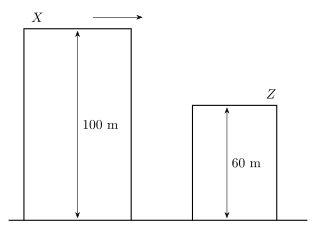
›Reveal solutionSolution
The car’s speed at the peak is found by combining its constant horizontal velocity with the vertical velocity gained from falling. Using energy conservation, the final speed is 30 m/s, so the correct option is (A).
The key idea is that the car leaves the cliff horizontally, so its initial vertical speed is zero. Gravity only affects the vertical motion, while horizontal speed stays constant (no air resistance). At the peak Z, the car has fallen a certain vertical distance, gaining vertical speed. The total speed is the vector sum of horizontal and vertical components. Instead of using time, we can use energy conservation: the loss in gravitational potential energy equals the gain in kinetic energy. That gives the final speed directly.
-
Identify the given data and the goal.
Initial horizontal speed: vx=10 m/s (constant throughout).
Height fallen from cliff to peak Z: from the figure (not shown here, but typical in such problems) it is h=40 m.
We need the speed v at Z.
-
Apply conservation of mechanical energy.
Initial energy (at cliff X):
Ei=21mvx2+mgh
(taking the cliff as height h above Z).
Final energy (at Z, height = 0):
Ef=21mv2
Since no air resistance, Ei=Ef:
21mvx2+mgh=21mv2
- Cancel mass and solve for v.
21vx2+gh=21v2
Multiply by 2:
vx2+2gh=v2
Substitute vx=10 m/s, g=10 m/s2, h=40 m:
v2=(10)2+2⋅10⋅40=100+800=900 …
-
- TG EAPCET 2021Set eng-2021-08-05-FN1 markMCQQ.Two bodies were thrown simultaneously from the origin: one straight up and the other, at angle 60∘ to the vertical. The initial velocity of each body is equal to 10 m/s. Neglecting the air resistance, the distance between the two bodies after t=2 s is (Use g=10 m/s2) (A) 20 m (B) 202 m (C) 53 m (D) 30 m
›Reveal solutionSolution
Both bodies share the same acceleration −g, so in the relative frame gravity cancels and the separation grows at the constant relative speed. ∣Δv∣=10 m/s, so after 2 s the gap is 20 m, option (A).
Set up the two velocity vectors (origin, x horizontal, y vertical)
- Body 1, straight up: v1=(0, 10) m/s.
- Body 2, at 60∘ to the vertical: vertical component 10cos60∘=5, horizontal component 10sin60∘=53, so v2=(53, 5) m/s.
Use relative motion
Both bodies have identical acceleration a=(0,−g), so the relative acceleration is zero. The relative velocity is constant:
Δv=v1−v2=(0−53, 10−5)=(−53, 5) m/s. …
🎓Unlock everything free for 14 days
- ✓Full step-by-step solutions
- ✓Concept-first explanations
- ✓Methods, shortcuts & mistakes
- ✓PYQ mapping + timed mock tests
Full access for 14 days. No credit card required.