Physics · Ch 7 — System of Particles and Rotational Motion
Angular Momentum in Case of Rotation About a Fixed Axis
Angular Momentum in Case of Rotation About a Fixed Axis
Angular Momentum About a Fixed Axis
When a rigid body rotates about a fixed axis, every particle of the body moves in a circle centred on that axis. Each particle therefore carries angular momentum about the axis. The total angular momentum of the body is simply the sum of the angular momenta of all its particles.
Consider a rigid body rotating with angular speed about a fixed axis (say the -axis). Take a particle of mass at a perpendicular distance from the axis. Its linear speed is , and its linear momentum is .
The angular momentum of this particle about the axis of rotation is defined as:
The direction of is along the axis of rotation, given by the right-hand rule (curl fingers in the direction of rotation, thumb points along the axis). Since all particles rotate in the same sense, their individual angular momenta all point in the same direction along the axis.
The total angular momentum of the body about the fixed axis is therefore:
The quantity in parentheses is the moment of inertia of the body about that axis. Hence:
This is the rotational analogue of linear momentum . The moment of inertia plays the role of mass, and angular velocity plays the role of linear velocity.
The relation holds only when the axis of rotation is fixed in space and the body rotates about it. For a general rigid body motion (like a spinning top that precesses), the angular momentum vector is not simply — it can have components perpendicular to the axis of rotation.
Direction of Angular Momentum
For rotation about a fixed axis, the angular momentum vector is directed along the axis of rotation. Its sense is given by the right-hand rule: if the fingers of the right hand curl in the direction of rotation, the thumb points in the direction of .
If the axis is taken as the -axis, we can write:
where is the unit vector along the axis of rotation.
Relation Between Torque and Angular Momentum
The rotational analogue of Newton's second law () is:
For rotation about a fixed axis, this becomes:
where is the torque about the axis, and is the angular acceleration. This holds provided the moment of inertia is constant (which it is for a rigid body rotating about a fixed axis).
The equation is the rotational equivalent of . It tells us that torque causes angular acceleration, just as force causes linear acceleration.
Conservation of Angular Momentum
If no external torque acts on the system about the axis of rotation, then:
For a rigid body rotating about a fixed axis, this means:
If the moment of inertia changes (e.g., by pulling arms in while spinning on a rotating stool), the angular velocity adjusts to keep constant. This explains why a figure skater spins faster when she pulls her arms in — her moment of inertia decreases, so her angular speed increases to conserve angular momentum.
Conservation of angular momentum applies only when the net external torque about the axis is zero. Internal forces (like the skater pulling her arms in) cannot change the total angular momentum of the system.
Angular Momentum of a System of Particles
For a system of particles (not necessarily a rigid body), the total angular momentum about a fixed axis is the sum of the angular momenta of individual particles:
…
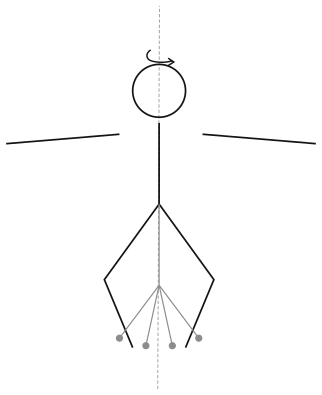
Drawn by us to help you understand the concept clearly, and verified to make sure it's accurate. For exams, practice from your textbook's own diagram.
When the girl sits on the freely-rotating swivel chair and stretches her arms out horizontally, she increases her body's moment of inertia I about the vertical rotation axis, because more of her mass now sits farther from that axis. Since no external torque acts about the vertical axis once she is spinning (friction at the pivot is small), her angular momentum L = Iomega stays constant. So when I goes up as she stretches her arms out, her angular speed omega must go down to keep Iomega fixed -- she visibly slows her spin. The reverse happens when she pulls her arms back in close to her body: I decreases, so omega must increase, and she spins faster. This is exactly Eq. (6.44), L_z = …