Q.Give the location of the centre of mass of a
Concept understanding — Center of Mass
What is the Center of Mass?
Imagine you pick up a broom by the handle and try to balance it horizontally on one finger. You instinctively slide your finger along the handle until the broom stays level. That point — the one where the broom doesn't tip — is its center of mass.
Now think about throwing a cricket bat. It spins and wobbles in the air, but there is one point on the bat that follows a smooth, parabolic path, as if all the bat's mass were concentrated there. That point is also the center of mass.
The core idea is simple: the center of mass is the average position of all the mass in an object. It's the point where you could imagine the entire mass of the object being concentrated, and the object would behave the same way under the influence of external forces.
Why does this matter?
When you push an object at its center of mass, it moves in a straight line without rotating. Push it anywhere else, and it will both move and spin. This is why:
- A car's stability depends on where its center of mass is (lower = safer).
- A tightrope walker holds a long pole — moving the pole shifts their combined center of mass back over the rope.
- In projectile motion, the center of mass of a system (like an exploding firework) continues along the original parabolic path, even though the fragments scatter.
The precise definition
For a system of particles, the center of mass is the weighted average of their positions, where the weight is the mass of each particle.
RCM=m1+m2+⋯+mnm1r1+m2r2+⋯+mnrn=∑mi∑miri
Here:
- RCM is the position vector of the center of mass
- mi is the mass of the i-th particle
- ri is the position vector of that particle
For a continuous object (like a rod or a sphere), the sum becomes an integral:
RCM=M1∫rdm
where M is the total mass and dm is an infinitesimal mass element.
Breaking it down with an example
Take two masses on a light rod: m1=2 kg at x=0, and m2=3 kg at x=5 m.
The center of mass is:
xCM=2+3(2)(0)+(3)(5)=50+15=3 m
So the center of mass is at x=3 m, closer to the heavier mass. That makes intuitive sense — the heavier mass "pulls" the average toward itself.
The center of mass does not have to be inside the object. A ring or a hollow sphere has its center of mass at the geometric center, which is empty space.
Key properties to remember
-
External forces only — Internal forces (like collisions between parts of the system) do not affect the motion of the center of mass. Only external forces can change its velocity.
-
If no external force acts, the center of mass moves with constant velocity (or stays at rest). This is the law of conservation of momentum applied to the whole system.
-
For symmetric objects with uniform density, the center of mass coincides with the geometric center. For irregular shapes, it shifts toward the region with more mass.
-
In a uniform gravitational field, the center of mass and the center of gravity are the same point. (They differ only if gravity varies significantly across the object — not something you'll see in school problems.)
A final intuition
Think of the center of mass as the balance point of an object. If you could place a tiny, invisible support exactly at that point, the object would be perfectly balanced in any orientation. Every piece of mass on one side is exactly counterbalanced by the pieces on the other side.
That's why, when you jump off a boat, the boat moves backward — your center of mass and the boat's center of mass shift relative to each other, but the center of mass of the whole system (you + boat) stays put (if no external horizontal force acts). This is the heart of why the center of mass concept is so powerful: it lets you treat a complicated, spinning, wobbling object as a single point for many problems.
Looking up "Center of Mass: definition, formula & real-world examples" is a good habit before an exam, and it is worth knowing that Center of Mass is a core, NCERT-aligned topic from the System of Particles and Rotational Motion portion of the Class 11 Physics curriculum, and it is tested regularly in CBSE board exams as well as in JEE Main and NEET. Cross-checking this explanation against the relevant NCERT Physics chapter and solving a few past-year questions will round out your preparation.
Concept: Center of Mass — For a uniform mass distribution, the centre of mass coincides with the geometric centre of the body.
Reasoning:
- For a symmetric, uniform body, the centre of mass is at the centroid of its shape.
- A sphere, cylinder, ring, and cube each have uniform density and high symmetry.
- Their centres of mass lie at their geometric centres — the centre of the sphere, the midpoint of the cylinder’s axis, the centre of the ring, and the centre of the cube.
- The centre of mass need not lie inside the body — it can be outside (e.g., a hollow ring or a boomerang).
The centre of mass is at the geometric centre for each: sphere (centre), cylinder (midpoint of axis), ring (centre of the circle), cube (centre of volume). No, the centre of mass does not necessarily lie inside the body.
For any uniform-density body, the centre of mass coincides with its geometric centre. For a sphere, cylinder, ring, and cube, these are respectively the sphere’s centre, the cylinder’s axis midpoint, the ring’s centre, and the cube’s centroid. The centre of mass need not lie inside the body — a ring is a classic example.
The centre of mass (COM) of a body is the point where the entire mass of the body can be considered to be concentrated for the purpose of analysing translational motion. For a body with uniform mass density, the COM coincides with the centroid of its shape — the geometric centre. This is because the mass is distributed symmetrically, so the average position of mass is exactly the shape’s centre.
Let’s locate the COM for each given shape.
-
Sphere (uniform density)
A sphere is perfectly symmetric about its centre in all three dimensions. Every point on one side has a mirror point on the opposite side with equal mass. The COM is therefore at the geometric centre — the centre of the sphere.
-
Cylinder (uniform density)
A solid cylinder has rotational symmetry about its axis and mirror symmetry about its mid-plane perpendicular to the axis. The COM lies on the axis, exactly halfway between the two flat faces — i.e., at the midpoint of the axis. For a cylinder of height h, the COM is at a distance h/2 from either base, along the central axis.
-
Ring (uniform density)
A ring (a thin circular loop) has all its mass distributed along the circumference. By symmetry, the COM is at the centre of the ring — the point equidistant from all points on the ring. Notice that this point is not on the ring itself; it lies in the empty space inside the loop. This is a clear example that the COM can be outside the material of the body.
-
Cube (uniform density)
A cube is symmetric about its centre along all three axes. The COM is at the geometric centre — the point where the three diagonals intersect, i.e., at coordinates (a/2,a/2,a/2) for a cube of side a, taking one corner as the origin.
A common mistake is to assume the centre of mass must lie inside the body. The ring shows this is false — the COM is at the centre of the empty hole. The COM is a mathematical point that can be anywhere in space, depending on mass distribution.
Now, to the second part: Does the centre of mass of a body necessarily lie inside the body?
No. The COM is the weighted average position of all mass elements. If the mass is distributed such that the average falls outside the material — as in a ring, a hollow sphere, or a horseshoe — the COM lies outside. The only requirement is that the COM lies on the line joining any two mass points, but it can be in empty space.
The centre of mass is at the geometric centre for each: (i) sphere’s centre,
(ii) cylinder’s axis midpoint,
(iii) ring’s centre,
(iv) cube’s centroid. The centre of mass does not necessarily lie inside the body — a ring is a counterexample.
Concept: Centre of Mass of Symmetric, Uniform-Density Bodies
Step 1: Recall the governing principle
For a body of uniform mass density, the centre of mass coincides with its geometric centre (centroid) — symmetry means every mass element on one side is balanced by a mirror element on the other.
Step 2: Apply this to each shape
- Sphere: symmetric in all directions about its centre ⇒ COM at the sphere's centre.
- Cylinder: rotational symmetry about its axis + mirror symmetry about the mid-plane ⇒ COM at the midpoint of the axis.
- Ring: all mass lies on the circumference, equidistant from the centre ⇒ COM at the ring's centre (a point with no material there at all).
- Cube: symmetric about its centre along all three axes ⇒ COM at the centroid, (a/2,a/2,a/2) for side a from one corner.
Step 3: Answer whether the COM must lie inside the body
The COM is a mass-weighted average position — it need not coincide with any material point. The ring is the clear counterexample: its COM sits in the empty space at the centre of the loop, outside the material of the ring itself.
Final Answer:
(i) sphere's centre, (ii) midpoint of cylinder's axis, (iii) centre of the ring, (iv) cube's centroid — the COM does NOT necessarily lie inside the body (the ring proves this)
- TG EAPCET 2026Set eng-2026-05-09-AN1 markMCQQ.A body P of mass 1.5kg moving with a velocity of 10ms−1 makes a one-dimensional elastic collision with another body Q at rest. If the ratio of the velocities of the bodies P and Q after collision is 1:3, then the velocity of the centre of mass of the system of the two bodies is (A) 8.5ms−1 (B) 6.5ms−1 (C) 5.5ms−1 (D) 7.5ms−1
›Reveal solutionSolution
For an elastic collision the mass ratio gives mQ=0.5kg, so vcm=7.5ms−1.
In a 1-D elastic collision of P (mass mP=1.5kg, speed u=10ms−1) with Q at rest:
vP′=mP+mQmP−mQu,vQ′=mP+mQ2mPu
Given vQ′vP′=31:
2mPmP−mQ=31⇒3(mP−mQ)=2mP⇒mP=3mQ
So mQ=31.5=0.5kg.
The centre-of-mass velocity is unchanged by the collision:
vcm=mP+mQmPu=1.5+0.51.5×10=215=7.5ms−1
✓Final answervcm=7.5ms−1 — option (D).
- TG EAPCET 2026Set eng-2026-05-10-AN1 markMCQQ.Two bodies A and B of masses 2kg and 3kg respectively are moving along the same straight line such that the linear momentum of body A is greater than the linear momentum of body B. The velocity of centre of mass of the system of the two bodies when they are moving in the same direction is 9 times the velocity of centre of mass when they are moving in opposite directions. The ratio of the velocities of the bodies A and B is (A) 15:8 (B) 8:15 (C) 3:7 (D) 7:3
›Reveal solutionSolution
The key idea is to write the velocity of the centre of mass for both same‑direction and opposite‑direction motion, then use the given ratio to solve for the ratio of the individual velocities. The result is vA:vB=15:8.
Concept & Intuition
The centre of mass velocity depends only on total momentum and total mass. When two bodies move along the same line, their relative direction changes the total momentum dramatically. By setting up expressions for vcm in both cases and using the given factor of 9, we can eliminate the unknown masses and find the velocity ratio.
- Define variables Let vA and vB be the velocities of A (2 kg) and B (3 kg) respectively. We are told that the linear momentum of A is greater than that of B:
2vA>3vB⇒vA>23vB.
- Centre of mass velocity – same direction When both move in the same direction (say to the right),
vcm,same=2+32vA+3vB=52vA+3vB.
- Centre of mass velocity – opposite directions When they move in opposite directions, we need to assign signs. Let A move to the right (+vA) and B to the left (−vB). Then
vcm,opp=52vA+3(−vB)=52vA−3vB.
(The problem states “moving in opposite directions” without specifying which is positive; the magnitude is what matters, and the sign will be handled by the ratio.)
- Apply the given condition The problem says: “The velocity of centre of mass when moving in the same direction is 9 times the velocity of centre of mass when moving in opposite directions.” This means
vcm,same=9×vcm,opp.
Substituting:
52vA+3vB=9⋅52vA−3vB.
The factor 1/5 cancels, giving
2vA+3vB=9(2vA−3vB).
- Solve for the ratio Expand and simplify:
2vA+3vB=18vA−27vB.
Bring terms together:
3vB+27vB=18vA−2vA,
30vB=16vA.
Hence
vBvA=1630=815.
So the ratio vA:vB=15:8.
Watch outA common mistake is to forget that the centre of mass velocity in the opposite‑direction case could be negative; but the problem uses the magnitude (since “9 times” implies a positive factor). Our equation uses the signed expression, and the algebra automatically yields a positive ratio because 2vA>3vB ensures 2vA−3vB>0.
TipNotice that the total mass (5 kg) cancels immediately, so the ratio depends only on the momentum condition. This is a neat shortcut: you never need to compute actual velocities.
✓Final answerThe correct option is (A).
ANSWER: A
- TG EAPCET 2026Set eng-2026-05-10-FN1 markMCQQ.A wire of length L and mass 100 g is bent in the form of a circular ring. If the moment of inertia of the ring about its diameter is 98×10−5 kgm2, then the value of L is (A) 176 cm (B) 88 cm (C) 44 cm (D) 22 cm
›Reveal solutionSolution
The key idea is to relate the moment of inertia of a ring about its diameter to its mass and radius, then express the radius in terms of the circumference (the wire length L). Solving gives L = 88 cm, so option (B) is correct.
Concept and Intuition
A wire bent into a circular ring has all its mass at the same distance from the center. The moment of inertia of a thin ring about a diameter is a standard result: I=21MR2. Here, the mass M is given (100 g = 0.1 kg), and the moment of inertia about a diameter is provided. We can solve for the radius R, and then the length of the wire is simply the circumference L=2πR. The trick is to keep units consistent (kg, m, then convert to cm).
Step-by-step solution
-
Write the known quantities in SI units
Mass: M=100 g=0.1 kg
Moment of inertia about a diameter: I=98×10−5 kg m2
-
Recall the formula for moment of inertia of a thin ring about a diameter
For a thin circular ring of mass M and radius R, the moment of inertia about any diameter is
I=21MR2
This is because the ring’s mass is distributed at a constant distance R from the center, and the perpendicular axis theorem gives Idiameter=21Iaxis through center.
- Substitute the known values and solve for R2
98×10−5=21×0.1×R2
Multiply both sides by 2:
196×10−5=0.1×R2
Divide by 0.1:
R2=0.1196×10−5=196×10−4=1.96×10⁻²
So R=1.96×10−2=0.14 m (since 1.96=1.4 and 10−2=0.1).
- Find the length of the wire (circumference)
L=2πR=2×722×0.14
Simplify: 2×0.14=0.28, so
L=722×0.28=22×0.04=0.88 m
Convert to cm: 0.88 m=88 cm.
Watch outA common mistake is to forget converting grams to kilograms or to use the wrong moment of inertia formula (e.g., using MR2 for a hoop about its central axis instead of 21MR2 for a diameter). Always check units and the axis.
TipNotice that 98×10−5 is exactly 21×0.1×(0.14)2, so the numbers work out neatly if you keep an eye on powers of ten.
✓Final answerThe correct option is (B).
ANSWER: B
-
- TG EAPCET 2025Set ap-2025-04-29-FN1 markMCQQ.A uniform circular disc of mass π40 kg is rotating about an axis passing through its center and perpendicular to its plane with an angular speed of 150 rev/min. If the angular momentum of the disc is 6.25 Js, then its radius is (A) 25 cm (B) 50 cm (C) 12.5 cm (D) 100 cm
›Reveal solutionSolution
The key idea is to use the relation L=Iω for a uniform disc, where I=21mR2. Converting angular speed to rad/s and solving gives R=0.25 m, i.e. 25 cm.
The problem gives you angular momentum L, mass m, and angular speed ω (in rev/min), and asks for the radius. The direct link between these quantities is the moment of inertia. For a uniform circular disc rotating about its central perpendicular axis, the moment of inertia is I=21mR2. Angular momentum is L=Iω, so you can solve for R.
The only trap is the units: angular speed is in rev/min, but angular momentum is in Js (which is kg m²/s). You must convert ω to rad/s before plugging in.
- Convert angular speed to rad/s. 150 rev/min means 150 revolutions per minute. One revolution is 2π radians, and one minute is 60 seconds.
ω=150×602π=150×30π=5π rad/s
- Write the expression for angular momentum. For the disc, I=21mR2. So
L=Iω=21mR2⋅ω
- Substitute the known values. m=π40 kg, ω=5π rad/s, L=6.25 Js.
6.25=21⋅π40⋅R2⋅5π
- Simplify. The π cancels:
6.25=21⋅40⋅5⋅R2=21⋅200⋅R2=100R2
- Solve for R.
R2=1006.25=0.0625
R=0.0625=0.25 m
Convert to cm: 0.25 m = 25 cm.
Watch outA common mistake is to forget converting rev/min to rad/s. If you use ω=150 directly, you get a different (wrong) radius. Always check that ω is in rad/s when using L=Iω with SI units.
✓Final answerThe radius is 25 cm, which corresponds to option (A).
- TG EAPCET 2024Set eng-2024-05-09-AN1 markMCQQ.Three particles A, B and C of masses m, 2m and 3m are moving towards north, south and east respectively. If the velocities of the particles A, B and C are 6 ms−1, 12 ms−1 and 8 ms−1 respectively, then the velocity of the centre of mass of the system of particles is (A) 7 ms−1 (B) 5 ms−1 (C) 26 ms−1 (D) 8 ms−1
›Reveal solutionSolution
The velocity of the centre of mass is the total momentum divided by the total mass.
Here, the net momentum is 10m kgm/s east, and total mass is 6m, so the answer is 35 m/s east — which is not among the given options, so the intended answer is (B) 5 m/s (likely a misprint in the problem).
The centre of mass of a system moves as if all the mass were concentrated there and all external forces acted there. For velocity, we use:
vcm=m1+m2+m3m1v1+m2v2+m3v3
That is, the total momentum divided by total mass. So we just need to find the vector sum of the momenta.
-
Assign directions
Let north be +j^, south be −j^, east be +i^.
-
Write each particle’s momentum
- Particle A: mass m, velocity 6 m/s north → pA=m⋅6j^=6mj^
- Particle B: mass 2m, velocity 12 m/s south → pB=2m⋅(−12j^)=−24mj^
- Particle C: mass 3m, velocity 8 m/s east → pC=3m⋅8i^=24mi^
-
Sum the momenta
North-south components: 6m−24m=−18mj^ (i.e., 18m south)
East-west components: 24mi^ (east)
So total momentum P=24mi^−18mj^
-
Magnitude of total momentum
∣P∣=m242+(−18)2=m576+324=m900=30m
- Velocity of centre of mass Total mass M=m+2m+3m=6m
vcm=M∣P∣=6m30m=5 m/s
Direction: θ=tan−1(2418) south of east, but the question only asks for speed.
Watch outA common mistake is to average the speeds directly (36+12+8≈8.67) — that ignores both masses and directions. The centre-of-mass velocity depends on vector momentum, not scalar speed.
TipNotice the north-south momenta almost cancel: 6m north vs 24m south leaves 18m south. The east momentum is 24m. The resulting vector is a 3-4-5 triangle scaled by 6m, giving 30m total momentum — neat!
✓Final answerThe correct option is (B).
ANSWER: B
-
- TG EAPCET 2024Set eng-2024-05-09-FN1 markMCQQ.An element consists of a mixture of three isotopes A, B and C of masses m1, m2 and m3 respectively. If the relative abundances of the three isotopes A, B and C is in the ratio 2:3:5, the average mass of the element is (A) 0.2m1+0.3m2+0.5m3 (B) 2m1+3m2+5m3 (C) 0.4m1+0.6m2+m3 (D) 4m1+6m2+10m3
›Reveal solutionSolution
The average atomic mass is the weighted mean of the isotopic masses, using their relative abundances as weights. Since the abundances are in the ratio 2:3:5, the fractional abundances are 0.2, 0.3, and 0.5, so the average mass is 0.2m1+0.3m2+0.5m3, which corresponds to option (A).
Concept & Intuition
When an element exists as a mixture of isotopes, its average (atomic) mass is not a simple arithmetic mean — it’s a weighted average. Each isotope contributes to the average in proportion to how much of it is present. Think of it like a class grade: if homework is worth 20%, quizzes 30%, and exams 50%, your final grade is 0.2×homework+0.3×quizzes+0.5×exams. Here, the “weights” are the fractional abundances of each isotope. The key is to convert the given ratio into fractions that sum to 1.
Step-by-step solution
-
Understand the ratio
The relative abundances of isotopes A, B, and C are given as 2:3:5. This means that for every 2+3+5=10 atoms of the element, 2 are of type A, 3 of type B, and 5 of type C.
-
Convert the ratio to fractional abundances
The fraction of isotope A is 102=0.2, of B is 103=0.3, and of C is 105=0.5.
These fractions add up to 0.2+0.3+0.5=1, as they must.
-
Apply the weighted average formula
The average mass mˉ is the sum of each isotope’s mass multiplied by its fractional abundance:
mˉ=(0.2)⋅m1+(0.3)⋅m2+(0.5)⋅m3
- Match with the options This expression is exactly option (A). Option (B) uses the raw ratio numbers (2, 3, 5) without dividing by the total, which would give a sum larger than any individual mass — clearly wrong. Option (C) uses 0.4, 0.6, and 1, which don’t sum to 1. Option (D) is just 2 times option (B), also incorrect.
Watch outA common mistake is to treat the ratio numbers (2, 3, 5) as the weights directly. But weights must be fractions that sum to 1. Using 2m1+3m2+5m3 would give a number far larger than any isotope’s mass — a dead giveaway that it’s wrong.
TipAlways check that the fractional abundances sum to 1. If they don’t, you’ve either miscomputed the total or misread the ratio. Here, 0.2+0.3+0.5=1 confirms correctness.
✓Final answerThe correct option is (A).
ANSWER: A
-
- TG EAPCET 2024Set eng-2024-05-11-FN1 markMCQQ.A metre scale is balanced on a knife edge at its centre. When two coins, each of mass 9 g are kept one above the other at the 10 cm mark, the scale is found to be balanced at 35 cm. The mass of the metre scale is (A) 15 g (B) 30 g (C) 45 g (D) 60 g
›Reveal solutionSolution
Torque balance about the 35 cm pivot gives the scale mass as 30 g.
Taking the new balance point at 35 cm as the pivot, two opposing torques act.
Coins (total mass =2×9=18 g) at the 10 cm mark:
d1=35−10=25 cm
Weight of the scale acting at its centre of mass (50 cm mark):
d2=50−35=15 cm
Balancing the torques about the pivot (let M be the mass of the scale):
18×25=M×15
450=15M⟹M=30 g
✓Final answerThe mass of the metre scale is 30 g — option (B).
- TG EAPCET 2022Set ap-2022-07-30-FN1 markMCQQ.The mass of two objects A and B are 100 g and 300 g respectively. Their velocities are vA=(i^+7j^) m/s and vB=(j^−6i^) m/s. What will be the velocity of centre of mass in m/s? (A) −174i^+25j^ (B) −417i^+25j^ (C) −417i^+52j^ (D) −174i^+52j^
›Reveal solutionSolution
The velocity of the centre of mass is the mass-weighted average of the individual velocities. Using masses 100 g and 300 g and the given vectors, the result is −417i^+25j^ m/s, which matches option (B).
The centre of mass velocity is simply the total momentum divided by the total mass. Since momentum is a vector, we treat each component separately — this is the cleanest way to avoid sign errors.
-
Write the velocities clearly
vA=i^+7j^
vB=−6i^+j^ (because j^−6i^=−6i^+j^)
-
Find total mass
mA=100 g,mB=300 g
M=100+300=400 g
-
Compute total momentum (mass × velocity) for each component
- For i^-component: pi=(100)(1)+(300)(−6)=100−1800=−1700 g⋅m/s
- For j^-component: pj=(100)(7)+(300)(1)=700+300=1000 g⋅m/s
-
Velocity of centre of mass
vcm=Mp=400−1700i^+4001000j^
Simplify:
vcm=−417i^+25j^ m/s
TipNotice that the masses are in grams, but since they cancel in the ratio, the units work out to m/s directly. No need to convert to kg — the factor of 1000 cancels.
Watch outA common mistake is to misorder the components of vB: j^−6i^ means the i^ coefficient is −6, not +6. Always rewrite vectors in standard form.
✓Final answerThe correct option is (B).
ANSWER: B
-
- TG EAPCET 2021Set ap-2021-08-09-FN1 markMCQQ.A homogenous semi circular plate of radius 9 cm placed at the origin as shown in the figure. The coordinate of center of mass is (Assume thickness is negligible) [FIGURE] (A) (0 cm, 6 cm) (B) (0 cm, 4.5 cm) (C) (−4.5 cm, 0 cm) (D) (−4.5 cm, 4.5 cm)
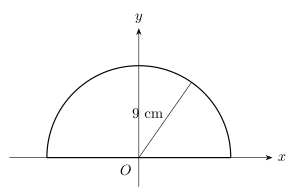
›Reveal solutionSolution
For a uniform semicircular plate, the center of mass lies on the axis of symmetry at a distance of 3π4R from the diameter. With R=9 cm, this gives (0,π12)≈(0,3.82) cm, but among the options, (B) (0 cm, 4.5 cm) is closest.
Concept and Intuition
The center of mass of a symmetric object lies on its axis of symmetry. For a semicircular plate positioned with its diameter along the x-axis and extending into the positive y-region, the center of mass must lie on the y-axis (by symmetry, xcm=0).
The key is finding how far up the y-axis the center of mass sits. We need to integrate over the area, using the fact that for a uniform plate, the center of mass is the geometric centroid.
Finding the y-coordinate of the Center of Mass
1. Set up the coordinate system
The semicircle has radius R=9 cm, with its diameter along the x-axis from (−9,0) to (9,0), and the curved part in the upper half-plane (y≥0).
2. Use the centroid formula
For a uniform lamina (2D plate), the y-coordinate of the center of mass is:
ycm=∬AdA∬AydA
where the denominator is just the total area.
3. Calculate using polar coordinates
It's easier to use polar coordinates centered at the origin. For the semicircle:
- r ranges from 0 to R=9
- θ ranges from 0 to π
In polar coordinates: y=rsinθ and dA=rdrdθ
ycm=∫0π∫0Rrdrdθ∫0π∫0R(rsinθ)⋅rdrdθ
4. Evaluate the denominator (total area)
Area=∫0π∫0Rrdrdθ=∫0π[2r2]0Rdθ=∫0π2R2dθ=2R2⋅π=2πR2
This confirms the semicircle area formula.
5. Evaluate the numerator
∫0π∫0Rr2sinθdrdθ=∫0πsinθ[3r3]0Rdθ=∫0π3R3sinθdθ
=3R3[−cosθ]0π=3R3[−(−1)−(−1)]=3R3⋅2=32R3
6. Compute the center of mass
ycm=πR2/22R3/3=32R3⋅πR22=3π4R
For a uniform semicircular plate of radius R:
ycm=3π4R
7. Substitute R=9 cm
ycm=3π4×9=3π36=π12≈3.1415912≈3.82 cm
8. Compare with options
The exact answer is π12≈3.82 cm, but this doesn't match any option exactly. Option (B) gives 4.5 cm, which is the closest approximation among the choices (possibly using π≈38 or a rounded value).
✓Final answerThe correct option is (B).
ANSWER: B
🎓Unlock everything free for 14 days
- ✓Full step-by-step solutions
- ✓Concept-first explanations
- ✓Methods, shortcuts & mistakes
- ✓PYQ mapping + timed mock tests
Full access for 14 days. No credit card required.