Physics · Ch 12 — Thermodynamics
Adiabatic Process
Adiabatic Process
Adiabatic Process: The Foundation
An adiabatic process is one in which no heat flows between the system and its surroundings. The word comes from Greek — adiabatos meaning "impassable" — and it describes a wall that heat cannot cross.
In an adiabatic process, . The First Law of Thermodynamics then reduces to:
Any change in internal energy comes entirely from work done by or on the system. If the system does work (), its internal energy drops. If work is done on the system (), its internal energy rises.
This is a direct consequence of the First Law: . With , we get (where is work done on the system). Many textbooks write work done by the system as positive, giving . Both conventions appear — what matters is the physical idea: no heat exchange means energy change equals work.
A perfectly adiabatic process is an idealisation. In practice, a process is approximately adiabatic if it happens very quickly (so heat has no time to flow) or if the system is very well insulated. The rapid compression of air in a diesel engine's cylinder is a classic example — the temperature rises so sharply that the fuel ignites without a spark plug.
The Relation Between and in an Adiabatic Process
For an ideal gas undergoing a reversible adiabatic process, pressure and volume obey a simple power law. The derivation uses the First Law together with the ideal gas equation and the expression for molar specific heat.
Consider one mole of an ideal gas. In an infinitesimal adiabatic step, , so the First Law gives:
For an ideal gas, the internal energy depends only on temperature: , where is the molar specific heat at constant volume. The work done by the gas in a small volume change is . Therefore:
The minus sign appears because we are writing as work done by the gas (positive when the gas expands). The First Law in the form (with ) gives .
Now use the ideal gas equation for one mole: . Differentiate:
From the first equation, . Substitute into the differentiated ideal gas equation:
Rearrange:
Bring the terms together:
Recall that for an ideal gas, so , the ratio of specific heats. Thus:
Separate variables:
Integrate both sides:
Exponentiate:
For a reversible adiabatic process in an ideal gas:
where .
This is the central result. The constant depends on the initial state — if the gas starts at and ends at , then:
Properties Derived from
The book lists three key properties that follow directly from this relation. Each one gives a different way to describe the same adiabatic curve.
Property (I):
Start from . Use the ideal gas law (for moles). Substitute:
The is constant, so:
This tells you how temperature changes when volume changes adiabatically. If the gas expands ( increases), must drop — the gas cools. If compressed, it heats up.
Property (II):
Again start from . This time eliminate using :
This form is useful when you know pressure and temperature but not volume.
Property (III): Work Done in an Adiabatic Process
For a finite change from volume to , the work done by the gas is:
Since (a constant), we have . Therefore:
For (which is always true for gases — ):
Since , we can write this in several equivalent forms:
Work done by an ideal gas in a reversible adiabatic process:
Or, using the ideal gas law:
The second form is often more convenient. Notice that if the gas expands (), it cools (), so is positive — the gas does work. If compressed, is negative — work is done on the gas.
Do not confuse the adiabatic work formula with the isothermal work formula. For an isothermal process, . For an adiabatic process, the work depends on the temperature change, not the logarithm of the volume ratio. They are fundamentally different because in an isothermal process, heat flows to keep temperature constant; in an adiabatic process, no heat flows and temperature changes.
The - Diagram: Adiabatic vs Isothermal …
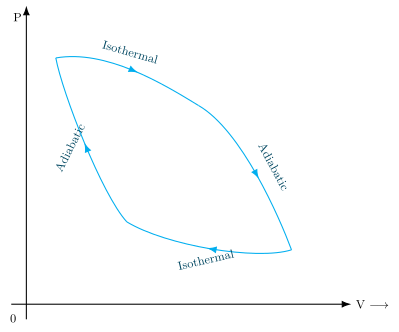
Drawn by us to help you understand the concept clearly, and verified to make sure it's accurate. For exams, practice from your textbook's own diagram.
The figure shows a pressure–volume (-) diagram for an ideal gas undergoing a complete cycle. The vertical axis is pressure , the horizontal axis is volume (starting from zero at the origin). Four curves form a closed, roughly quadrilateral shape: two gently sloping curves (the isotherms) form the top and bottom boundaries, and two steeper curves (the adiabats) form the left and right boundaries. Each curve is labelled accordingly.
The physical idea is a direct comparison of two different thermodynamic paths between the same two states. An isothermal process occurs at constant temperature; an adiabatic process occurs with no heat exchange (). On a - diagram, an adiabatic curve is steeper than an isothermal curve passing through the same point. This figure shows a cycle where the gas expands and contracts along alternating isothermal and adiabatic paths, forming a closed loop. The area enclosed by the loop represents the net work done by the gas over one complete cycle.
The key formulas the textbook develops with this figure are the equations for the two types of processes. For an isothermal process involving an ideal gas, Boyle’s law applies:
Here is pressure, is volume, and the constant depends on the amount of gas and the fixed temperature (since ). For an adiabatic process, the relation is:
where is the ratio of specific heats at constant pressure and constant volume. For a monatomic ideal gas, ; for a diatomic gas, . The exponent is always greater than 1, which is why the adiabatic curve is steeper than the isothermal curve on the - diagram.
A common mistake is to think the adiabatic curve is steeper only because . While that is true, the physical reason is that during adiabatic compression, the gas temperature rises (no heat escapes), so pressure increases more rapidly than in an isothermal compression where temperature is held constant. The formula captures this exactly. …