Physics · Ch 12 — Thermodynamics
Quasi-static Process
Quasi-static Process
The Idea of a Quasi-static Process
In thermodynamics, we often want to study how a system changes from one equilibrium state to another. The simplest way to think about this is a sudden, violent change — like a gas expanding explosively into a vacuum. But such a process is impossible to analyse with simple equations because the gas is never in a well-defined state (pressure, temperature, volume) during the rush. Its properties are chaotic and non-uniform.
To make the analysis tractable, we need a special kind of process: one that happens so slowly that the system is always infinitesimally close to an equilibrium state. This is called a quasi-static process (from the Latin quasi, meaning "as if", and Greek statikos, meaning "causing to stand"). Think of it as a process that proceeds through a continuous succession of equilibrium states.
A quasi-static process is an idealisation. In reality, no process is perfectly quasi-static because that would require infinite time. But many real processes — like the slow compression of a gas in a piston — can be approximated as quasi-static for practical calculations.
The key consequence is that at every instant during a quasi-static process, the state variables (pressure , volume , temperature ) are well-defined and obey the ideal gas equation . This allows us to use calculus to describe the process precisely.
The Work Done in a Quasi-static Process
Consider a gas confined in a cylinder fitted with a frictionless, movable piston of cross-sectional area . The gas exerts a pressure on the piston. The force on the piston is .
Now imagine the gas expands quasi-statically, pushing the piston outward by an infinitesimal distance . The infinitesimal work done by the gas is:
But is simply the infinitesimal change in volume, . So:
This is the fundamental expression for work in a quasi-static process. For a finite change in volume from to , the total work done by the gas is:
The sign convention is crucial. In physics (and in NCERT), is the work done by the system. If the gas expands (), is positive. If the gas is compressed (), is negative — meaning work is done on the system. In chemistry, the opposite sign convention is often used, so be careful in cross-disciplinary problems.
The – Diagram and Work
The integral has a beautiful geometric interpretation. If you plot pressure on the y-axis and volume on the x-axis, the curve representing the quasi-static process is called a – diagram. The work done by the gas during the process is exactly the area under the curve between and .
This is a powerful tool. For any quasi-static process, you can read the work directly from the graph. Moreover, the shape of the curve tells you the nature of the process — is it isothermal (constant temperature), isobaric (constant pressure), isochoric (constant volume), or adiabatic (no heat exchange)?
Work is a path-dependent quantity. The value of depends on the specific path taken from the initial state to the final state, not just on the endpoints. This is why work is not a state function — it is a process-dependent quantity.
Properties of Quasi-static Processes
The textbook lists three essential properties that follow from the definition. Each one is a direct consequence of the process being a continuous sequence of equilibrium states.
Property (I): At every stage, the equation of state holds.
Since the system is always in equilibrium, the ideal gas equation (or any applicable equation of state) is valid at every intermediate point. For an ideal gas:
This means that if you know any two of , , and at any instant during the process, you can calculate the third. This is what makes the analysis possible — you are never dealing with undefined or chaotic states.
Property (II): The work done is given by .
We have already derived this. The proof is straightforward:
›Proof
Start with the definition of work: . For a piston, the force is and the displacement is along the direction of the force. So . But , the change in volume. Hence . Integrating from initial volume to final volume gives .
This property is the workhorse of thermodynamic calculations. For any quasi-static process, once you know how varies with (the path), you can compute the work.
Property (III): The process can be reversed by an infinitesimal change in the external conditions. …
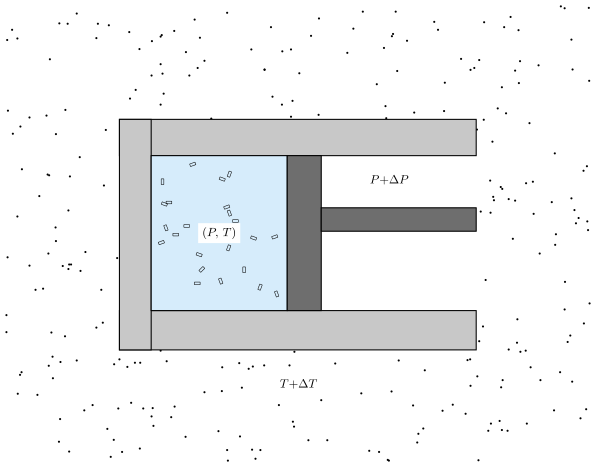
Drawn by us to help you understand the concept clearly, and verified to make sure it's accurate. For exams, practice from your textbook's own diagram.
The figure shows a horizontal cylinder containing a gas at pressure and temperature . On the left side of the cylinder, small circles represent gas molecules. A grey piston sits inside the cylinder, free to move. To the right of the piston, the diagram shows a granular medium labelled — this represents the external pressure acting on the piston from the outside. The entire cylinder is enclosed within a larger, stippled square labelled , which represents a thermal reservoir (a heat bath) whose temperature is infinitesimally higher than the gas temperature.
The key physical idea is the quasi-static process. In such a process, the system (the gas) is never more than an infinitesimal step away from equilibrium with its surroundings. The external pressure differs from the gas pressure by only an infinitesimal amount . Similarly, the reservoir temperature differs from the gas temperature by only an infinitesimal . Because these differences are infinitesimal, the piston moves extremely slowly, and the gas passes through a continuous sequence of equilibrium states. No finite imbalance ever builds up — the process is reversible in principle.
A common mistake is to think that a quasi-static process is the same as a slow process. Slowness alone is not enough — the system must also be in thermal and mechanical equilibrium with its surroundings at every instant. The figure makes this explicit by showing both the pressure difference and the temperature difference as infinitesimals.
The textbook uses this figure to develop the formula for work done in a quasi-static process. When the piston moves by an infinitesimal distance , the gas does work on the piston:
Here is the gas pressure (which is always equal to within an infinitesimal), and is the infinitesimal change in volume. For a finite change from volume to , the total work is:
Each symbol:
- — work done by the gas (positive when the gas expands, negative when compressed)
- — pressure of the gas (equal to external pressure in a quasi-static process)
- — infinitesimal change in volume
- , — initial and final volumes
The figure also sets the stage for understanding heat transfer in a quasi-static process. Because the reservoir temperature is only infinitesimally above the gas temperature, heat flows extremely slowly into the gas. The infinitesimal heat added is , and the first law for an infinitesimal step becomes:
…