Commerce · Ch 11 — Staffing
Selection
Selection
Selection: Choosing the Right Person for the Job
Selection is the process of identifying and choosing the best candidate from a pool of applicants. It is not a single event but a series of steps — employment tests, interviews, and checks — through which unsuitable candidates are eliminated at each stage until the right person is found. The process begins with screening applications and may continue even after the job offer is made and accepted, because selection involves a judgment about the candidate’s future performance. The true test of a good selection process is how well the chosen person performs on the job.
The Process of Selection
The textbook outlines eight key steps in the selection process. Each step acts as a hurdle; only those who clear one step move to the next.
(i) Preliminary Screening
This is the first filter. The manager uses the information in the application form to eliminate candidates who are clearly unqualified or unfit. A preliminary interview may also be conducted to reject candidates for reasons that did not appear in the application form — for example, poor communication skills or unsuitable attitude.
(ii) Selection Tests
An employment test is a mechanism (paper-and-pencil or an exercise) designed to measure specific characteristics of a candidate. These characteristics range from aptitudes (like manual dexterity) to intelligence and personality. The textbook describes five important types of tests:
- Intelligence Tests: These psychological tests measure the intelligence quotient (IQ) of an individual. IQ is an indicator of a person’s learning ability and their capacity to make decisions and judgments.
- Aptitude Tests: These measure a person’s potential to learn new skills. They indicate the capacity to develop. A high aptitude score suggests that the candidate can be trained successfully for the job.
- Personality Tests: These tests probe the overall personality — emotions, reactions, maturity, and value system. Because they attempt to measure deep personal traits, they are difficult to design and implement.
- Trade Tests: These measure the existing skills and knowledge of a candidate in a specific trade or profession. The key difference: aptitude tests measure potential to acquire skills, while trade tests measure actual skills already possessed.
- Interest Tests: These are used to understand a person’s pattern of interests — what kind of work they are naturally drawn to. Every individual has a fascination for some jobs over others.
(iii) Employment Interview
An interview is a formal, in-depth conversation. The interviewer’s role is to seek information about the candidate’s suitability, and the interviewee’s role is to provide that information. In modern practice, the interviewee also uses the interview to seek information about the company and the job.
(iv) Reference and Background Checks
Employers ask for names, addresses, and telephone numbers of references — previous employers, known persons, teachers, or professors. The purpose is to verify the information provided by the applicant and to gain additional insight into their background.
(v) Selection Decision
The final decision is made from among the candidates who have passed all previous steps — tests, interviews, and reference checks. The views of the manager who will directly supervise the new employee are generally given weight, because that manager will be responsible for the new hire’s performance.
(vi) Medical Examination
Before the job offer is made, the candidate must undergo a medical fitness test. The job offer is given only to those declared medically fit.
(vii) Job Offer
A formal letter of appointment is sent to the successful candidate. This letter typically includes a date by which the appointee must report for duty. The candidate must be given reasonable time to accept and report.
(viii) Contract of Employment
After the candidate accepts the job offer, certain documents are executed. One key document is the attestation form, which contains vital details about the candidate that are authenticated and attested. This serves as a valid record for future reference. A written contract of employment is also prepared. The textbook lists typical headings that should be included in such a contract:
- Job title
- Duties and responsibilities
- Date when continuous employment starts and basis for calculating service
- Rates of pay and allowances
- Hours of work
- Leave rules
- Sickness procedures
- Grievance and disciplinary procedures
- Work rules
- Termination of employment
Why Selection Decisions Matter
The textbook includes a note on the consequences of selection decisions. Any selection decision can result in four possible outcomes:
- Correct acceptance: The candidate was predicted to be successful and proves to be successful on the job.
- Correct rejection: The candidate was predicted to be unsuccessful and would have performed poorly if hired.
- Reject error: A candidate who would have performed successfully is rejected.
- Accept error: A candidate who ultimately performs poorly is accepted. …
Indian employees have never had it so good. Intense competition and rising attrition levels are forcing companies to hand out 15-20% mid-term salary hikes.
Reliance Industries, Marico and Dabur have offered mid-term increments and out-of-turn hikes of 15-20% to top performers in recent months. This is over and above the 15-20% salary hikes handed out during annual appraisals last year. This comes at a time when India Inc. is desperately trying to hold back talent, especially in telecom, IT, BPO and retail.
A massive recruitment spree in sunrise sectors like BPO, telecom and retail has led to a demand-supply mismatch and mid-term hikes going up to 40%. Average attrition rates in IT have moved up to 22% from 18% and those in BPOs to 50% from 46%. In the manufacturing sector, talent exodus is averaging 8-12%.
Several corporates are even offering bonuses and increments on a quarterly basis to top teams. An HR head said, “Although it is a short-term reaction, we have to react proactively to the market scenario and retain our performers. If one loses an employee, the average time taken for a new person to pick up the skills is up to six months, which is critical time lost for a company. Also, replacement costs like hiring consultants would in any case add up to a huge expense and a lot of pressure on HR,” said Dabur India HR chief. …
Consider, for a moment that any selection decision can result in 4 possible outcomes. A decision is correct when an applicant was predicted to be successful and proved to be successful on the job, or when the applicant was predicted to be unsuccessful and would perform accordingly if hired. In the first case, we have successfully accepted; in the second case we have successfully rejected. Problems arise when errors are made in rejecting candidates who would have performed successfully on the job (reject errors) or accepting those who ultimately perform poorly (accept errors). Don't you think, these problems can be significant and can result in costly mistakes? …
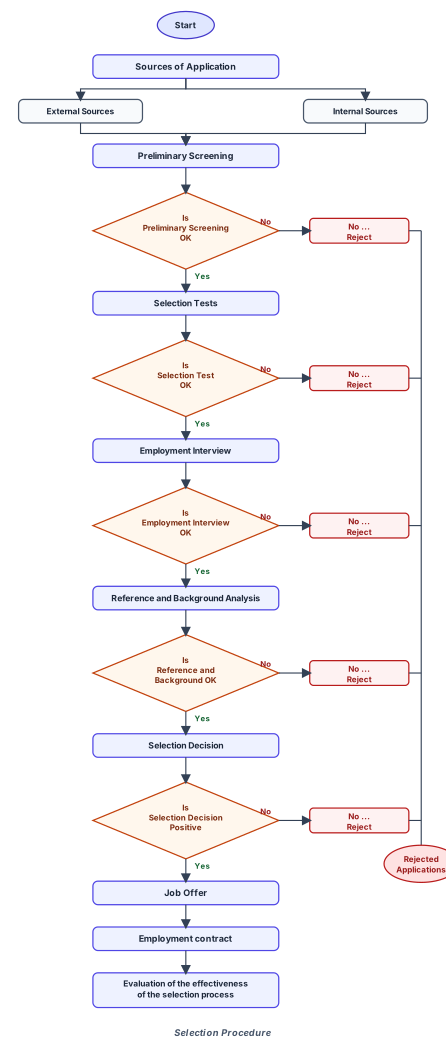
This is the textbook's own flowchart for the selection procedure, showing the same eight-step process described in the section above as a sequence of pass/fail hurdles.
Applications arrive from External Sources and Internal Sources and go through Preliminary Screening. From there, the candidate must clear five successive "Is ... OK?" checks — Preliminary Screening, Selection Test, Employment Interview, Reference and Background, and finally Selection Decision. A "Yes" at any hurdle carries the applicant forward to the next stage; a "No" removes them into the Reject path, which the diagram shows joining a single line down to "Rejected Applications" — visually reinforcing that a candidate can be screened out at any one of the five stages, not just at the end. …