Cellular Respiration Pathways: From Food to Fuel
Think of your body as a city that never sleeps. Every cell needs electricity to run — to pump ions, build proteins, send signals, divide. That electricity comes in a chemical form: ATP (adenosine triphosphate). Cellular respiration is the city's power plant. It takes fuel (glucose, fats, proteins) and burns it slowly, capturing the released energy as ATP.
The key insight: you don't just set glucose on fire. That would release all the energy as useless heat. Instead, the cell dismantles glucose step by step, like a staircase, so it can pocket the energy at each landing.
The Big Picture: Three Main Stages
Cellular respiration has three major phases, each happening in a different part of the cell:
| Stage | Where it happens | What goes in | What comes out |
|---|
| Glycolysis | Cytoplasm | Glucose (6C) | 2 pyruvate (3C), 2 ATP, 2 NADH |
| Krebs Cycle (Citric Acid Cycle) | Mitochondrial matrix | 2 acetyl-CoA (2C) | 4 CO₂, 2 ATP, 6 NADH, 2 FADH₂ |
| Electron Transport Chain (ETC) + Chemiosmosis | Inner mitochondrial membrane | NADH, FADH₂, O₂ | ~34 ATP, H₂O |
The overall equation for aerobic respiration of one glucose molecule is:
C6H12O6+6O2→6CO2+6H2O+energy (as 36–38 ATP)
Stage 1: Glycolysis — The Universal Starter
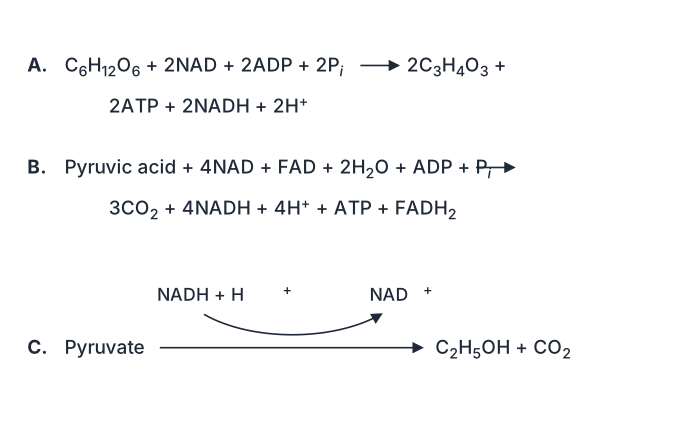
Glycolysis is ancient. It happens in the cytoplasm, requires no oxygen, and is nearly identical in bacteria, fungi, plants, and animals. It splits one 6-carbon glucose into two 3-carbon pyruvate molecules.
The process has two phases:
- Energy investment phase — the cell spends 2 ATP to phosphorylate glucose, making it reactive.
- Energy payoff phase — the split molecules are oxidized, producing 4 ATP and 2 NADH (an electron carrier).
Net per glucose: 2 ATP, 2 NADH, 2 pyruvate.
Glycolysis does not require oxygen. It's the only energy source for red blood cells and for muscles during a sprint. But without oxygen, pyruvate gets converted to lactate (lactic acid) — that burning sensation in your legs.
Stage 2: The Krebs Cycle — Extracting Electrons
Before entering the Krebs cycle, each pyruvate is transported into the mitochondria and converted to acetyl-CoA, releasing one CO₂ and making one NADH per pyruvate. So for one glucose, that's 2 CO₂ and 2 NADH before the cycle even starts.
The Krebs cycle itself is a circular pathway. Acetyl-CoA (2 carbons) combines with oxaloacetate (4 carbons) to form citrate (6 carbons). Through a series of reactions, citrate is gradually dismantled back to oxaloacetate, releasing two CO₂ molecules and capturing energy as:
- 3 NADH
- 1 FADH₂ (another electron carrier)
- 1 ATP (or GTP, depending on the organism)
Since one glucose gives two acetyl-CoA, multiply everything by 2.
Think of the Krebs cycle as a carbon-stripping machine. Its real purpose isn't making ATP directly — it's loading up NAD⁺ and FAD with high-energy electrons (making NADH and FADH₂). Those electrons are the real prize.
Stage 3: The Electron Transport Chain — The Payoff
This is where the vast majority of ATP is made. NADH and FADH₂ carry electrons to protein complexes embedded in the inner mitochondrial membrane. The electrons are passed from complex to complex like a hot potato, losing energy at each step.
That energy is used to pump protons (H⁺) from the matrix into the intermembrane space, creating a concentration gradient — like water behind a dam.
At the end of the chain, the electrons combine with oxygen (the final electron acceptor) and protons to form water. This is why you breathe oxygen: it's the terminal electron acceptor. Without it, the chain stops, and respiration halts.
Oxygen is essential. If oxygen is absent, the ETC cannot function. The cell falls back on glycolysis alone (fermentation), producing only 2 ATP per glucose instead of ~36. That's an 18-fold drop in efficiency.
Chemiosmosis: The Proton Turbine
The proton gradient created by the ETC represents potential energy. Protons flow back into the matrix through a molecular turbine called ATP synthase. As they pass through, the turbine spins, driving the synthesis of ATP from ADP and phosphate. …