Q.Describe the process of multiplication of viruses.
You're viewing a preview — the full solution, concept, methods & PYQ mapping are locked.
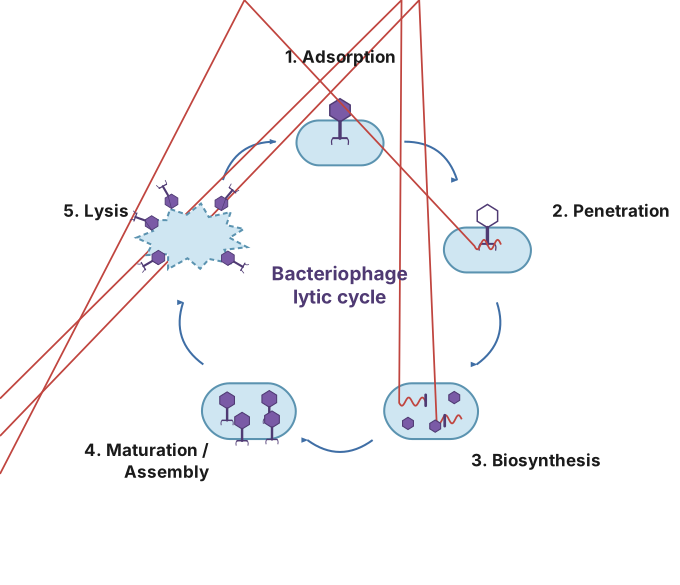
Start your 14-day free trial to unlock the full solution →Viral multiplication is described as replication rather than reproduction, because a virus has no independent metabolism of its own and depends entirely on hijacking a living host cell's machinery to make new copies of itself. In bacteriophages, this process begins identically regardless of what follows: the phage attaches to the surface of a susceptible host bacterium using its tail fibres, and then injects its nucleic acid into the host cell, leaving its protein coat outside.
From this point, one of two pathways may follow. In the lytic cycle, the injected phage DNA immediately redirects the host cell's own machinery to replicate the phage DNA and manufacture new phage components (heads, tails, tail fibres), which self-assemble into complete new phage particles inside the host. The phage-encoded enzyme lysozyme then breaks down the host bacterium's cell wall from within, causing the cell to burst open (lysis) and release the newly made phages - the number released per cell being the burst size - which are then free to infect further host bacteria. Phages that always follow this destructive route are called virulent phages, of which the T-even phages (T2, T4, T6) are the standard example. …
Unlock everything free for 14 days
- Full step-by-step solutions
- Concept-first explanations
- Methods, shortcuts & mistakes
- PYQ mapping + timed mock tests
Full access for 14 days. No credit card required.