Q.Explain a process in which a biocatalyst is used in the industrial preparation of a compound.
🔒You're viewing a preview — the full solution, concept, methods & PYQ mapping are locked.
🔒 Start your 14-day free trial to unlock the full solution →Concept understanding — Electrophilic Aromatic Substitution
Electrophilic Aromatic Substitution – The First Meeting
Imagine you have a benzene ring — that perfect, flat hexagon of six carbons with alternating double bonds. It's stable, almost stubbornly so. You want to attach something new to it, say a bromine atom or a nitro group. But benzene doesn't react like an alkene. It doesn't just add across a double bond. Instead, it does something more elegant: it kicks out a hydrogen and keeps its aromatic ring intact.
That's the heart of Electrophilic Aromatic Substitution (EAS).
The Intuition: Why "Substitution" and Not "Addition"?
Benzene's stability comes from its delocalised π electrons — a cloud above and below the ring. This cloud is electron-rich, so it attracts electrophiles (electron-loving species). But if an electrophile simply added to a double bond, the ring would break its aromaticity, losing that huge stabilisation. That would be energetically costly.
So benzene does something smarter: it lets the electrophile attack, temporarily breaks aromaticity to form a high-energy intermediate (the arenium ion), and then loses a proton to restore the aromatic ring. The net result? A hydrogen is replaced by the electrophile. The ring is back to its stable, aromatic self.
The key trade-off: temporary loss of aromaticity is acceptable because the final product regains it. Addition reactions would permanently destroy aromaticity — benzene avoids that.
The Precise Statement
Electrophilic Aromatic Substitution is a reaction in which an electrophile (E+) replaces a hydrogen atom on an aromatic ring, proceeding through a sigma complex (arenium ion) intermediate, and restoring aromaticity after deprotonation.
The general equation:
Ar−H+EX+Ar−E+HX+
where Ar represents an aromatic ring.
The Mechanism in Three Steps
-
Generation of the electrophile – Many EAS reactions need a catalyst to create a strong enough E+. For example, bromination uses FeBrX3 to polarise BrX2 into BrX+.
-
Attack by the aromatic ring – The π electrons of benzene attack the electrophile, forming a sigma complex (also called the arenium ion or Wheland intermediate). This intermediate is non-aromatic — it has four π electrons delocalised over five carbons, and one sp3 carbon bearing the electrophile and a hydrogen.
Benzene+E+⟶Sigma complex (non-aromatic)
- Deprotonation – A base (often the counterion of the catalyst, like FeBrX4X−) removes the proton from the sp3 carbon. The pair of electrons from the C–H bond flows back into the ring, restoring the aromatic sextet.
Sigma complex+Base⟶Product+HX+
The sigma complex is not aromatic. It's a high-energy intermediate. Students often mistakenly think it's still aromatic — it isn't. That's why the step is fast and the complex is short-lived.
Why This Matters for Exams
EAS is the gateway to understanding how to put groups onto benzene rings. The rate-determining step is usually the formation of the sigma complex (step 2). The regiochemistry (where the electrophile goes) depends on whether the ring already has a substituent — that's the topic of activating/deactivating groups and ortho/para vs. meta directors.
But for now, remember this: …
Why this formula?
Electrophilic Aromatic Substitution: Why the Mechanism Holds
The Core Puzzle: Why Benzene Doesn't Just Add
Benzene (C6H6) has three double bonds — so why doesn't it undergo addition reactions like alkenes?
The answer lies in aromatic stabilisation: benzene's delocalised π-electron cloud (the "aromatic sextet") is about 150 kJ/mol more stable than a hypothetical cyclohexatriene with localised double bonds.
If benzene simply added an electrophile (like Br2), it would lose this stabilisation — a huge energy penalty.
So, nature chooses a different path: substitution instead of addition, preserving the aromatic ring.
The Key Formula: The Reaction Profile
The rate-determining step in electrophilic aromatic substitution (EAS) is the formation of the arenium ion (σ-complex):
Ar-H+E+slowAr-E+H(σ-complex)
Then, fast deprotonation restores aromaticity:
Ar-E+H+B−fastAr-E+BH
Why This Holds: The Energy Barrier Logic
-
First step (slow): The electrophile E+ attacks the electron-rich ring. The σ-complex is non-aromatic — it has only 4 π-electrons delocalised over 5 carbons (the sixth carbon is sp3 hybridised). This intermediate is higher in energy than the starting benzene.
-
Second step (fast): A base removes the proton, restoring the aromatic sextet. This step is strongly exothermic — the system regains ~150 kJ/mol of stabilisation.
The overall reaction is exothermic, but the activation energy is dominated by the destabilisation of the σ-complex.
The Rate Law: Why It's First Order in Both
From the mechanism:
Rate=k[Arene][E+]
Reasoning:
- The slow step involves one molecule of arene and one molecule of electrophile.
- No other species appear before the rate-determining step.
- Therefore, the rate law is bimolecular — first order in each reactant.
This is not derived from the overall stoichiometry — it comes directly from the molecularity of the slow step.
The Hammett Equation: Quantifying Substituent Effects
For substituted benzenes, the rate constant k relative to benzene (k0) follows:
logk0k=σρ
Why This Holds
- σ (sigma constant): Measures the electronic effect of a substituent (electron-donating or withdrawing) relative to hydrogen. It is derived from the ionisation constants of benzoic acids — a purely empirical scale.
- ρ (rho constant): Measures the sensitivity of the reaction to substituent effects. A positive ρ means the reaction is favoured by electron-withdrawing groups (rare in EAS); a negative ρ means electron-donating groups accelerate the reaction.
Why it works:
The σ-complex has a positive charge delocalised over the ring. Substituents that stabilise this positive charge (electron-donating groups like −OH, −NH2) lower the activation energy — hence σ is negative for such groups. Electron-withdrawing groups (−NO2, −CN) destabilise the σ-complex — σ is positive.
The linear free-energy relationship holds because the transition state resembles the σ-complex in charge distribution.
The Directing Effect: Why Ortho/Para vs Meta
The position of substitution is governed by the stability of the σ-complex for each possible attack site. …
The key idea is biocatalysis — using a living organism's own enzymes to carry out an industrial-scale chemical transformation under mild conditions. The process directly relevant to this chapter is the industrial manufacture of ethanol by fermentation.
Reasoning:
- Substrate: Sugars (from molasses or starch-derived syrup) provide the sucrose/glucose feedstock.
- Biocatalysts: Yeast supplies two enzymes — invertase, which hydrolyses sucrose into glucose and fructose, and zymase, which converts glucose and fructose into ethanol and carbon dioxide. …
This question asks for an industrial process that uses a biocatalyst (an enzyme) to prepare a compound. The example directly covered in this chapter is the fermentation of sugars to ethanol, where yeast's own enzymes — invertase and zymase — do the chemical work. The key idea: a biocatalyst lets this transformation happen at ordinary temperature and pressure, something that would otherwise need harsher conditions.
Why a Biocatalyst?
Many industrial reactions need high temperature, strong acids/bases, or metal catalysts. Biocatalysts — enzymes, usually supplied by a living microorganism such as yeast — offer a mild, highly specific alternative: they work near room temperature and neutral pH, with very little unwanted side product.
The process examined here is the fermentation of sugars to ethanol, one of the oldest and largest-scale biocatalytic processes, and the one this chapter's own account of 'manufacture of ethanol' is built around.
Step-by-Step Process
-
Feedstock preparation
A sugar source — molasses (which contains sucrose) or a starch-derived syrup — is diluted with water to give a fermentable solution.
-
Enzyme action — invertase
Yeast cells secrete the enzyme invertase, which hydrolyses sucrose into glucose and fructose:
C12H22O11 (sucrose)+H2OinvertaseC6H12O6 (glucose)+C6H12O6 (fructose)
- Enzyme action — zymase The same yeast also supplies zymase, a complex of enzymes that converts glucose and fructose into ethanol and carbon dioxide:
C6H12O6zymase2C2H5OH+2CO2
-
Fermentation conditions
The mixture is kept anaerobic (excess CO2 excludes air) at about 293–298 K for one to three days. The enzymes are deactivated once the ethanol concentration rises to roughly 10–14%, which caps the yield of this step.
-
Recovery
The fermented 'wash' is distilled and rectified to concentrate the ethanol; further dehydration (e.g. with quicklime, or azeotropic distillation) is needed to get anhydrous ('absolute') ethanol beyond the 95.6% ethanol–water azeotrope. …
Concept: Biocatalysis in Industrial Chemistry
Biocatalysis uses natural catalysts — enzymes (proteins) or whole cells — to perform chemical transformations. In industry, this offers high specificity, mild reaction conditions (low temperature, neutral pH), and reduced by-products compared to traditional chemical catalysts.
Method: Enzyme-Catalysed Hydrolysis for Acrylamide Production
Method name: Nitrile Hydratase Biocatalysis
Relevant compound: Acrylamide (CH2=CHCONH2)
Steps of the process
-
Feedstock preparation
Acrylonitrile (CH2=CHCN) is dissolved in water to form a dilute solution (typically 2–5% w/v). This prevents enzyme inhibition at high substrate concentrations.
-
Biocatalyst selection
The enzyme nitrile hydratase (from Rhodococcus rhodochrous J1 or Pseudomonas chlororaphis) is immobilised on a solid support (e.g., polyacrylamide gel or alginate beads). Immobilisation allows reuse and continuous operation.
-
Reaction conditions
- Temperature: 10–20°C (mild, preventing unwanted polymerisation)
- pH: 7.0–8.5 (buffered with phosphate)
- Continuous stirred-tank reactor (CSTR) or packed-bed reactor
-
Biocatalytic conversion
Nitrile hydratase selectively adds water to the nitrile group (−CN) without affecting the carbon-carbon double bond:
CH2=CHCN+H2Onitrile hydrataseCH2=CHCONH2
-
Product recovery
The reactor effluent is passed through a charcoal column to remove residual acrylonitrile and colour. The solution is then concentrated by evaporation and crystallised.
-
Enzyme recycling
Immobilised enzyme is filtered and reused for multiple batches (up to 200 cycles in some industrial setups).
Why this method is preferred …
Common Mistakes: Biocatalysts in Industrial Preparation
Students often lose marks on this question due to a few recurring errors. Here’s a breakdown of each mistake and how to avoid it.
✗ Mistake 1: Confusing "biocatalyst" with "chemical catalyst"
What happens: Students describe a process using a metal catalyst (e.g., Pd, Pt) or an acid/base catalyst, thinking any catalyst qualifies.
Why it’s wrong: A biocatalyst is specifically an enzyme or a whole microbial cell — not a synthetic chemical.
How to avoid:
- Always check: Is the catalyst a protein (enzyme) or a living microorganism?
- If the catalyst is not biological, it is not a biocatalyst.
✗ Mistake 2: Describing a lab-scale reaction instead of an industrial process
What happens: Students write about a reaction done in a test tube or a small flask (e.g., "add enzyme to glucose solution in a beaker").
Why it’s wrong: The question explicitly asks for industrial preparation — meaning large-scale, continuous or batch production in a bioreactor.
How to avoid:
- Use terms like fermenter, bioreactor, immobilised enzyme column, continuous flow, large-scale.
- Mention downstream processing (separation, purification) if relevant.
✗ Mistake 3: Vague or incomplete process description
What happens: Students write only the name of the process (e.g., "glucose isomerase converts glucose to fructose") without explaining how it is done industrially.
Why it’s wrong: The question asks to explain a process — you must include:
- The biocatalyst (name the enzyme or microbe)
- The substrate (starting material)
- The product
- Conditions (temperature, pH, immobilisation method)
- Why it is used industrially (advantage)
How to avoid:
Use a structured answer:
- Biocatalyst: e.g., glucose isomerase (immobilised on a support)
- Substrate: glucose syrup
- Product: high-fructose corn syrup (HFCS)
- Process: continuous flow through a packed-bed reactor at 60°C, pH 7.5
- Industrial significance: higher yield, lower cost, no by-products
✗ Mistake 4: Choosing a process that does not use a biocatalyst
What happens: Students pick the Haber process (ammonia) or contact process (sulfuric acid) — these use chemical catalysts, not biocatalysts.
How to avoid:
Memorise 2–3 standard examples of industrial biocatalysis:
| Process | Biocatalyst | Product |
|---|---|---|
| Glucose → Fructose | Glucose isomerase | High-fructose corn syrup |
- TG EAPCET 2024Set eng-2024-05-09-FN1 markMCQQ.The correct statements of the following are A) Aniline forms a stable benzene diazonium chloride at 285K B) N – Phenylethanamide is less reactive towards nitration than aniline C) p−CH3C6H4COCl is Hinsberg reagent (A) A & B only (B) A & C only (C) B only (D) C only
›Reveal solutionSolution
A fails on temperature (diazonium salts need 273–278 K, not 285 K); C fails on identity (Hinsberg's reagent is benzenesulphonyl chloride, not an acyl chloride); only B — acetanilide being less reactive than aniline towards nitration — is correct. Option (C), "B only".
The concept first
All three statements orbit one theme: how the nitrogen lone pair of an aromatic amine behaves, and how we control it.
Diazonium chemistry. Aniline + NaNO2/HCl gives C6H5N2+Cl−. The ion is stabilised by resonance with the ring — which is precisely why the aromatic diazonium salt can be isolated at all, whereas aliphatic ones decompose instantly. But even so, it is only kinetically stable in ice-cold conditions. Above about 278 K, the excellent leaving group N2 departs and water attacks, giving phenol.
Protecting the amino group. Aniline is so strongly activated that direct nitration is a mess: the strongly acidic nitrating mixture protonates the −NH2 to −NH3+ (a meta-directing deactivator), and oxidation side-reactions occur. The classical fix is to acetylate aniline to acetanilide (N-phenylethanamide). Now the nitrogen lone pair is shared with the acetyl carbonyl, so the ring is still activated but much less so, the amine can't be protonated, and nitration gives clean para-nitroacetanilide, which is then hydrolysed back. Understanding why we bother acetylating is exactly what makes statement B obviously true.
Hinsberg's reagent. Benzenesulphonyl chloride, C6H5SO2Cl, distinguishes the three classes of amine: 1∘ amines give a sulphonamide with an acidic N–H, soluble in alkali; 2∘ amines give a sulphonamide with no N–H, insoluble in alkali; 3∘ amines do not react. Note the SO2 — that is the fingerprint.
Step-by-step
Statement A — "Aniline forms a stable benzene diazonium chloride at 285 K".
Diazotisation is carried out at 273–278 K (0–5∘C). 285 K is 12∘C — above the safe window. At that temperature the salt decomposes:
C6H5N2+Cl−+H2O⟶C6H5OH+N2↑+HCl
So it is not stable at 285 K. A is incorrect. ✗ …
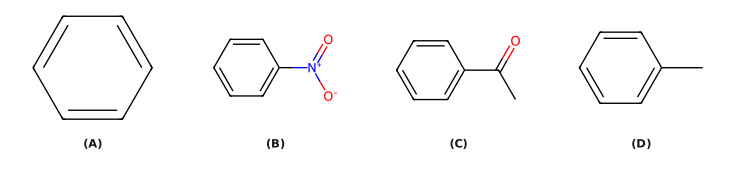
- TG EAPCET 2023Set ap-2023-05-10-FN1 markMCQQ.Which of the following compound is most reactive towards Friedel-Crafts alkylation reaction? (A) Benzene (C6H6) (B) Nitrobenzene (benzene ring bearing −NO2) (C) Acetophenone (benzene ring bearing −COCH3) (D) Toluene (benzene ring bearing −CH3)
›Reveal solutionSolution
Friedel–Crafts alkylation needs an electron-rich ring. The methyl group of toluene is activating, while −NO2 and −COCH3 are strongly deactivating (rings carrying them do not undergo Friedel–Crafts at all). Toluene — option (D).
The concept first
In Friedel–Crafts alkylation, a Lewis acid generates a carbocation:
R−Cl+AlCl3⟶R++[AlCl4]−
That carbocation is an electrophile; it is attacked by the aromatic ring's π electrons. So the reaction rate is governed by one thing: how much electron density the ring can offer.
Substituents fall into two camps:
- Activating (ring-enriching): −CH3 and other alkyls (+I, hyperconjugation), −OH, −OR, −NH2 (+R). They raise the rate.
- Deactivating (ring-depleting): −NO2, −CHO, −COR, −COOH, −CN, −SO3H (−I and −R). They lower the rate — and in the special case of Friedel–Crafts they lower it so much that the reaction fails entirely. (Nitrobenzene is even used as a solvent for Friedel–Crafts reactions, precisely because it will not react.)
Step-by-step
Step 1 — Rank the substituents by their electronic effect.
- (A) Benzene — no substituent; the baseline.
- (B) Nitrobenzene, −NO2 — one of the strongest deactivators known (−I and −R). Ring badly electron-poor.
- (C) Acetophenone, −COCH3 — a carbonyl; −I and −R, strongly deactivating. Also, its lone pair can complex with AlCl3, poisoning the catalyst.
- (D) Toluene, −CH3 — electron-donating by +I and hyperconjugation. Ring electron-rich.
Step 2 — Apply the rule. Rate of electrophilic substitution increases with ring electron density: …
- TG EAPCET 2023Set ap-2023-05-10-FN1 markMCQQ.Which of the following is a Sandmeyer reaction? (A) C6H5N2ClCu2Br2/HBrC6H5Br (B) C6H5N2ClCu/HBrC6H5Br (C) C6H5N2ClH2OC6H5OH (D) C6H5N2ClHBF4C6H5F
›Reveal solutionSolution
The Sandmeyer reaction replaces −N2+ using a cuprous salt: C6H5N2ClCu2Br2/HBrC6H5Br. That is option (A); the others are the Gattermann, hydrolysis, and Balz–Schiemann reactions respectively.
The concept first: one diazonium salt, four different name reactions
Aryl diazonium salts are a crossroads. From the same C6H5N2Cl you can go in many directions, and each direction has its own name and its own reagent. Examiners test whether you can tell them apart, so learn them as a set, not one at a time:
Reagent Product Name of reaction Cu2Cl2/HCl, Cu2Br2/HBr, CuCN/KCN ArCl, ArBr, ArCN Sandmeyer Cu powder + HCl/HBr ArCl, ArBr Gattermann H2O, warm ArOH (phenol) hydrolysis HBF4, then Δ ArF Balz–Schiemann KI ArI (direct, no Cu needed) H3PO2/H2O or C2H5OH ArH deamination The distinguishing mark of Sandmeyer is the cuprous (Cu(I)) salt, Cu2X2, in the corresponding halogen acid.
Step-by-step: test each option
- C6H5N2ClCu2Br2/HBrC6H5Br — cuprous bromide in HBr, giving bromobenzene. This is exactly the Sandmeyer prescription. ✓
- C6H5N2ClCu/HBrC6H5Br — the product is the same, but the reagent is copper powder, not the cuprous salt. This is the Gattermann reaction — a close cousin, deliberately placed here as the trap. ✗
- C6H5N2ClH2OC6H5OH — this is simple hydrolysis to phenol (which is why diazonium salts must be kept cold). Not Sandmeyer. ✗ …
- TG EAPCET 2022Set ap-2022-07-31-FN1 markMCQQ.The major product formed in the following reactions isi) NaOH, C2H5Iii) CH3COCl, anhyd. AlCl3iii) Zn-Hg, conc. HCl (A) [Image of benzene ring with OC2H5 and C2H5 substituents at 1,2 positions] (B) [Image of benzene ring with OC2H5 and C2H5 substituents at 1,3 positions] (C) [Image of benzene ring with OH and C2H5 substituents at 1,2 positions] (D) [Image of benzene ring with OC2H5 and C2H5 substituents at 1,4 positions]
›Reveal solutionSolution
The sequence involves Williamson ether synthesis, Friedel–Crafts acylation, and Clemmensen reduction; the final product is 1-ethoxy-4-ethylbenzene, which corresponds to the 1,4‑disubstituted pattern — option (D).
Concept & Intuition
This problem tests your ability to predict the outcome of a multi‑step synthesis on an aromatic ring. The three steps are classic transformations:
- Williamson ether synthesis – converts a phenol into an aryl alkyl ether.
- Friedel–Crafts acylation – introduces an acyl group (here, acetyl) ortho/para to the activating ether group.
- Clemmensen reduction – reduces the carbonyl (C=O) to a methylene (CH₂), giving an alkyl side chain.
The key insight: the ether group (–OC₂H₅) is a strong activating and ortho/para‑directing substituent. So the acylation will occur at the para position (less steric hindrance than ortho). The final reduction then turns the –COCH₃ into –CH₂CH₃, leaving the ether untouched. The product is a 1,4‑disubstituted benzene with –OC₂H₅ and –C₂H₅.
Step‑by‑Step Reasoning
- Step (i): NaOH, C₂H₅I The starting material is phenol (C₆H₅OH). NaOH deprotonates it to phenoxide (C₆H₅O⁻), which then attacks ethyl iodide (C₂H₅I) in an Sₙ2 reaction. This is a Williamson ether synthesis, giving ethoxybenzene (phenetole):
C6H5OHNaOHC6H5O−C2H5IC6H5OC2H5
- Step (ii): CH₃COCl, anhyd. AlCl₃
This is a Friedel–Crafts acylation. The –OC₂H₅ group is a strong ortho/para‑director because the oxygen lone pairs donate electron density into the ring.
- The ortho positions are sterically hindered by the ethoxy group.
- The para position is more accessible. Therefore, the acetyl group (–COCH₃) attaches para to the ethoxy group, forming 4‑ethoxyacetophenone:
C6H5OC2H5+CH3COClAlCl3p-C2H5O-C6H4-COCH3
- Step (iii): Zn‑Hg, conc. HCl …
- TG EAPCET 2021Set eng-2021-08-05-FN1 markMCQQ.Benzene reacts with n-propyl chloride in the presence of anhydrous AlCl3 to give predominantly (A) n-Propyl benzene (B) Isopropyl benzene (C) 3-Propyl-1-chloro benzene (D) 1-Chloro-3-n-propyl benzene
›Reveal solutionSolution
Friedel–Crafts alkylation of benzene with n-propyl chloride proceeds via a carbocation rearrangement, so the major product is isopropyl benzene, not n-propyl benzene.
The reaction described is a classic Friedel–Crafts alkylation. In this reaction, an alkyl halide reacts with benzene in the presence of a Lewis acid catalyst (here, anhydrous AlCl₃) to form an alkylbenzene. The key mechanistic step is the generation of a carbocation from the alkyl halide. That carbocation then attacks the benzene ring.
The trap in this specific case is that the n-propyl carbocation (CH₃CH₂CH₂⁺) is primary and therefore relatively unstable. Under the reaction conditions, it rapidly rearranges to the more stable secondary carbocation (CH₃CH⁺CH₃) via a 1,2-hydride shift. This rearranged carbocation is what actually attacks benzene, giving isopropyl benzene as the major product.
Let’s walk through the reasoning step by step.
- Generation of the electrophile. Anhydrous AlCl₃ coordinates with the chlorine atom of n-propyl chloride, weakening the C–Cl bond. This leads to the formation of a carbocation and an AlCl₄⁻ complex:
CH3CH2CH2Cl+AlCl3→CH3CH2CH2++AlCl4−
- Carbocation rearrangement. The primary carbocation (CH₃CH₂CH₂⁺) is not very stable. A hydrogen atom from the second carbon (along with its bonding pair) shifts to the positively charged carbon. This 1,2-hydride shift converts the primary carbocation into a more stable secondary carbocation:
CH3CH2CH2+1,2-hydride shiftCH3CH+CH3
- Electrophilic attack on benzene. The rearranged secondary carbocation acts as the electrophile. It attacks the electron-rich benzene ring, forming a sigma complex (arenium ion): C6H6+CH3CH+CH3→C6H6+(CH(CH3)2) …
- TG EAPCET 2021Set eng-2021-08-06-FN1 markMCQQ.The major product formed when salicylaldehyde is reacted with 2 equivalents of bromine in glacial acetic acid at 0∘C (A) [FIGURE] A benzene ring bearing −OH and −CHO on adjacent carbons (salicylaldehyde) with a single Br on the ring carbon next to (ortho to) the −OH group (B) [FIGURE] A benzene ring bearing −OH and −CHO on adjacent carbons with two Br atoms: one on the carbon next to (ortho to) the −OH and one on the carbon para to the −OH (i.e. 3,5-dibromo-2-hydroxybenzaldehyde) (C) [FIGURE] A benzene ring bearing −OH and −CHO on adjacent carbons with a single Br on the ring carbon para to the −OH group (D) [FIGURE] A benzene ring bearing −OH and −CHO on adjacent carbons (drawn on the right of the ring) with two Br atoms on the two ring carbons on the opposite (left) side of the ring
›Reveal solutionSolution
The strongly activating −OH controls the substitution, so two equivalents of bromine enter the positions ortho and para to it — giving 3,5-dibromo-2-hydroxybenzaldehyde, option (B).
The concept first
When a ring carries two substituents, the more powerfully activating one decides where the electrophile goes.
- −OH: strongly activating via its lone pair (+R≫−I), ortho/para directing.
- −CHO: deactivating (−R,−I), meta directing. The phenol group is far stronger, so it wins. Conveniently, the positions ortho/para to the OH of salicylaldehyde are also meta to the CHO — the two groups' preferences agree, which is why the reaction is so clean.
Step-by-step
- Number the ring. Salicylaldehyde is 2-hydroxybenzaldehyde: CHO at C-1, OH at C-2.
- Find the positions activated by the OH (at C-2).
- ortho to C-2 → C-1 (blocked by the CHO) and C-3 ✓
- para to C-2 → C-5 ✓ So the two available activated sites are C-3 and C-5.
- Cross-check against the CHO (at C-1). Meta to C-1 → C-3 and C-5 — exactly the same two carbons. Both directing effects therefore point to C-3 and C-5. …
🎓Unlock everything free for 14 days
- ✓Full step-by-step solutions
- ✓Concept-first explanations
- ✓Methods, shortcuts & mistakes
- ✓PYQ mapping + timed mock tests
Full access for 14 days. No credit card required.